What a SaaS Design Agency Actually Does for Founders

Yusuf
Founder and lead designer at 925studios

You've just closed a funding round. The roadmap is full, the product needs a clearer onboarding flow, marketing needs a site that can explain the category, and engineering needs someone who can turn decisions into shipped interfaces. Your hiring plan lists a product designer, a brand designer, and a frontend developer as separate problems.
That looks tidy in a spreadsheet. In practice, it creates three recruiting processes, three onboarding tracks, and a permanent coordination gap between strategy, brand, design, and code. A SaaS design agency can be the more practical decision when your priority is activation, conversion, and shipped product work, not merely adding headcount.
Table of Contents
The Hiring Decision Most Funded Founders Get Wrong
A founder who's raised seed or Series A funding often opens a document and writes the same three lines:
Product designer
Brand or marketing designer
Frontend developer
The roles make sense individually. The problem is that SaaS customers experience them as one thing. They see the landing page, enter the signup flow, reach the dashboard, and decide whether the product feels trustworthy and useful. If each stage is owned by a different person who starts at a different time, the gaps appear between handoffs.
Recruiting also delays decisions that should already be moving. A senior product designer needs context on the product, customers, and roadmap. A brand designer needs positioning and buyer insight. A frontend developer needs settled designs and usable specifications. Hiring them separately means founders often spend months coordinating people before the team has a shared system for making and shipping work.
Founder rule: If your roadmap is moving faster than your hiring process, buy coordinated senior capacity before you buy three isolated roles.
The broader market supports this specialization. The global web design services market was valued at about USD 61 billion in 2025 and is projected to reach roughly USD 100 billion by 2031, with an estimated 8.5% CAGR from 2026 to 2031, according to Ken Research's global web design market analysis. Global web development was valued at about USD 61.2 billion in 2025, while North America accounted for more than 40.8% of revenue, or about USD 24.95 billion, in the same research.
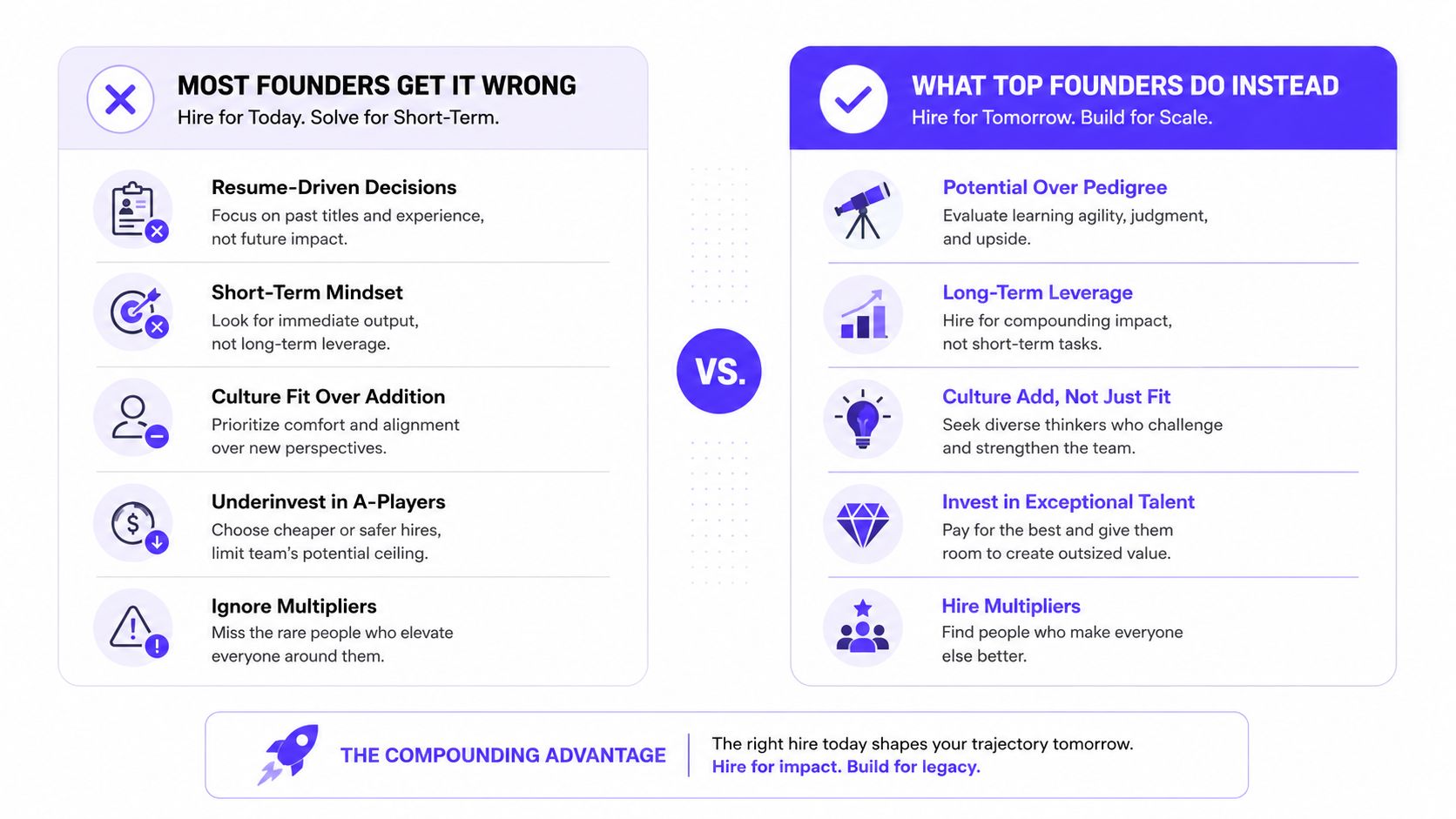
The case for an agency isn't that hiring is bad. Full-time talent can become the right choice when your product has stable priorities and enough design management capacity. The case is narrower and more useful: one accountable studio can replace three separate hiring tracks while your company still needs senior thinking across product, brand, and frontend execution.
What a SaaS Design Agency Actually Is
A SaaS design agency is a studio that works across the full path from product idea to shipped interface. It should cover product UX, marketing site design, design system maintenance, and frontend delivery under one engagement.
That model maps directly to the three roles on your hiring plan.
The product designer role
The product side owns how users move through the software. That includes onboarding, information structure, feature flows, dashboards, prototypes, and research. The right partner doesn't just make screens attractive. It watches where users hesitate, tests realistic tasks, and removes friction from the path to value.
For SaaS teams, this often means turning a vague request such as “improve activation” into specific work. The studio might simplify account setup, reorder the first dashboard, expose a useful default action, or separate advanced controls from the first-use experience.
The brand designer role
The brand and marketing side explains why the product matters before a user signs in. It covers positioning, visual identity, landing pages, pricing pages, comparison pages, launch materials, and sales collateral.
A good marketing page shouldn't merely repeat feature names. It should help an AI SaaS buyer understand the job the product performs, help a Web3 buyer understand what happens to their assets, or help a fintech buyer assess trust and risk without hunting through vague claims.
The frontend developer role
Frontend delivery turns approved design into a working experience. Depending on the setup, that can mean a precise handoff to your engineering team or direct implementation in React, Next.js, or Webflow. The process should include staging, quality assurance, responsive behavior, and analytics instrumentation.
The engagement usually starts with discovery, then moves through a weekly review cadence. Loom can capture walkthroughs, Notion can hold decisions and requirements, Figma can hold the working interface, and Linear can connect design tasks to engineering work. The point isn't the tool list. The point is shared accountability for what ships.
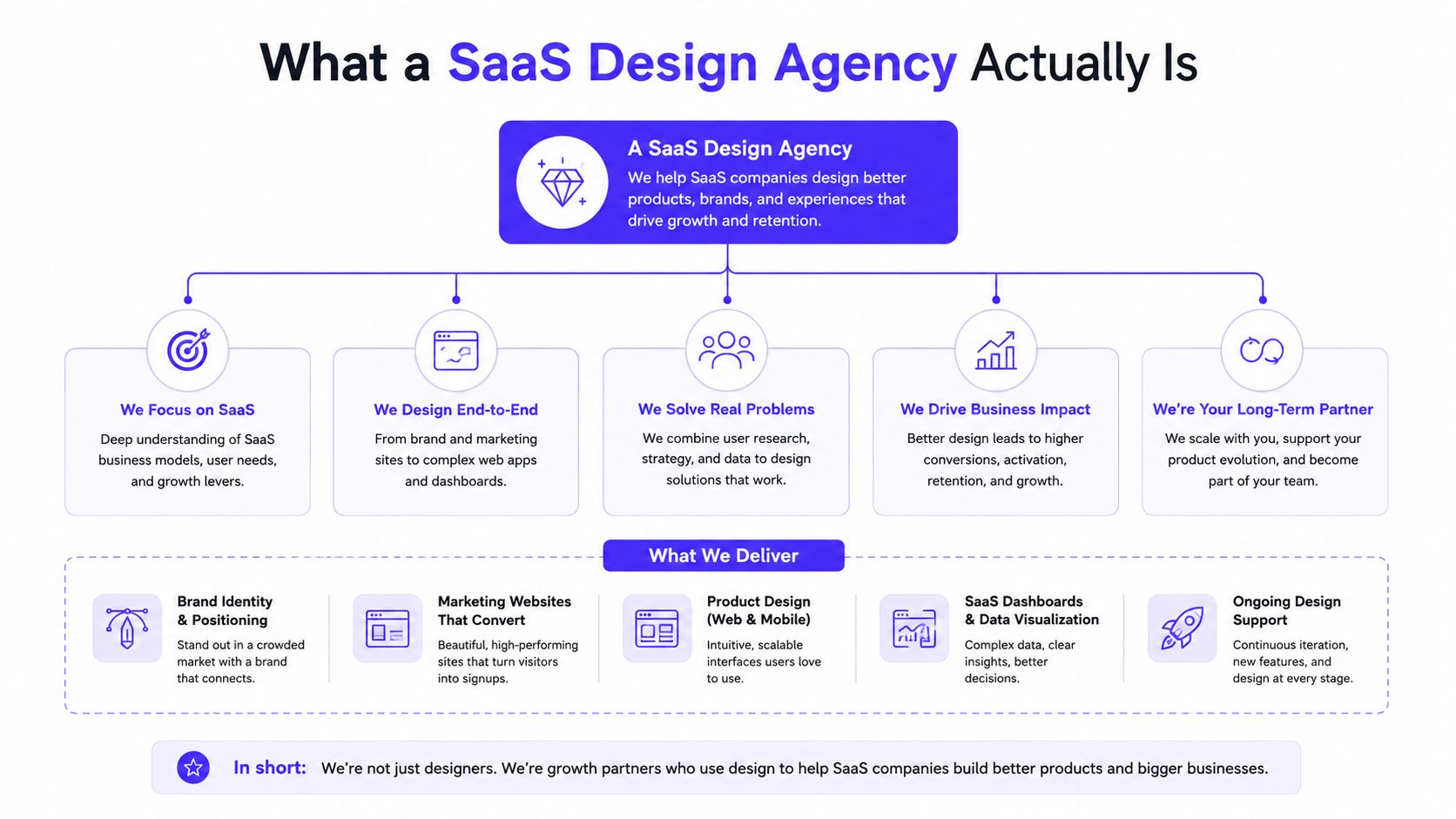
A freelance designer may solve a defined design task but leave research, systems, and implementation to your team. A generic marketing agency may build a polished website without understanding dashboard behavior or activation. A SaaS design agency earns its place by connecting the first click to the first successful product action. If pipeline attribution is part of the problem, you can also track SaaS pipeline attribution alongside the design work so marketing improvements connect to revenue conversations.
The Four Deliverables That Replace Three Hires
A SaaS design agency earns its fee through shipped work, not a folder of polished screens. Treat the engagement like a hiring decision. You are effectively covering product UX, design-system ownership, and frontend delivery, with marketing-site work added when growth depends on the website. Each deliverable should identify the work, the handoff, and the business behavior it must change.
Product UX
Product UX covers the flows users must complete before they reach value. That includes onboarding, account setup, feature structure, dashboard organization, interactive Figma prototypes, and usability testing.
The output should be a tested path through the product, not a large file of disconnected screens. An AI SaaS team may need a new-user flow that starts with a real task before showing advanced model controls. A fintech team may need a KYC sequence that explains each request before a user abandons the form. These decisions affect activation and time-to-value directly.
Research must examine user behavior rather than internal taste. B2B SaaS guidance recommends realistic task scenarios, usability tests matched to the question, behavior-based personas, and systematic synthesis, as described in Brightscout's UX research best practices. The target outcomes are activation, time-to-value, task completion, and trial-to-paid conversion.
Marketing websites
A SaaS website must help different buyers decide whether to continue. The usual scope includes the homepage, product or solution pages, pricing, comparison pages, signup entry points, and, where relevant, industry pages.
The studio should connect the message, page structure, proof, and calls to action. A self-serve pricing page should give qualified visitors a path to start without forcing every person into a sales call. A fintech site should explain security and compliance plainly. A Web3 site should describe custody, wallet actions, and user responsibility in language a newcomer can follow.
Judge the work by qualified trial or demo conversion, not visual polish. If the site attracts attention but fails to move the right buyer toward signup or a sales conversation, the agency has not solved the growth problem.
Design systems
A design system gives product and marketing teams reusable building blocks. It can include a Figma library, design tokens, components, interaction patterns, accessibility guidance, and documented usage rules.
The point is faster, more consistent production. Teams should not redraw buttons, forms, tables, and navigation patterns for every release. Figma reported that participants completed a task 34% faster with access to a design system, while a simple form page was built 47% faster with a reusable component library than from scratch, according to Figma's research on measuring design-system value.
A broader review connects component reuse with developer time savings, clearer communication, faster launch and deployment, and greater consistency across distributed teams, as documented in this design-system review from the International Association of Industrial and Academic Systems. The operating result is shorter redesign cycles and more predictable shipping.
Frontend delivery
Frontend delivery closes the gap between design intent and the product users touch. The scope may include direct React or Next.js implementation, Webflow development, a production-ready handoff, responsive states, staging, quality assurance, and analytics wiring.
A handoff that leaves engineers to interpret every state is incomplete. Shipped work must cover empty states, loading behavior, validation errors, permissions, mobile layouts, and edge cases outside the polished prototype. This is the third in-house capability the agency replaces, and it matters because an approved design has no effect on activation or conversion until users can use it.
Deliverable | What Gets Shipped | Metric Moved |
|---|---|---|
Product UX | Onboarding flows, feature structure, prototypes, and tested task paths | Activation and task completion |
Marketing sites | Positioning-led homepage, pricing, comparison, and conversion pages | Trial signups or demo requests |
Design systems | Tokens, components, libraries, and usage rules | Shipping velocity and redesign cycle time |
Frontend delivery | React, Next.js, or Webflow implementation, QA, staging, and analytics | Time to ship and implementation quality |
Adobe's survey report found that design-system-focused teams reported 68% increased development velocity, 61% increased design velocity, and 66% improved speed to market, as reported in Adobe's design business potential report. Those figures do not guarantee the same result for your company. They do show why a maintained system should be managed as an operating asset, not a decorative library.
Why AI SaaS, Web3, and Fintech Founders Benefit Most
AI SaaS, Web3, and fintech products share a difficult constraint. Their users need to trust systems they don't fully understand, and the cost of confusion appears quickly in onboarding, conversion, support, or retention.
AI SaaS
AI products often expose too much capability too early. A new user sees model choices, prompts, settings, sources, automations, and output controls before understanding the first useful action.
A capable studio uses progressive disclosure, showing the essential decision first and making deeper controls available when they become relevant. Independent research on digital subscriptions recommends mapping dashboard metrics to specific user decisions, then revealing detail on demand rather than presenting every data point at once, as explained in Baymard's digital subscription UX research. For AI SaaS, that principle can turn an intimidating workspace into a guided first success.
For a deeper product-specific perspective, see AI product design.
Web3
Web3 products have the opposite communication problem. The underlying actions are often abstract, but the interface still needs to feel calm and legible to someone who doesn't use crypto terminology every day.
The design work should make wallet connection, network selection, transaction review, fees, custody, and recovery understandable at the moment each decision appears. The studio should test whether a non-crypto user can explain what will happen before confirming an action. If the screen requires a glossary, the interface has already lost.
Fintech
Fintech founders face trust pressure at every step. A confusing checkout, unclear fee explanation, or ambiguous KYC request can stop a high-intent user and create additional compliance questions.
The agency should design these flows with both goals in view. It needs to reduce uncertainty without hiding required disclosures, create dashboards that prioritize the decisions users make, and give engineering a complete set of states to build.
The common thread isn't visual style. It's senior design judgment before a startup can justify a full internal team. A focused studio gives founders access to product, brand, and frontend thinking while the company is still proving which workflows deserve permanent ownership.

The work should remain tied to shipped behavior. For AI SaaS, that's a user reaching a useful output. For Web3, that's a user completing a transaction with informed confidence. For fintech, that's a customer completing a regulated flow without unnecessary uncertainty.
Pricing and Engagement Models Compared
Choose the engagement model as you would choose a hire. Match the buying structure to the work your roadmap can keep moving, the decisions you need made, and the speed at which the team must ship.
Project
A project fits a defined outcome, such as a marketing site rebuild, a new onboarding flow, or a product redesign with a clear boundary. You agree on scope, milestones, review points, and a final handoff or launch.
Project fees typically range from USD 15,000 to USD 80,000, depending on the surface area and number of distinct pages or flows, according to the supplied industry pricing reference from Excited Agency's SaaS design agency guide. This model suits a pre-launch redesign or focused feature sprint where activation or conversion has a specific problem to solve.
The trade-off is flexibility. If priorities change every week, a fixed brief turns into change requests instead of a useful operating plan. Choose a project when the outcome is clear and the team can protect the scope long enough to ship it.
Retainer
A retainer gives the studio an ongoing place in the product team. It suits companies that need recurring UX decisions, marketing pages, design-system maintenance, and launch support without building a permanent internal department.
The supplied pricing reference places a senior designer and lead retainer at USD 5,000 to USD 15,000 per month, based on the engagement guidance in Excited Agency's SaaS design agency guide. Founders choose this model when roadmap flexibility matters more than strict project cost predictability.
The studio can move from onboarding to a pricing page, then to a dashboard improvement as evidence changes. That flexibility can improve shipped velocity, but it requires a decisive product owner on your side. Without one, the retainer becomes a queue of requests rather than focused product work.
Embedded
An embedded engagement places the designer or studio inside your Slack, standups, planning rituals, and review process. It is the closest agency alternative to an internal hire because the team shares your operating cadence and daily decisions.
Pricing is closer to a loaded salary, typically USD 20,000 to USD 35,000 per month, according to the same SaaS design agency pricing reference. The benefit is integration depth without recruiting overhead. The cost is dedicated access, so use this model only when the roadmap can keep that capacity occupied.
Model | Typical Price | Best For | Trade-Off |
|---|---|---|---|
Project | USD 15,000 to USD 80,000 | Defined redesign or feature flow | Clear scope, less flexibility |
Retainer | USD 5,000 to USD 15,000 per month | Ongoing product and marketing work | Flexible scope, less cost certainty |
Embedded | USD 20,000 to USD 35,000 per month | Deep team integration and continuous shipping | Highest integration, highest commitment |
Hiring also carries a substantial fixed cost. A 2026 US cost breakdown places a mid-level product designer at USD 90,000 to USD 130,000 in salary alone, while a fully loaded hire can reach USD 155,000 to USD 205,000 per year after benefits, recruiting, tooling, and onboarding, according to Foundey's product designer hiring cost breakdown. Compare the full operating cost, not only the agency invoice.
The choice between a project, retainer, embedded team, or subscription also changes how capacity is reserved and work is delivered. This comparison of design agency and design subscription models helps clarify that trade-off before you commit.
How to Evaluate a SaaS Design Agency Before You Sign
A polished portfolio shows presentation skill. It does not prove that an agency can improve activation, clarify a trial path, or ship a production interface with your engineers. Evaluate the studio like a senior hire, because the decision affects conversion and shipping speed, not just visual quality.
Use the first call to test four areas: relevant product experience, measurement literacy, senior involvement, and operating fit. The right partner can explain a design choice, the user behavior it should change, and how the team will verify the result in one conversation.
Ten questions that expose the difference
Ask for shipped product examples: Can they show work used by real customers, not only Figma mockups?
Request a design-system walkthrough: Can they explain components, states, and maintenance in plain language?
Clarify frontend partnership: Will they work with your engineers, ship React or Next.js, or build in Webflow when appropriate?
Look for activation evidence: Can they connect an onboarding change to activation or time-to-value?
Test their research process: Do they use realistic tasks and observed behavior, or rely on stakeholder opinions?
Confirm assigned seniority: Is the person selling the engagement involved in delivery, and who makes the core decisions?
Call relevant references: Will founders from AI SaaS, Web3, or fintech explain how the partnership operated?
Review intellectual property terms: Does the contract address ownership of designs, code, systems, and working files?
Assess communication in discovery: Do they ask about users, funnel behavior, product constraints, and engineering realities?
Read the proposal for outcomes: Does it name activation, conversion, task completion, or time-to-ship instead of only listing screens?

Ask the team to show how research becomes a product decision. Look for realistic scenarios, appropriate testing methods, behavior-based personas, and a clear synthesis process. Subjective agreement is a weak filter. A working session that connects observed behavior to a proposed change is stronger.
The strongest proposal connects each major design choice to a user action, a product constraint, and a way to learn whether the change worked.
Check how the agency works inside your tools. A partner that refuses your Linear workflow, Figma files, code repository, or standup rhythm can create more coordination work than it removes. Compare how to hire a design agency for a startup before judging visual taste. The practical test is simple: can this studio help your team make better decisions and ship them without adding another layer of management?
Case Highlights and What Outcomes Look Like
The best agency case study doesn't stop at “we redesigned the product.” It explains what was broken, what shipped, and which user behavior changed.
Consider an AI SaaS startup with a fragmented brand and inconsistent product UI. The studio consolidated the product and marketing experience into one design system, then rebuilt the first-use path around a clear outcome. The relevant result was a reduction in time-to-first-value from 12 minutes to 90 seconds, alongside a 38% increase in week-one activation. Those figures come from the supplied case highlight and should be treated as the engagement's reported outcome, not a universal benchmark.
A fintech founder faced a different problem. The product was credible, but the marketing site described features before explaining buyer value. The studio rewrote the homepage around buyer intent, redesigned the page structure, and tested page variants. Over six weeks, demo-request conversion moved from 1.2% to 3.4%, according to the supplied case highlight.
The lesson isn't that every redesign produces the same lift. The lesson is that the agency should define the behavior it wants to change before it opens Figma. A founder evaluating finding a design partner for product teams should ask for this level of specificity.
Engagement | Problem | What Shipped | Primary Metric Moved |
|---|---|---|---|
AI SaaS product redesign | Fragmented brand and product UI, slow first-use experience | Unified design system and rebuilt onboarding | Time-to-first-value moved from 12 minutes to 90 seconds, week-one activation increased by 38% |
Fintech marketing redesign | Feature-led homepage created weak buyer clarity | Intent-led homepage and tested page variants | Demo-request conversion moved from 1.2% to 3.4% over six weeks |
A portfolio can show craft. An outcome-led case study shows responsibility. Choose the studio that can explain the decisions between the two.
Choosing One Partner Instead of Building a Team
The decision is simple to state. You can hire a product designer, brand designer, and frontend developer separately, or you can engage one studio that carries responsibility across all three disciplines.
Choose the agency model when your roadmap is moving faster than recruiting, your category depends on credibility, or your team would rather ship product than manage design coordination. Stay with in-house hiring when you have stable priorities, enough management capacity, and a long-term need for dedicated internal ownership.
For funded founders between seed and Series B building AI SaaS, fintech, or Web3 products, one partner often makes more operational sense than three disconnected hires. You get one working context, one set of decisions, and one team accountable for the experience that moves from acquisition to activation.
Book a 30-minute scoping call with a short product brief, bring two relevant case references to review, and ask one direct question: which activation metric should this work change, and how will we know?
925 Studios gives AI SaaS, Web3, and fintech teams one creative partner across product design, brand, design systems, website development, and frontend delivery. Visit 925 studios with your roadmap and current funnel problem, then use a focused scoping conversation to decide whether replacing three hires with one accountable studio fits your stage.

Let’s keep in touch.
Discover more about high-performance web design. Follow us on Twitter and Instagram.