
Design Agency vs Design Subscription: A Founder's Guide

Yusuf
Founder and lead designer at 925studios

The popular advice is simple: choose an agency for quality and a subscription for speed and savings. That advice is too shallow for a startup. A design subscription can produce a steady stream of assets without giving your product team the judgment needed for a complex dashboard. An agency can run excellent discovery and still leave your engineers with an expensive prototype that nobody ships.
The core question is whether you're buying isolated design capacity or one accountable partner for the work your company must ship. At Seed to Series B, that often means product design, brand identity, and frontend development at the same time. The right model depends on scope, ownership, ramp time, contract flexibility, and whether the partner can replace the gaps created by three separate hires.
Decision factor | Traditional design agency | Design subscription | Bundled creative studio |
|---|---|---|---|
Billing | Project fee or retainer | Fixed monthly fee | Monthly engagement or fixed project |
Best fit | Strategy, discovery, complex launches | Repeatable ongoing requests | Product, brand, and frontend together |
Workflow | Staged production and reviews | Queue-based requests | Embedded collaboration across disciplines |
Typical limitation | Higher coordination and project overhead | Usually one active request at a time | Requires clear scope and shared priorities |
Accountability | Often tied to agreed deliverables | Usually tied to request throughput | Can extend from strategy to shipped work |
Founders comparing providers can also use practical evaluation resources such as how Virtustant compares to other agencies, especially when the decision includes broader outsourcing questions. But a vendor directory won't answer the most important question for your company: who owns the outcome after the design file is delivered?
Table of Contents
Why the Agency vs Subscription Question Is Misframed
The assumption that agencies are always slow and subscriptions are always cheap breaks down as soon as the work becomes product-specific. A traditional agency may move deliberately because it's handling research, positioning, user flows, stakeholder review, and implementation guidance. A subscription may turn around a banner quickly, but that doesn't mean it can define the information architecture for a fintech dashboard or make the trade-offs behind a complex AI workflow.
The market itself has room for both models. Global design-services revenue is estimated at about $176.4 billion in 2025, with roughly 5.3% to 5.7% CAGR, so agency and subscription buying are both part of a large, expanding category rather than niche purchasing models. Established agency work commonly sits around $50 to $200 or more per hour globally, while SMB-oriented subscription plans are often positioned around $800 to $4,000 or more per month. These figures come from the design-services market benchmark.
The question founders should ask instead
Ask who can take responsibility for the complete chain:
A user understands the product.
The brand creates trust.
The interface supports the intended workflow.
The frontend matches the approved experience.
The team ships without losing context between specialists.
That chain matters for AI SaaS, Web3, and Fintech products because the interface often explains a complicated product before a salesperson ever joins the conversation. A polished marketing site with a confusing application still loses credibility. A strong product concept with weak frontend execution still creates friction for users and engineers.
Founder rule: Choose the model that owns the riskiest handoff in your next quarter, not the model with the most attractive headline price.
For some teams, that's a subscription for ongoing marketing production. For others, it's an agency for a brand repositioning or research-heavy product engagement. For a Seed to Series B company carrying product, brand, and build responsibilities without dedicated owners, a creative studio that combines those roles can be more practical than either extreme.
How Each Model Actually Works Day to Day
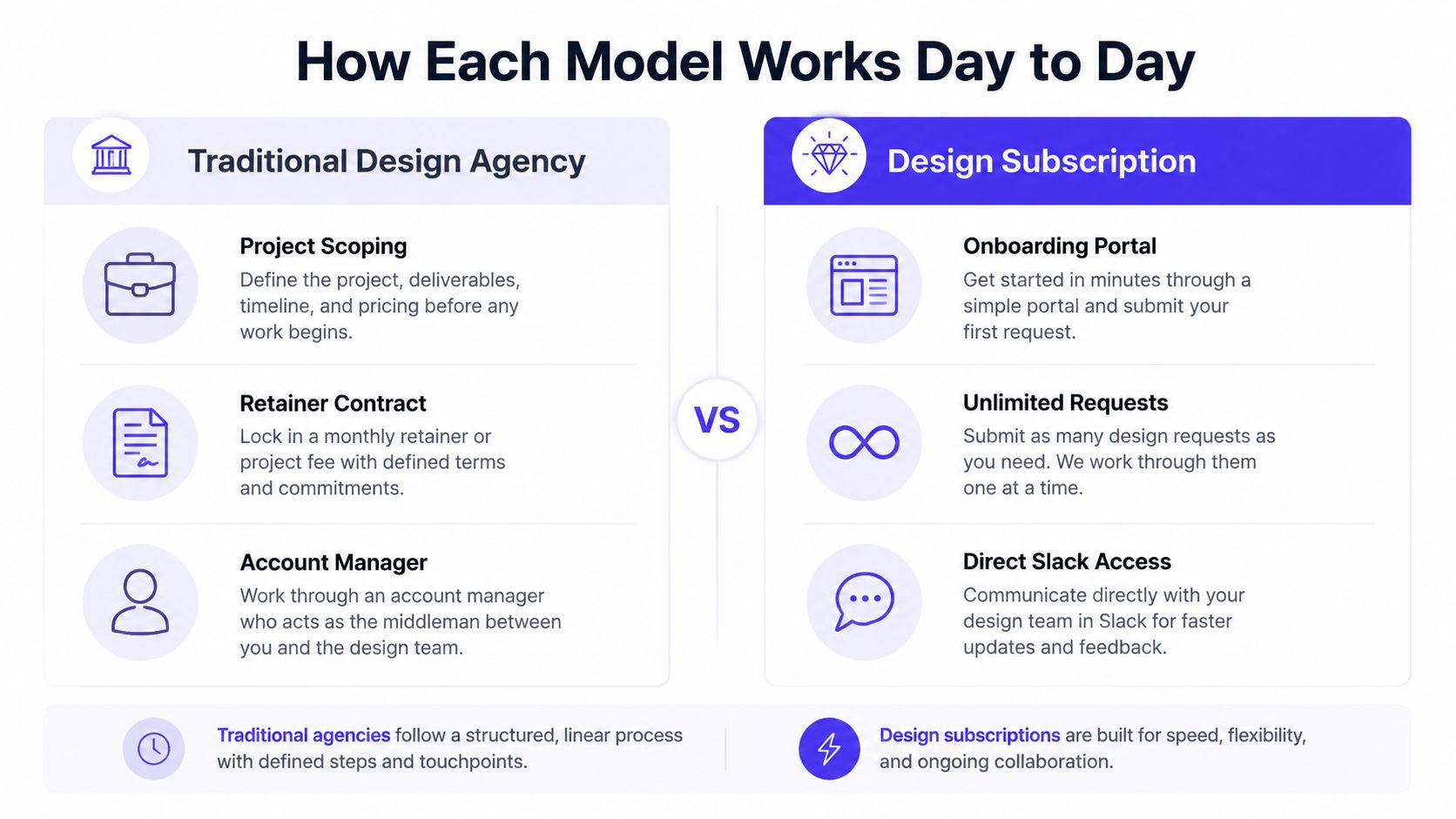
A traditional agency starts by defining the engagement. You'll usually discuss the problem, agree on a scope, set milestones, and assign a team that may include a strategist, designer, project lead, and specialist contributors. Discovery comes before production, and work moves through staged reviews. That structure is useful when the problem is unclear and the company needs someone to help define what should be built.
An agency retainer changes the billing pattern, not the basic operating logic. You pay for recurring access, but requests may still be prioritized through an account manager, scheduled against team availability, and reviewed in formal stages. Published UK pricing examples place freelancers around £10.19 to £37.10 per hour and agencies around £50 to £150 or more per hour, illustrating the difference between individual capacity and managed agency delivery. The UK outsourcing cost comparison also describes subscription tiers ranging from about $499 to $2,399 per month in mainstream examples, with enterprise plans beginning around $5,000 per month in one 2026 comparison.
A design subscription works differently. You pay a flat monthly fee, submit requests into a queue, and generally move one active task forward at a time. Common static assets are often marketed with 24 to 48 hour service windows, and some plans advertise same-day or next-day execution for simple work. Subscription guides commonly describe one to two business day targets and unlimited revisions within scope, but the one-active-request rule remains important. Your team gets continuous access, not parallel production across every request.
The third option
A bundled creative studio sits between these models operationally. It can use a recurring engagement for ongoing support, or a fixed-scope project for a defined launch, while covering product design, brand, and frontend in one relationship. The value isn't the label. It's the reduction in context loss between the person shaping the experience, the person defining the brand, and the person building the interface.
That distinction also affects how your company appears before a prospect signs up. Teams working on discovery and acquisition may find broader context in resources about brand visibility in AI answers, but visibility only helps if the destination experience is clear and credible. A subscription can supply the landing page assets. An agency or studio may be better positioned to connect the message, product experience, and implementation.
Cost and Time Trade-offs That Decide the Real Winner
Price comparisons fail when they treat design as a line item instead of a capacity decision. A subscription may look inexpensive next to an agency project, but it can become poor value if your team needs product ownership and the provider only handles isolated assets. An agency may look expensive, yet be cheaper than several failed design cycles when the company needs research, positioning, and a coherent launch.
Fresh 2026 pricing guides place many startup-focused subscriptions around $599 to $3,500 per month, while agency projects often begin near $8,000 and can exceed $200,000 for broad product engagements. Those ranges are cited in the agency versus subscription pricing comparison. They're not interchangeable quotes. A monthly plan buys recurring access and queue capacity. An agency project buys a defined outcome with a larger production team and more formal coordination.

The hiring alternative deserves equal attention. A fully loaded in-house product designer can cost about $155,000 to $205,000 annually in a major U.S. market, including salary, benefits, tooling, recruiting, and onboarding. A more detailed estimate puts recruiting and first-year onboarding at roughly $204,560 to $241,860. Those figures are reported in the 2026 product designer hiring cost analysis.
Time-to-value is a budget variable
A subscription can begin producing common assets within its service window, but the first useful product outcome still depends on onboarding, context, and request quality. An agency may take longer before the first visible delivery because discovery and alignment happen first. That delay can be rational if it prevents the team from building the wrong workflow.
Retainer economics also explain why subscriptions need disciplined queue management. One guide defines healthy utilization as 85% to 100% of allocated hours, warns that clients may feel underserved below 70%, and gives a sample CAC payback period of 1.25 months when acquisition cost is $2,500 against $2,000 in monthly retainer profit. The retainer-management guide uses those figures to show why providers protect capacity and limit concurrency.
For a CFO, the practical calculation is simple. Compare the cost of the vendor with the cost of the delay, rework, engineering waiting time, and hiring overhead. For a product leader, compare the same vendor against the number of decisions your internal team must still make after delivery. If the work remains stuck in Figma, the cheapest design model is still expensive.
Read the Fintech design cost breakdown before approving a project budget, particularly if compliance, trust, and frontend implementation are part of the scope.
Team Coverage Across Product, Brand, and Frontend
Most design comparisons assume that “design” means marketing assets. Founders know the workload is broader. You may need a dashboard redesign, a credible website, a sharper identity, and production-ready frontend work while your product manager is also handling customer calls and your engineers are focused on the roadmap.

Product design
Product design owns the user's path through the application. For an AI SaaS company, that might mean clarifying how a user creates a workspace, interprets generated output, reviews a recommendation, and takes the next action. For a fintech product, it may mean reducing confusion around balances, permissions, transactions, or approval states.
A marketing-focused subscription can execute a polished screen, but it may not own the underlying product decisions. Ask whether the provider conducts user-flow analysis, works inside your existing product constraints, and stays involved through implementation. If the answer is limited to visual requests, treat the service as production support, not product ownership.
Brand identity
Brand work includes more than a logo. It establishes the visual rules that make your website, product, sales deck, and launch assets feel like the same company. Web3 companies often need trust without looking interchangeable. Fintech teams need clarity without flattening the product into generic corporate language.
An agency can lead a brand sprint well, especially when positioning and research are central. A subscription may maintain the system after the initial identity exists. The gap appears when nobody connects brand decisions to the interface. A visual identity that looks strong on a homepage but disappears inside the application hasn't solved the full problem.
Frontend development
Frontend is where many engagements lose accountability. A designer hands over a prototype, an engineer interprets it under deadline pressure, and the shipped interface drifts from the intended experience. The company then pays for a second round of corrections.
Use this checklist before choosing a provider:
Product ownership: Who makes workflow decisions when requirements conflict?
Brand continuity: Who applies the identity across product and marketing?
Frontend responsibility: Who writes or owns the production implementation?
Handoff quality: What gets delivered to engineering, and who answers questions?
Outcome tracking: What does “done” mean after the file or page is approved?
A subscription wins when your missing role is ongoing asset production. An agency wins when you need a concentrated team for a defined strategic problem. A studio that covers all three disciplines wins when the company can't afford to hire a product designer, brand designer, and frontend developer separately.
Three Founder Scenarios That Show Each Model Winning
The right answer changes with the work, not with the company's preference for a particular vendor category. These three situations show where the trade-offs become concrete.

An AI SaaS startup at Seed
The company has no in-house designer. Its dashboard confuses new users, and the marketing site doesn't explain the product clearly. The founders need a redesigned dashboard and a new site within six weeks, with engineering ready to build once the direction is approved.
A pure marketing subscription is the wrong choice. It may keep the site and campaign queue moving, but it doesn't necessarily provide the product judgment or frontend ownership needed to reshape the application. A traditional agency could work if it has strong SaaS product experience, but the company should avoid a handoff where the agency stops at the prototype.
The best fit is a bundled studio engagement with one owner across product, brand, and frontend. The shipped outcome is a clearer dashboard, a credible marketing site, and implementation that matches the approved experience.
A Web3 company at Series A
The company is launching a new product vertical. It needs a brand extension, a high-conversion landing page, and launch assets that explain a technical offer without overwhelming unfamiliar buyers.
Here, a traditional agency or focused brand studio can win. The main risk is positioning, not a constant stream of small requests. The team needs a coherent launch idea and a visual system that can survive beyond the first page.
A subscription becomes useful after the launch system exists. It can handle recurring campaign pages, social assets, product announcements, and sales collateral. If the provider can't define the brand or connect it to the product, use the subscription as maintenance capacity rather than the strategic lead.
A Fintech company at Series B
The product team has one designer and is hiring. The company needs frontend support while the internal team ramps, and the product roadmap can't wait for recruiting, onboarding, and context transfer.
A traditional agency may be excessive if the company already knows what to build. A design subscription may cover interface requests, but it can leave the frontend bottleneck untouched. The strongest fit is one partner that can support product decisions, maintain brand consistency, and build the frontend while the internal hire becomes productive.
The model wins when it removes the bottleneck that blocks shipping, not when it produces the most attractive proposal.
Decision Matrix and Vendor Checklist for Seed to Series B
Use the matrix to make the decision before vendors influence the criteria. “Best fit” means the model most likely to own the next business outcome, not the model with the lowest monthly fee.
Stage | Primary need | Best fit | Why |
|---|---|---|---|
Seed | Product clarity, initial brand, and launch website | Bundled creative studio | One partner can connect product decisions, identity, and implementation |
Seed | High-volume ads, social assets, and sales collateral | Design subscription | Queue-based access handles repeatable production without a full project |
Series A | Brand repositioning or new product vertical | Traditional agency | Discovery, positioning, and launch coordination matter more than request volume |
Series A | Ongoing product and marketing support | Subscription or bundled studio | The choice depends on whether frontend ownership is required |
Series B | Internal design team expansion with build gaps | Bundled creative studio | It covers senior judgment and frontend capacity while hiring continues |
Series B | Complex research or enterprise transformation | Traditional agency | A larger staged engagement can support discovery and cross-functional change |
Vendor checklist
Review the portfolio for work that resembles your actual product. A beautiful consumer brand doesn't prove that a team can design an AI workflow, a regulated fintech interface, or a Web3 onboarding path.
Ask direct questions:
Relevant experience: Can the team show shipped SaaS, Web3, or fintech work?
Frontend ownership: Does it build production interfaces or only prepare design files?
Ramp time: Who starts the work, and what information do they need?
Queue transparency: If it's a subscription, how are priorities and active requests managed?
References: Can you speak with a founder or product leader about delivery and handoff?
Contract flexibility: Can the engagement move from launch work to ongoing support?
The insights from Wispra are useful for framing the broader agency decision, but your vendor call should stay grounded in the work your team must ship.
Negotiation checklist
Request month-to-month terms where the work is exploratory. Define what counts as one request, how revisions work, and what happens when a request expands into product discovery. Clarify intellectual property ownership, source files, code ownership, access to repositories, and the handoff process before signing.
Add a kill clause or a clean termination window. You're not trying to trap a vendor. You're protecting the company from paying for capacity that no longer matches the roadmap.
For a practical framework on choosing the right engagement, use this guide to hire a design agency for a startup.
When One Partner That Replaces Three Hires Wins
Choose a design subscription when your product is mature and your main need is a reliable stream of marketing assets, campaign pages, sales materials, or interface updates. It's a poor substitute for product strategy, research, and frontend ownership.
Choose a traditional agency for a one-off brand sprint, deep discovery project, major repositioning, or complex transformation where the company needs a staged team and a defined outcome. Don't use it for simple recurring requests that a queue-based service can handle.
Choose a bundled creative studio when you're a Seed to Series B company that needs senior product judgment, a credible brand, and frontend execution without adding three separate hires. A fully loaded senior product designer alone can cost about $167,000 to $189,000 annually, or roughly $80 to $91 per hour, according to this 2026 product designer rate breakdown. The comparison is not just salary versus subscription. It's whether one partner can cover the work that would otherwise require separate product, brand, and frontend ownership.
If you're weighing external capacity against an internal hire, review these alternatives to hiring an in-house designer and list the exact outcomes your team needs this quarter.
925 Studios gives AI SaaS, Web3, and fintech teams one creative partner across product design, brand identity, website development, and frontend delivery. Visit 925 studios to discuss whether a recurring engagement or fixed-scope project can replace the three-hire gap blocking your next shipped product.


Let’s keep in touch.
Discover more about high-performance web design. Follow us on Twitter and Instagram.

