How to Hire Design Agency for Startup in 2026

Yusuf
Founder and lead designer at 925studios

You're probably in the same spot a lot of funded founders hit. The product is moving, the homepage looks dated, the app feels half-finished, and every week you spend waiting on design is another week engineering is guessing. At that point, the question isn't whether design matters, it's whether you can afford the wrong setup.
Hiring a full-time designer feels responsible, but a bad agency choice can burn just as much time and more money in hidden rework. A better move is to treat this like an operating decision, not a taste decision. The right partner should help you ship cleaner product, stronger brand, and a handoff your developers can use.
Table of Contents
When to Bring in an Agency Instead of Hiring In-House
The expensive mistake is hiring slowly, then paying for redesigns because the first version never made it to production. A mid-level in-house UI/UX designer costs $100,000 to $115,000 in base salary alone, and overhead adds another 20% to 30%. Agencies commonly start work in days, while hiring in-house takes an average of 36 days before a single pixel is touched. Parallel HQ
That gap matters when you're under pressure to ship a polished MVP before a raise, a launch, or a customer demo. It matters even more when your startup needs product UX, brand identity, and frontend work at the same time. One person can't cover all of that well on day one, and waiting for three hires usually slows the product down.
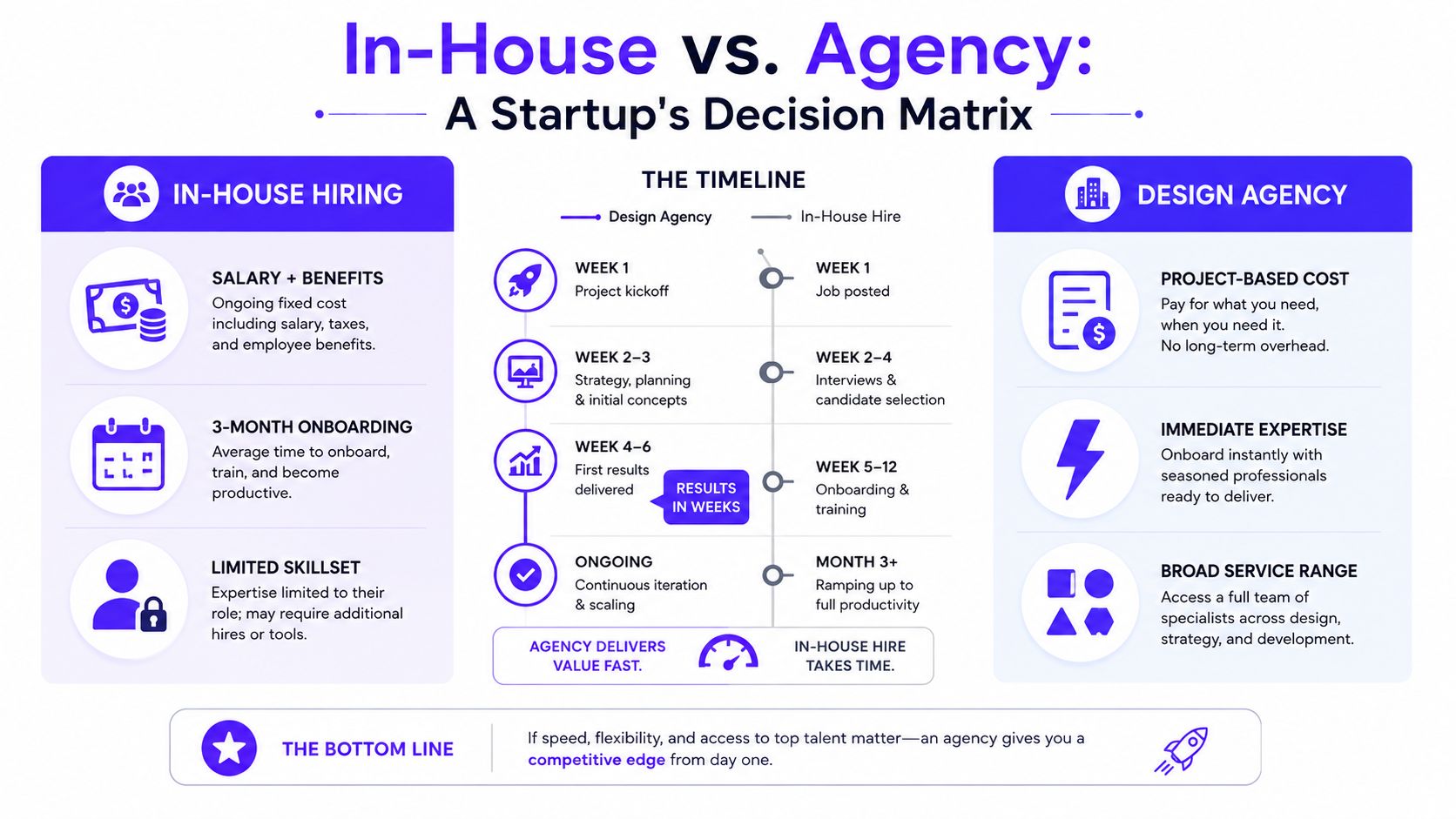
The point where agency beats headcount
If you need to reset a homepage, clean up onboarding, and tighten investor-facing brand assets in the same quarter, a design agency is usually the cleaner choice. You're not buying a single specialty, you're buying a working system with strategy, execution, and output that can move across product and marketing. That's why outsourced design has become normal for startups that need flexibility without permanent headcount.
A recent industry summary said that in 2024 more than 65% of small businesses worldwide outsourced at least one design project each quarter, about 55% of marketing agencies relied on outsourced graphic design to meet deadlines, and roughly 70% of startups and SMEs considered outsourced design critical for brand presence. It also estimated that outsourcing can save businesses up to 40% on design costs compared with hiring full-time designers. 360 Research Reports
That doesn't mean agencies are always right. If your roadmap is stable and you need one designer embedded full time for years, in-house can make sense. If you need output now, and especially if the work spans several disciplines, agency is the safer operating choice.
Practical rule: hire for the work you need in front of you, not the org chart you hope to have in six months.
If you're also deciding between a freelancer and a studio, the same logic applies. For a broader hiring framework, the tips for hiring senior developers on Hire-a.dev are useful because they treat hiring as a delivery problem, not a title problem.
Evaluating Portfolios for AI SaaS and Fintech Context
A gorgeous portfolio can hide a weak operator. That's especially true in AI SaaS and fintech, where the work is rarely just “make it look better.” You're dealing with dense dashboards, trust signals, feature flags, compliance constraints, and product decisions that affect activation, not just aesthetics.
The first filter is simple, ask whether the agency has shipped live work in the last 12 months that looks like your product, not just similar in color palette. A practical workflow is to define 3 to 5 measurable success metrics first, shortlist 3 to 5 agencies with relevant live work from the last 12 months, interview the actual delivery team, request 3 client references, and run a small paid test project before a full engagement. 925 Studios
What to look for in real work
For AI SaaS, I want to see whether they can simplify complexity without flattening the product. That means they understand how to present model output, confidence states, empty states, and workflow handoffs without confusing the user. For fintech, I want evidence that they know how to make money movement, verification, and account status feel credible.
If the agency only shows landing pages and brand boards, keep moving. If they can't explain who did the work, assume the pitch team and the delivery team are different people. That's a problem because the person selling you the engagement may not be the person solving your real product problems.
Ask one blunt question, “Show me the newest live product you shipped, then show me the exact team that built it.”
If you want a shortlist matched to startup use cases, the internal guide on best AI product design agencies is a useful reference point. And if your team is building around AI-assisted workflows, SigOS has a helpful guide to AI for SaaS product teams that can sharpen the questions you ask about product decisions, not just visuals.
Structuring Pricing for Runway and Flexibility
Founders usually ask the wrong pricing question. They ask, “How much does a design agency cost?” The better question is, “How do I structure this so a pivot doesn't wreck my runway?” That matters because startup work changes, and a scope that looks clean on paper can get messy once product, growth, and engineering start colliding.
The strongest neutral sources in the current results emphasize asking whether you need ongoing design or a one-time project, and whether pricing is predictable for runway planning, but they do not quantify the cost of scope changes, rework, or the tradeoff between fixed-scope and retainer models. ManyPixels
Choose the model around change, not just budget
Fixed-price is fine when the brief is stable and the deliverable is clear. Hourly works when you need flexible support, but it can drift if nobody is watching scope. Retainers make sense when your team needs steady access to design across product and marketing, especially if you're iterating weekly.
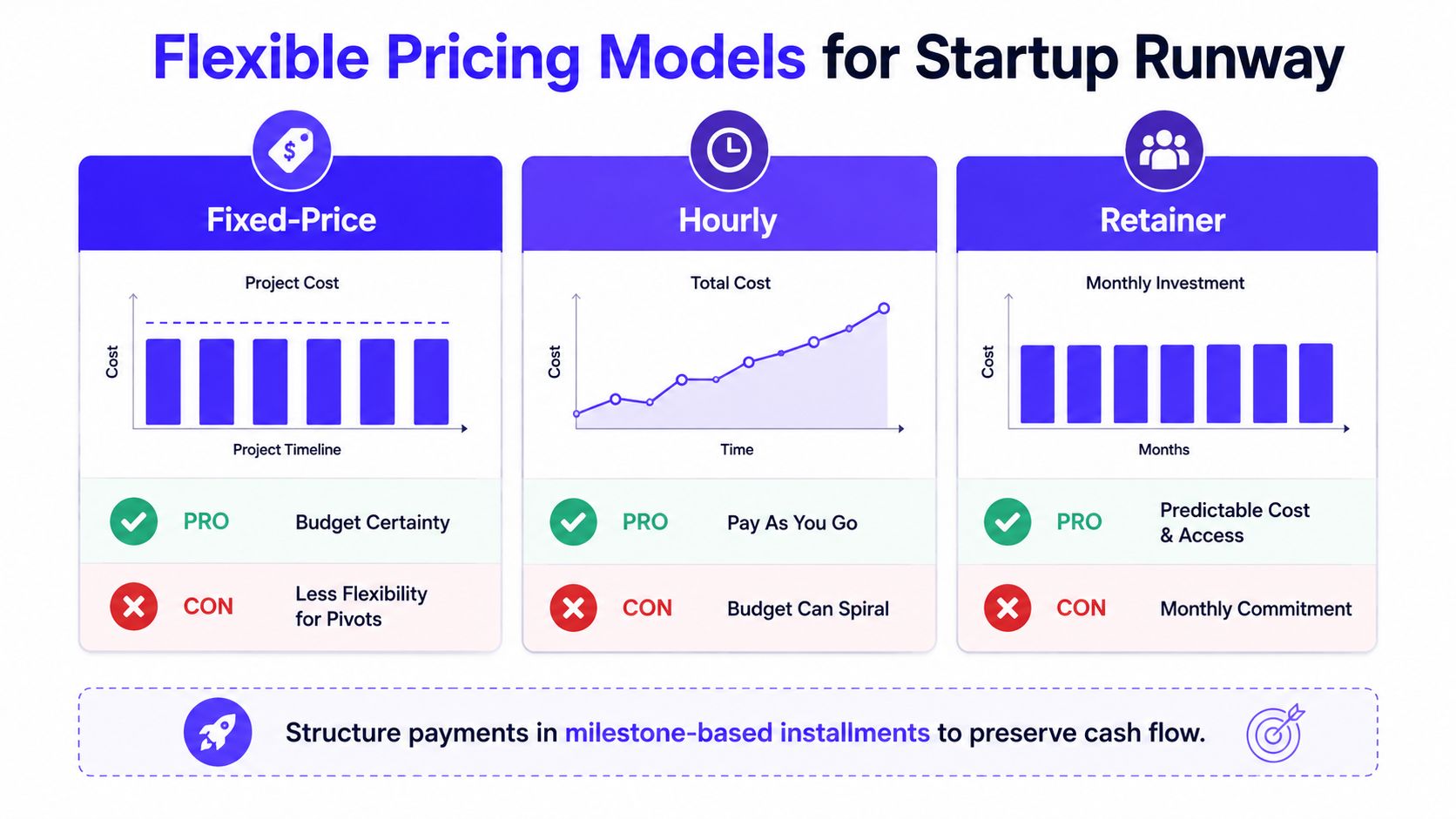
The structure I'd use
Start with one clear milestone, not a vague “brand refresh.” Then split payment into milestone-based installments so you're not front-loading risk into the first invoice. If the agency pushes back on visibility into phases, ask why. Good partners know startup scope changes, and they build for it.
A useful internal reference here is the UX agency pricing models explained guide, because it helps compare how agencies package ongoing work versus one-off delivery. My view is blunt, if the agency can't explain how they'll handle a pivot without turning every change into a new negotiation, they're not startup-ready.
Practical rule: pay for outcome windows, not just deliverable piles.
This is also where a startup-focused studio can be easier to manage than a big agency. 925 Studios is one option here, since it combines product UX, brand identity, frontend development, and design systems in one team, which matters when you want fewer handoffs and less internal coordination.
The First 30 Days and Onboarding Checklist
The first month usually decides whether the engagement helps or hinders your team. If onboarding is sloppy, you'll spend the next six weeks cleaning up assumptions instead of shipping. A serious agency should start with research, align on goals, and create a working rhythm before anyone reaches for visual polish.
For startup branding work, a more technical due-diligence benchmark is to require a process with a Discovery phase of 2 to 4 weeks that explicitly includes customer, competitor, and stakeholder research before visual design begins. Metabrand
What a clean kickoff looks like
Week one should be about goals, access, and decision-making. Who approves work, where files live, what the product team needs from design, and what engineering needs from design are the questions. If those aren't answered, the project will stall later.
Week two should collect existing assets and expose gaps. That includes brand files, product screenshots, customer notes, positioning docs, and anything else the agency needs to stop guessing. Week three should turn research into concepts, and week four should produce a first deliverable the team can critique in real time.
The point isn't to admire the process, it's to see whether the agency can absorb information quickly and turn it into something your team can build. If they can't run a clean discovery phase, they probably won't handle product ambiguity well either.
Here's the onboarding sequence I trust:
Kickoff and goals alignment. Define business targets, product constraints, and who signs off.
Asset and brand audit. Collect everything in one place so nobody is redesigning from memory.
Concept review. Get early direction before the team spends time polishing the wrong idea.
First major deliverable. Review one concrete output, not a slide deck full of opinions.
A short video can help teams internalize how a startup-friendly kickoff should feel, especially when product and marketing are both in the room.
If you want a practical reference for what the first month should look like, the UX agency onboarding first 30 days guide is worth reading before you sign anything.
Red Flags in Handoff and Operational Fit
A lot of agency pain shows up after the design is approved. The files look good in the meeting, then engineering opens them and finds missing states, vague spacing rules, or no system for reuse. That's when the cost hits, because your team starts rebuilding work the agency already billed for.
Recent guides now suggest asking how many funded startups the agency has worked with in the last 18 months, how its sprint process works, who approves work, and what a completed design-system handoff looks like, which signals that process quality is becoming a differentiator beyond aesthetics. Parallel HQ
The questions that expose weak operators
Ask who owns the final handoff. Ask how they work with developers while the project is still in motion. Ask what happens when requirements change halfway through a sprint. If the answers are vague, you're probably dealing with a team that's more comfortable presenting than shipping.
Watch for agencies that treat handoff as a file dump. Good teams leave behind structure your developers can use, not just polished screens. Bad teams hand over a pretty Figma file and disappear when implementation gets messy.
A second red flag is overconfidence in the pitch and underperformance in the delivery team. If the person who sold you the project won't be involved, that's not a small detail. It's often the whole problem.
If the agency can't explain the path from concept to shipped screen in plain English, your engineers will pay for that confusion later.
For AI SaaS, Web3, and fintech teams, this matters even more because design decisions often touch frontend logic and state management. A weak handoff slows shipping, and a slow shipping cycle is a product problem, not just a design annoyance.
Measuring the Impact of Your Design Partner
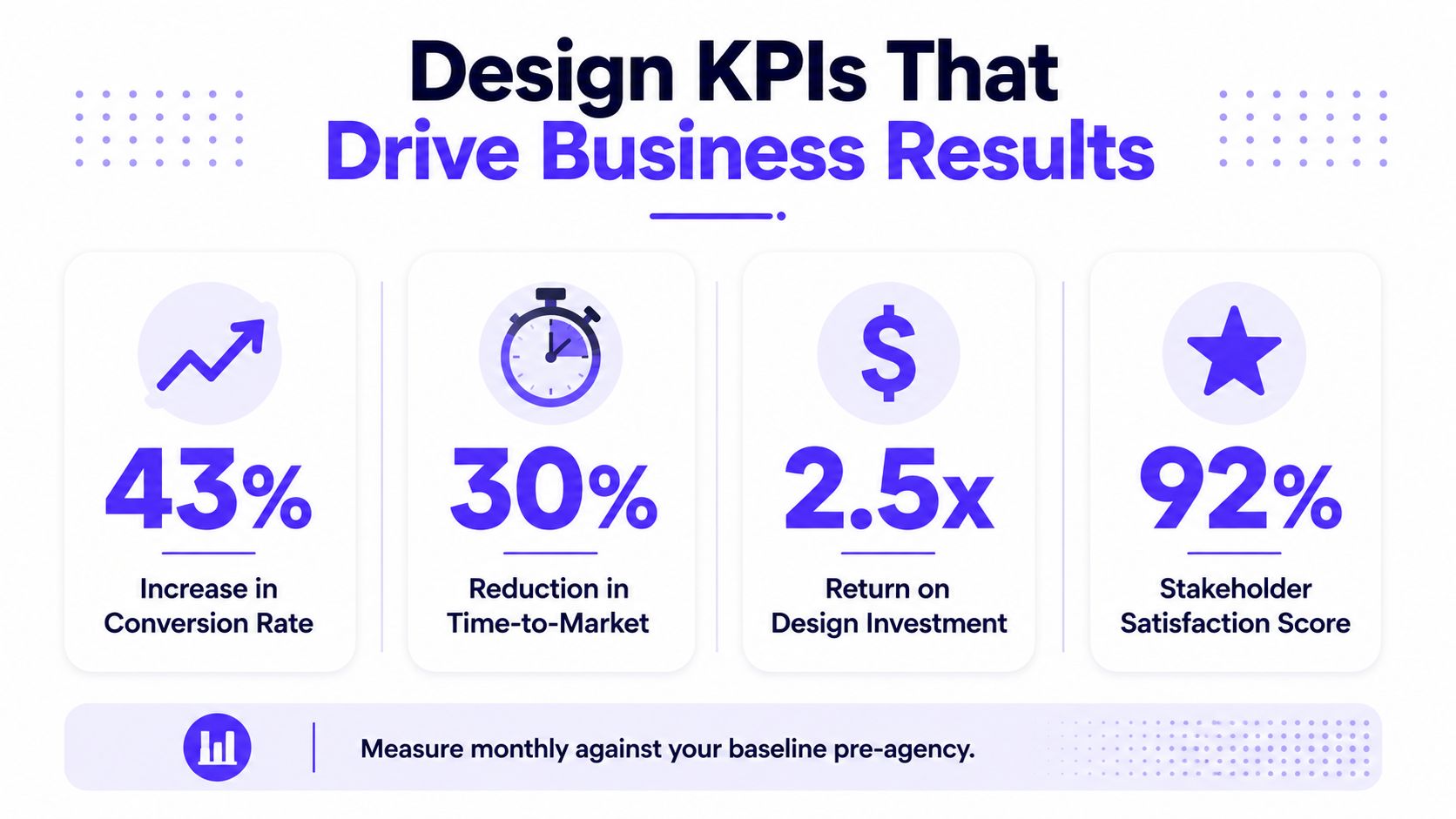
Design should move a business metric, or at least a product metric you can tie to revenue later. If your agency can't connect its work to conversion, activation, or faster shipping, then you're paying for taste. Founders don't need artwork, they need momentum.
Figma reports that 77% of global business leaders say communicating visually has directly increased their business performance. Figma That's not a reason to worship visuals, it's a reminder that clear design affects how teams sell, explain, and build.
What to measure without getting lost in vanity metrics
Start with the baseline before the agency changes anything. Then track whether the product is easier to understand, whether the handoff to engineering is cleaner, and whether your team is shipping faster with fewer design-related revisions. If you're a marketing-led startup, watch whether the homepage and onboarding story make more sense to actual buyers.
The cleanest review rhythm is monthly, not end-of-project only. That forces you to judge output against the original business problem. If the agency is vague about success, they'll drift into subjective feedback, and that's how startups end up with a nicer-looking product that still doesn't convert.
The strongest sign of a good partner isn't that every screen is beautiful. It's that product, marketing, and engineering all spend less time arguing about what the design means. That's operational fit, and it's usually what determines whether design improves velocity.
If you want one partner that covers product UX/UI, brand identity, frontend delivery, and design systems for AI SaaS, Web3, and fintech teams, 925 studios is built around that model. If your startup needs fewer handoffs and a team that can ship polished interfaces without forcing you into an in-house hiring cycle, reach out and see whether the fit is real.


Let’s keep in touch.
Discover more about high-performance web design. Follow us on Twitter and Instagram.