
Hire Design Agency for Startup: 2026 Guide

Yusuf
Founder and lead designer at 925studios

A mid-level in-house UI/UX designer costs about $138,000 to $153,000 in the first year once overhead and recruitment are included, while a startup-scale agency retainer usually sits around $60,000 to $144,000 a year and can start in days instead of waiting through a 36-day hiring cycle. If you're trying to hire design agency for startup work, the question isn't whether design matters, it's which kind of design work is the bottleneck right now.
Table of Contents
When a Design Agency Makes Sense for Your Startup
$138,000 to $153,000 for a first-year in-house designer is not a small bet, especially when the agency path can start in days and often lands in the $60,000 to $144,000 annual range instead (Parallel HQ comparison). That's why the question isn't “Should we do design?” It's “Do we need a product design engine, a marketing presentation layer, or both?”
The clearest signal is growth friction
If design quality is actively blocking activation, conversion, or trust, you don't need another debate about aesthetics. You need a team that can diagnose the bottleneck and ship the fix. For founders in AI SaaS, Web3, and fintech, that usually shows up as onboarding confusion, interface clutter, or a homepage that doesn't make the product feel credible enough to try.
Practical rule: hire outside help when design is no longer a support function, it's a growth constraint.
A startup agency makes the most sense when the work has to combine UX research, visual design, interaction design, and design systems without forcing you to hire three separate people. That's exactly where one embedded partner can beat a single full-time hire, because the scope is broader than one specialist and the timeline is tighter than a normal team build-out. If you're weighing whether an external partner is a better fit than trying to build in-house, the comparison in AI website builder vs design agency is worth reading before you commit.
Use agency help when discovery still matters
A lot of startups jump into screens before they've clarified the user journey. That's backward. If the team still needs discovery work, the right agency can help define what to build before anyone burns time polishing the wrong thing.
For teams that care about content discovery and demand capture, it also helps to look at data-driven SEO for agencies as a way to benchmark how agencies think about outcomes, not just deliverables. The useful mindset is the same one founders should demand from design partners, connect creative work to a measurable problem.
Founder filter: if the brief starts with “make it prettier,” you're probably asking the wrong question.
Agency help is also the right move when you can't wait through a hiring cycle and still need senior-level output. A long internal search is fine when the company has time. It's a bad plan when the next release depends on cleaner flows, clearer messaging, and faster build velocity.
Deciding Between Product Design and Marketing Site Design
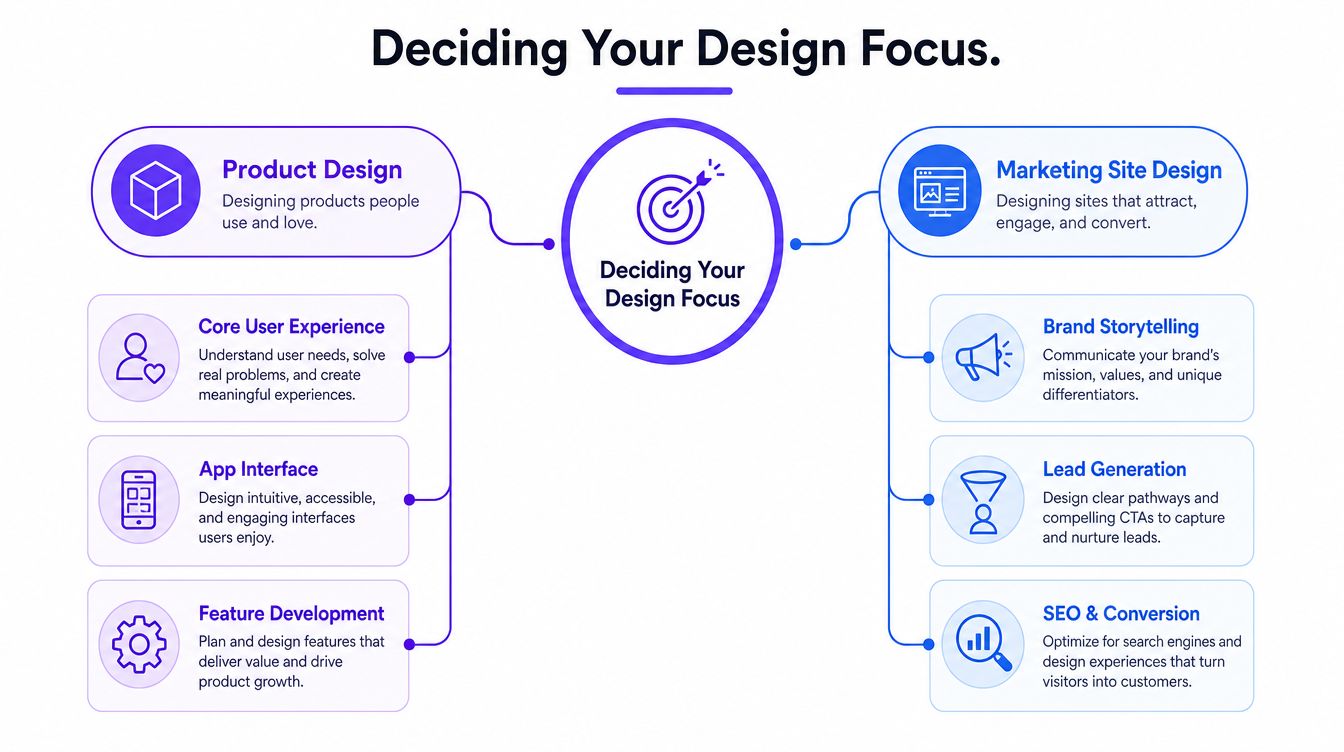
Choosing the wrong agency type is the biggest mistake founders make. A marketing-site agency solves acquisition, trust, and conversion for visitors. A product design agency solves activation, onboarding, and workflow clarity inside the product itself. Those are different problems, and they demand different portfolios, different process, and different instincts.
Pick product design when the user gets lost inside the app
If users sign up and then stall, the issue usually isn't your logo or homepage copy. It's the product experience. That's where a product design agency earns its keep, especially for dashboards, onboarding sequences, data-heavy flows, and workflow tools that need to feel obvious before they feel beautiful.
For AI SaaS, that might mean simplifying prompt setup, model selection, or output review. For Web3, it could mean wallet connection, transaction states, or account recovery. For fintech, the pain point is often compliance-heavy screens that overwhelm users before they reach value.
Pick marketing-site design when the problem is top-of-funnel trust
A marketing-site agency is the better fit when visitors don't understand what the company does, why it's different, or why they should leave their current solution. That's the right model for homepage rewrites, landing pages, brand storytelling, and SEO-backed conversion surfaces.
If your startup is still pre-scale and the site is doing the selling, the site has to carry a lot of weight. A marketing site that is visually polished but unclear on value props won't solve acquisition. It just gives you a prettier leak.
The distinction matters enough that I'd treat it as a hard gate before any agency review. If the biggest risk is user activation inside a complex product, a web-only shop won't fix it. If the biggest risk is weak trust in the market, a product-only team won't fix that either. The same logic shows up in SaaS website design, where the site has to do much more than look credible.
Use this simple self-check
If users don't understand the product after signup, start with product design.
If visitors don't believe the company before signup, start with marketing-site design.
If the product works but feels clunky, product design is the lever.
If the story is unclear but the product is fine, marketing-site design is the lever.
Evaluating Agencies with a Weighted Scoring Rubric
Most founders waste time judging agencies by polish alone. That's the wrong filter. A strong process starts with 3 to 5 measurable success metrics, then narrows the field to 3 to 5 agencies with relevant live work from the last 12 months, then interviews the actual delivery team, asks for 3 client references, and runs a small paid test project before signing anything (Utsubo guide). That sequence tells you how the team works when the work is real.
Use a weighted rubric instead of gut feel
Criterion | Weight | What Strong Looks Like | What Weak Looks Like |
|---|---|---|---|
Relevant design quality | 35% | Shipped work that looks current, clear, and usable in a live product or site | Pretty mockups with no proof they became shipped work |
Industry experience | 25% | Has handled products or sites similar to your startup's complexity | Generic portfolio with no AI SaaS, Web3, or fintech relevance |
Communication responsiveness | 20% | Fast, clear replies, direct answers, no handoff confusion | Slow follow-up, vague promises, sales polish with no delivery clarity |
Post-launch support terms | 20% | Clear ownership, revisions, support window, and next-step process | Loose language about “ongoing help” without specifics |
A weighted rubric works because it forces the tradeoff into the open. A stunning portfolio doesn't matter if the team can't ship with your engineers. A great strategist doesn't matter if no one answers messages quickly enough to keep the work moving. That's why the team you interview has to be the team that does the work.
Ask for a paid test project
A paid test project is the cleanest way to see how an agency handles constraints. Give them one real problem, one small scope, and one deadline. You'll learn more from that than from two hours of presentation decks.
Use the test to watch for three things. First, whether they ask smart questions before jumping into visuals. Second, whether they can produce buildable work, not just nice frames. Third, whether they can explain tradeoffs in plain language your team will use.
For founders who want a tighter question list before they start, ux agency hiring checklist questions 2026 is a useful companion to this process. The point isn't to over-qualify the agency, it's to avoid paying for a mismatch.
What a good RFP should include
Deliverables: define exactly what the agency is expected to ship.
Deadline: set a hard date, not a loose window.
Budget ceiling: give the maximum you'll approve.
Success criteria: name the business outcome, not just the visual output.
Ownership terms: make IP transfer and revision limits explicit.
Pricing, Contracts, and Timeline Benchmarks
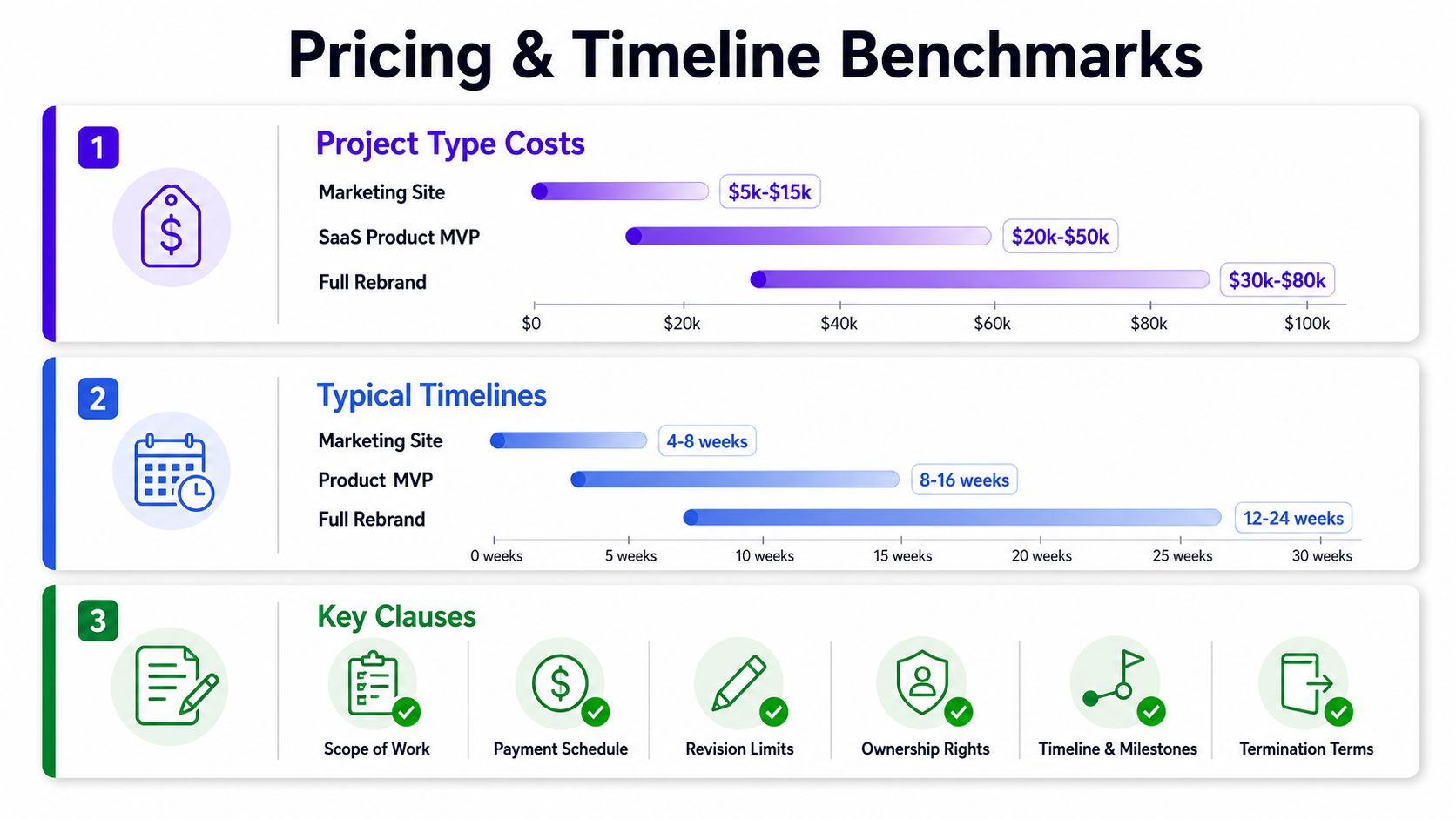
Agency pricing looks messy until you separate the model from the scope. Creative agency data shows small agency average project cost at $15,000, average project completion time at 28 days, 72% of projects delivered on time, and 15% delivered late (creative agency statistics roundup). Those are useful reality checks, not promises.
Pay for milestones, not blind trust
Sprint-based or milestone-based payments are the right default. Large upfront commitments hand too much risk to the startup before anyone has proven they can work together. Milestone payments also make it easier to tie spending to progress, which matters when the project touches conversion or product usability.
For startups, the important part isn't getting the cheapest quote. It's understanding what the quote includes, what the revision path looks like, and where hidden costs usually show up. Ambiguity is where budgets die.
Write the scope down like you mean it
A one-page brief is the minimum standard. It should cover specific deliverables, a hard deadline, and a maximum budget. Anything less invites scope drift, timeline drift, and arguments about what was promised.
The contract should also spell out revision limits, ownership and IP transfer, and the exact success criteria for sign-off. That protects both sides. You get clarity on what's being delivered, and the agency knows when the job is done.
Know what pricing model fits the work
The right partner depends on the work type. A marketing site, a product MVP, and a full rebrand are not the same project, even if agencies bundle them in the same sales conversation. If the work has changing requirements and needs ongoing iteration, a retainer or sprint model usually makes more sense than a fixed, one-and-done contract.
For a startup that needs product design, brand design, and front-end execution under one roof, 925 Studios is one option in the market because it combines those disciplines in a single partner model. That only matters if the scope needs all three. If not, don't buy more than you need.
Onboarding Your Design Agency for Fast Results
Agency work gets better when the startup brings real context on day one. Designers can't guess at product nuance, user pain, or sales promises. If you want useful output, give them access to the data and the people that explain how the business works.
Start with access and context
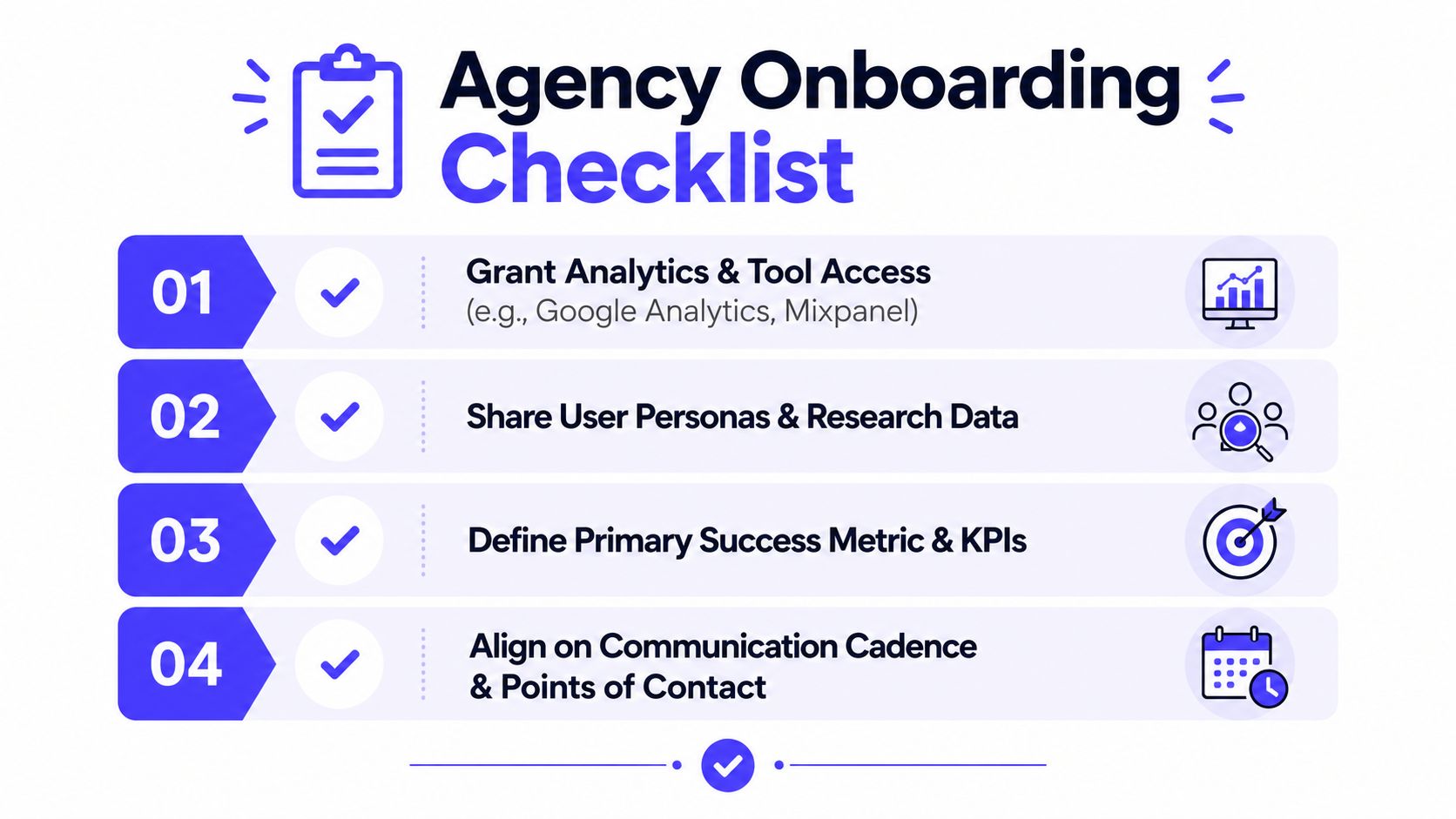
Before the kickoff, grant access to analytics, product docs, user research, and any existing brand or design system materials. Share the main customer segments, the core workflow, and the business rules that shape the product. Without that context, the agency will fill in the gaps with assumptions, and assumptions are expensive.
The startup also needs one point of contact. Too many voices from the founder team slow everything down and create contradictory feedback. One owner can gather input, make decisions, and keep the process clean.
Align on the working rhythm early
A structured kickoff matters because vague briefs create scope drift. Set the communication cadence, how blockers get escalated, and how decisions get approved. If the team waits until the end of the week to mention a problem, the delay is already baked in.
Hard rule: if feedback is unclear, the next round of work will be too.
The best teams keep review cycles short and specific. They don't ask for “more premium” or “make it pop.” They ask for changes tied to user behavior, conversion goals, or product clarity.
Give the agency the right inputs
Analytics access: let them see the actual drop-off points.
User research: share interviews, notes, and patterns.
Success metrics: define the one metric the work should move first.
Stakeholder map: tell them who approves what.
Product constraints: explain what engineering can and can't build right now.
The faster that context gets shared, the faster the agency can produce work that fits the product and the brand. That's true whether the partner is handling a homepage, a dashboard, or a full interface redesign. A vague brief makes a weak engagement. A clear one makes the agency useful quickly.
Measuring Design ROI with Real Conversion Metrics
Early-stage SaaS gives founders enough signals to judge whether design work is paying off. Median trial-to-paid conversion sits around 3% to 5% for opt-in trials and 8% to 12% for opt-out trials, and monthly churn of 5% to 7% is common in this stage. Those numbers make design decisions concrete. If onboarding, clarity, or trust is weak, the product leaks before revenue starts compounding. The point is simple, measure design against business movement, not taste.

Measure the right thing before the work starts
The cleanest way to judge a design agency is to define the metric first. Don't wait for the project to finish and then invent a success story. Set the benchmark up front, then compare the shipped result against the same number.
That may mean trial-to-paid conversion, support ticket volume, activation rate, or time-to-first-value. For founders, the right metric depends on where the funnel is breaking. For investors, the value is the same, because design stops being taste and starts being an operational advantage.
A cited benchmark shows trial-to-paid conversion rising to 5.8% after UX work, and companies investing in UX typically see 20% to 40% fewer support tickets within three months of shipping improved flows. Those are the kinds of outcomes that justify the spend when the agency is working on the right problem. For a broader view of how agencies are being evaluated against growth outcomes, the Surva.ai GEO agency guide reinforces the same standard, focus on measurable business movement, not polished deliverables.
Use design as a product metric lever
If your startup sells a complex product, design has to do more than make the interface look clean. It has to shorten the path to value. That means clearer onboarding, fewer confusing choices, and better handoff between marketing and product.
The useful test is simple. If the work improves trust but doesn't improve conversion, it is decorative. If it improves conversion and lowers support load, it is doing real business work. Hold a design partner to that bar whether you are reviewing a homepage, a signup flow, or a core dashboard.
Founders who are also thinking about search-driven demand capture should treat visibility and usability as part of the same revenue system. A startup does not need more design output. It needs design that changes the numbers the business already watches.

Let’s keep in touch.
Discover more about high-performance web design. Follow us on Twitter and Instagram.

