Fintech Design Cost: What Founders Actually Pay

Yusuf
Founder and lead designer at 925studios
A fintech UI/UX design engagement usually sits around $20,000 to $50,000 inside a broader build that often lands anywhere from $20,000 to $300,000+. For a practical rule of thumb, design and research commonly take 10% to 15% of the total project budget, and that's before development, compliance, and QA enter the room.
If you're in a vendor call right now, the number you're being quoted for screens is probably not the number you should care about. The cost lives in onboarding, KYC, trust cues, error recovery, compliance states, and every handoff that keeps money movement from breaking in production.
Table of Contents
What Fintech Design Cost Actually Means
You're on a call, the agency says the design phase is $35,000, and you're trying to decide whether that's expensive or cheap. The wrong way to answer is to compare it to a consumer app mockup quote. The right way is to ask what the design budget is doing inside the full build, because fintech design isn't just visual polish anymore, it's trust architecture, workflow mapping, and risk reduction baked into the product from day one. The broader 2026 build picture puts most fintech apps around $20,000 to $300,000+, with regulated neobanks pushing past $1 million and even reaching $2.5 million for a regulated neobank, while design and research alone often sit at 10% to 15% of the total budget. Andersen Lab's fintech cost overview
That means the design line item is usually not the main event. It's the part that keeps the rest of the budget from turning into rework, support headaches, and compliance surprises.
Read the quote against the total build
A $20,000 to $30,000 design allocation can be completely reasonable for a $200,000 product, and a $50,000 to $75,000 design allocation can make sense for a $500,000 regulated platform before development, compliance, and QA are even counted. If a vendor only talks about screens, you're probably looking at a shallow estimate. In fintech, the quote has to cover onboarding, permissions, error handling, trust signals, and financial actions that can't fail.
Practical rule: never judge fintech design cost in isolation. Judge it against the total scope, the regulatory load, and the number of user states the product must handle.
If you're building for a fintech audience, use a specialist lens. 925 Studios' fintech work is one example of how design, brand, and shipped product work can be bundled instead of split across three separate vendors.
Pricing Models and What Each One Costs
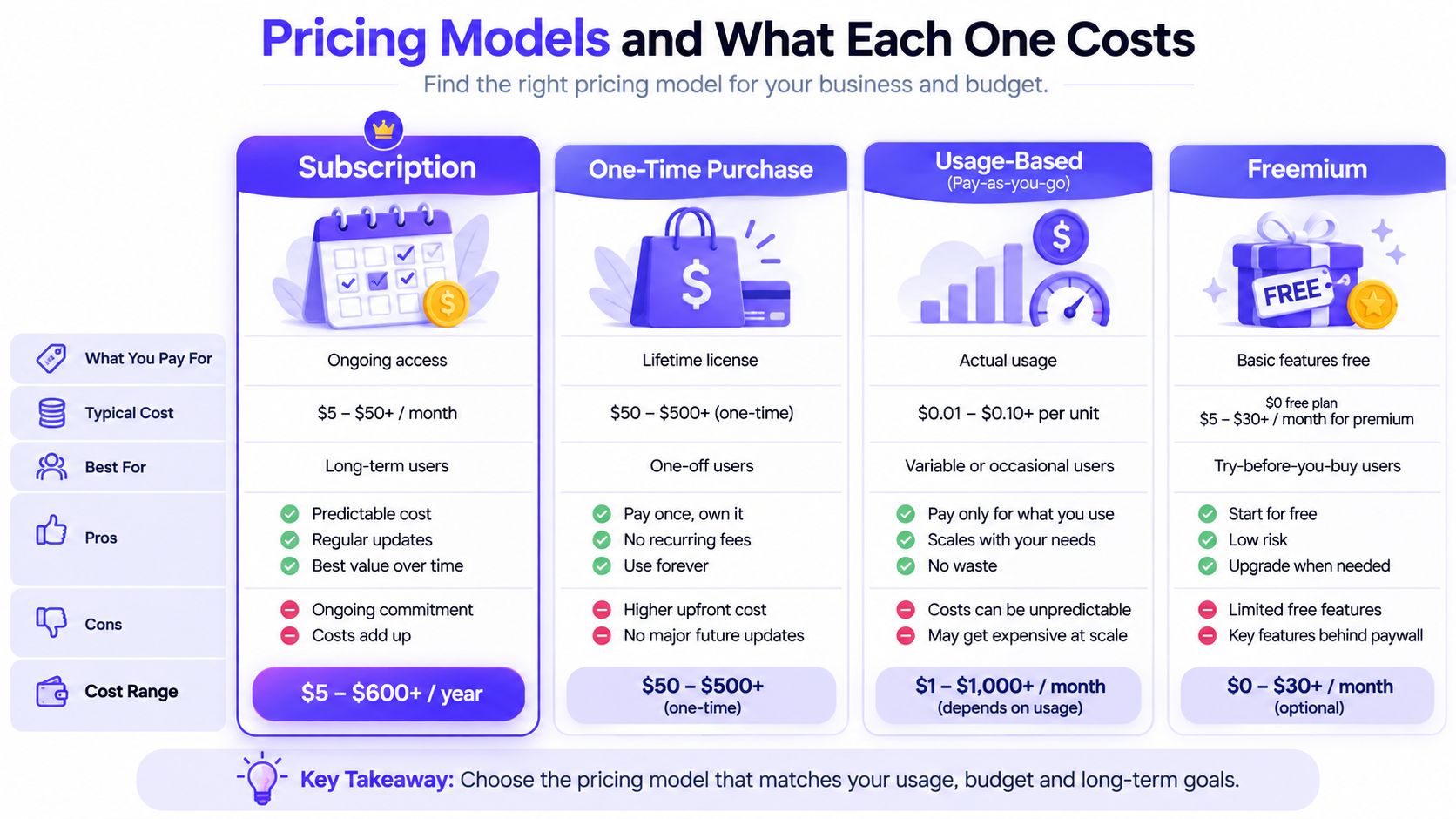
The pricing model usually changes the bill more than the logo on the proposal does. Hourly pricing is the cleanest way to buy narrow discovery work, but it gets expensive fast if the scope keeps shifting. Project pricing gives you a fixed target, while retainers make sense once the product is live and the work turns into ongoing iteration rather than one big launch.
Hourly, project, and retainer compared
Senior fintech designers in the US typically run $150 to $250 per hour, while strong offshore or nearshore teams often fall between $75 and $150 per hour. A 200-hour engagement can therefore land anywhere from $30,000 to $50,000 depending on who's doing the work and where they sit. Interexy's 2026 fintech cost breakdown
Project-based pricing usually compresses that into a fixed scope. A custom fintech MVP design often lands around $20,000 to $40,000+, while full-service US agency engagements covering research through high-fidelity screens can reach $50,000 to $200,000. For founders comparing agency proposals, that's the spread to keep in mind. 925 Studios' UX agency pricing guide
Retainers are the model most founders underuse and then pay for later. A monthly design retainer often runs $8,000 to $25,000 per month, which is the right fit when the product is already in market and the team needs continuous work on onboarding, compliance flows, growth experiments, and post-launch fixes.
A useful outside reference is browse crypto banking costs, because it shows how quickly financial product pricing can compound once banking features enter the scope.
Buy hourly when you need an audit, a discovery sprint, or a narrow diagnostic.
Buy project-based when the MVP scope is clear and the deliverables are locked.
Buy retainer when launch is behind you and the product needs continuous redesign.
The right structure depends on how certain you are about scope. The less certain you are, the more you should avoid fixed promises on detailed design output.
The Five Cost Drivers That Move the Bill
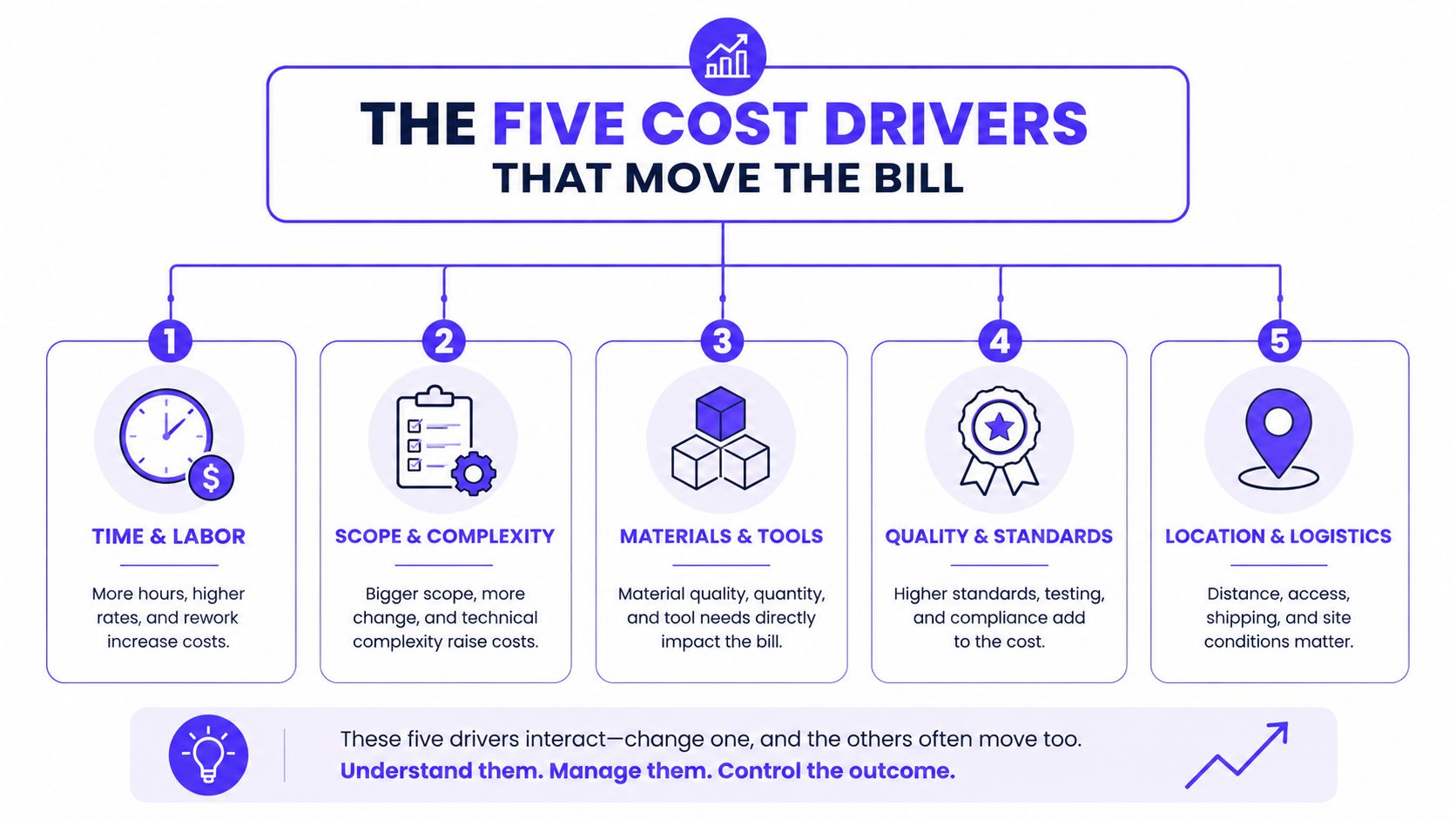
Most fintech design quotes look arbitrary until you break them into five drivers. Once you do, the price stops feeling mysterious. Complexity, compliance, integrations, design systems, and research each push the bill in a different direction, and on regulated products, compliance is usually the one founders underestimate most.
Complexity and compliance do the heaviest lifting
Complexity is about user roles, states, and edge cases. A product with one user path is cheap to design. A product with multiple roles, identity checks, approvals, failed payment states, and escalation paths isn't. That's where screen count balloons and where design work stops looking like “UI” and starts looking like operational logic.
Compliance is the big cost multiplier in regulated fintech. Requirements like PCI DSS, PSD2, SOC 2, AML/KYC, audit logging, and data-localization rules have to be designed into flows from the start, not patched in later. Industry guidance says compliance work can add roughly 20% to 40% of total project scope, or about $20,000 to $80,000 in direct effort depending on certification and market coverage. Purrweb's fintech app cost guide
Integrations are the next silent budget eater. Banks, KYC vendors, card networks, and ledgers all create loading states, failure states, reconciliation screens, and recovery paths that pure consumer apps never need. That means the designer isn't just drawing pages, they're mapping how the product behaves when external systems slow down or fail.
Design systems and research decide your future spend
A built design system costs more up front, but it pays back by reducing future feature work. One 2026 breakdown puts design systems at about $15,000 to $40,000 upfront, with later feature cost compression of 30% to 50% when the system is done well. That's not decoration, that's a powerful tool for efficiency. Anything's fintech workstream breakdown
Research is the driver most pricing pages skip, especially for underserved users. The Faster Payments Council notes that product design is often not targeted to the financial lives of underserved people, and recommends user research, pre- and post-testing, simple interfaces, and support for cash-based transactors. If you're serving low-income users, the unbanked, or small businesses, your real cost is not just design output, it's inclusive complexity. Faster Payments Council white paper
If your product touches regulated money movement, the cheapest quote is usually the one that ignored the hardest parts.
A founder who treats compliance, integrations, and inclusive research as optional almost always ends up paying for them later, just in a messier way.
Sample Budgets From Seed to Series B
The cleanest way to think about fintech design cost is by stage, not by aesthetics. A Seed company buying a narrow MVP does not need the same design infrastructure as a Series B company launching a regulated platform with multiple roles and products. The budget should follow the product's operational load, not the pitch deck's ambition.
Seed stage
A Seed-stage fintech building a single-feature product on top of an existing API usually lands at $20,000 to $50,000 total. Within that, design and research may take $2,000 to $7,500, backend and API integration can dominate at $6,000 to $17,500, mobile frontend often sits around $5,000 to $15,000, and QA takes a small but necessary slice. The realistic timeline is usually 3 to 4 months. Anything's fintech workstream breakdown
Series A and Series B
A Series A fintech launching a multi-role regulated product should plan for $200,000 to $500,000 total. In that band, design may sit at $20,000 to $50,000, backend at $60,000 to $175,000, compliance and security at $30,000 to $125,000, and mobile frontend at $50,000 to $150,000, with a timeline of 6 to 9 months. Interexy's 2026 estimate
A Series B fintech scaling a neobank or lending product routinely clears $500,000 to $2,500,000. Design and research can run from $50,000 to $250,000, with a design system taking $15,000 to $40,000 of that and compliance reaching $100,000 to $1,000,000. These builds typically take 9 to 18 months. Andersen Lab's 2026 cost overview
Stage | Total budget | Design and research | Timeline | Compliance share |
|---|---|---|---|---|
Seed | $20,000 to $50,000 | $2,000 to $7,500 | 3 to 4 months | Smaller slice, tied to basic flow decisions |
Series A | $200,000 to $500,000 | $20,000 to $50,000 | 6 to 9 months | Often a major budget line |
Series B | $500,000 to $2,500,000 | $50,000 to $250,000 | 9 to 18 months | Can become one of the largest cost centers |
The pattern is simple. As soon as regulated workflows and multi-role logic enter the product, design stops being a nice-to-have and becomes part of the system the business runs on.
Agency Versus In-House Versus a Studio Partner
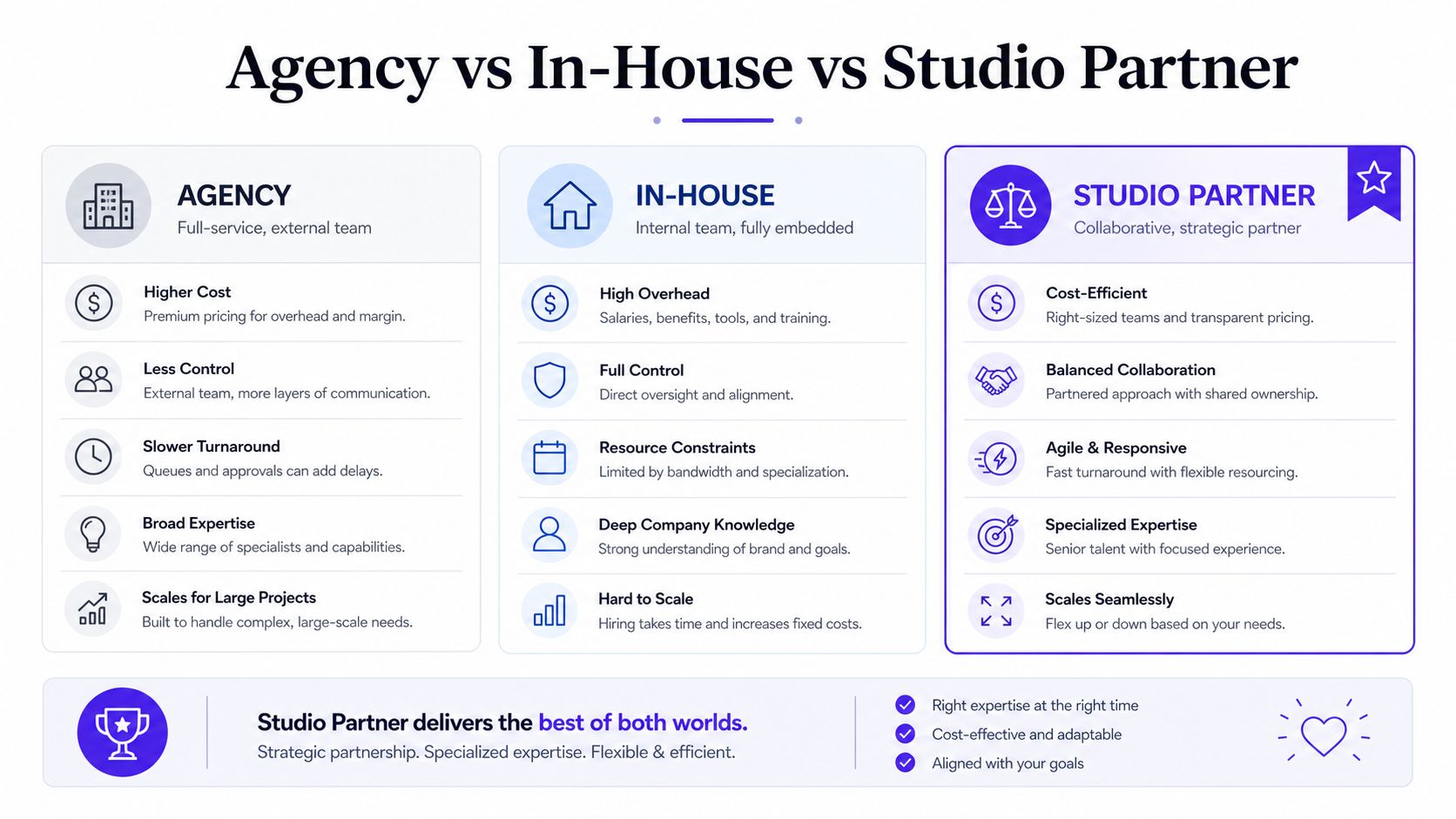
Founders usually frame this as agency versus in-house, but that's too narrow. The choice is between building a team, renting a team, or embedding with a partner that can cover design, brand, and frontend without forcing you to manage three separate hires. Each option buys you something different, and the wrong one creates hidden cost fast.
What each model really costs
A senior in-house product designer in the US costs roughly $130,000 to $190,000 in fully loaded annual salary. Add a brand designer at $110,000 to $160,000 and a frontend developer at $140,000 to $200,000, and the cost of a three-person in-house team goes above $400,000 per year before benefits, equipment, or recruiting fees. That's the expensive truth behind “we'll just hire internally.” AmbitionCFO's budgeting guide for leadership teams
A traditional agency often looks cheaper on a single project, usually $50,000 to $200,000 for the same scope. The trade-off is continuity. Once handoff happens, institutional memory walks out the door with the invoice.
A studio partner sits in between. For a bundled engagement, it often lands around $15,000 to $40,000 per month, and it keeps product design, brand, and frontend under one roof. 925 Studios operates in that lane, which matters when a founder wants one team to own strategy through shipped pixels instead of stitching together specialists after the fact.
Pick the model that matches your stage
If you need a one-off redesign and nothing else, agency pricing can work. If you're building a long-lived product and expect constant change, in-house eventually becomes the expensive but durable answer. If you're a funded startup that needs senior output without three separate hires, a studio partner is often the cleaner operational choice.
The model tells you more than the quote does. It tells you who owns the edge cases, who keeps the system coherent, and who gets blamed when the product breaks after launch.
How to Control Spend Without Cutting Trust
The fastest way to waste money in fintech is to buy polished screens before you've defined the logic behind them. The better move is to reduce scope where it doesn't affect trust, then spend where the product has to feel safe, legible, and compliant. That's the game.
Cut scope before you cut quality
Start by mapping every screen to a user outcome. That's where waste usually shows up, and on a mid-size project it can cut screen count by 20% to 30% and save $5,000 to $15,000. If a screen doesn't help someone move money, verify identity, recover from an error, or understand what just happened, it's probably not worth designing yet.
Borrow before you build. If a fintech component library already solves basic patterns, use it and customize it. Building tokens, components, and patterns from scratch makes sense only when the product is unique or highly regulated.
For teams dealing with banking-grade flows, this fintech UX compliance and trust guide is a useful benchmark for what strong flow mapping looks like before design starts.
Design for the post-launch bill
Do the compliance and KYC sprint upfront. If you wait until QA to discover audit logging gaps, verification dead ends, or broken recovery states, you'll pay for redesign later. That's where post-MVP design cost blows up.
Treat design like an ongoing operational system, not a one-time deliverable. A small monthly retainer is often cheaper than a compliance-driven redesign that can run $30,000 to $80,000 every 12 to 18 months. That recurring work keeps the product aligned with changing rules and changing user expectations.
Use this in your RFP: fixed scope, capped revisions, shared risk on integration work, and explicit ownership of compliance states.
If a vendor won't define those terms, the quote is probably hiding rework.
When you compare proposals, ask three blunt questions. What is locked, what can change, and who pays if an integration or compliance assumption breaks? That's where cost control lives.
A Budgeting Principle You Can Apply This Week
A useful way to think about fintech design cost is this. You're not paying for screens, you're paying for decisions you'd rather not postpone. Every compliance retrofit, every failed KYC path found late, every accessibility fix after launch, and every brand reset before growth all cost less when they're designed in from the start.
That's why a $30,000 engagement that includes research, design system foundations, and compliance flow mapping usually beats a $15,000 quote that only delivers polished screens. The cheaper quote feels safer on paper, but it usually creates more overhead in the operational budget later.
If you're trying to separate product spend from everything else, a simple overhead check helps. This guide to break down business overhead expenses gives you a clean lens for seeing which costs are one-time and which ones keep coming back. Fintech design belongs in the second category.
The right budgeting test is simple. Would you rather spend the money now and ship a product that earns trust, or save it now and pay again in redesign fees, compliance rework, and lost users over the next 18 months? For fintech, the answer should be obvious.
925 Studios designs and builds fintech product experiences for teams that need one partner across product design, brand, and frontend. If you're pricing a new build or trying to turn a vendor quote into a real budget, visit 925 Studios and see how the work maps to your product stage.


Let’s keep in touch.
Discover more about high-performance web design. Follow us on Twitter and Instagram.