
AI Website Builder vs Design Agency: Founder Guide

Yusuf
Founder and lead designer at 925studios

You're probably staring at the same problem a lot of funded founders hit. The product's moving, investors are asking for the site, sales wants a homepage that doesn't look rough, and the current web presence feels like a placeholder someone meant to fix later. That's when the AI website builder vs design agency question stops being theoretical and starts touching trust, pipeline, and how serious the company feels.
A fast tool can get something live. That part is real. But the harder question is whether the site is just a shell to validate an idea, or a commercial surface that has to carry brand, conversion, and credibility under pressure. That's the decision founders keep ducking, and it's usually the wrong one to duck.
Decision factor | AI website builder | Design agency or studio |
|---|---|---|
Best use case | Quick validation, internal pages, simple launch surfaces | Public homepage, conversion-heavy site, brand-led launch |
Typical pace | Hours to days, with drafts in minutes | Weeks, with strategy, design, and build work |
Typical cost shape | Low monthly spend | Higher upfront project cost |
Customization | Limited by templates and guided systems | Custom architecture, branding, and integrations |
SEO and conversion depth | Fine for basics | Stronger for serious growth work |
Ownership and handoff | Often platform-bound | More control over files, code, and systems |
If you want a wider view, see how compares before you choose your lane. Most founders don't need more opinion, they need a clean way to decide when “good enough” is enough.
Table of Contents
The Choice Every Funded Founder Faces
The site is really for
At 11pm, the founder is staring at a half-finished AI-built homepage. The copy is decent, the layout is clean enough, and yet it still looks like every other startup in the category. That's the moment the core question shows up, because the site is no longer a homework exercise, it's the first thing people see when they decide whether to take the company seriously.
For an AI SaaS company, a Web3 protocol, or a fintech startup, the website usually has one of two jobs. It's either a placeholder asset, which is fine for early proof and light traffic, or it's a commercial growth asset, which has to hold up under demos, inbound demand, press, and partner scrutiny. Most founders feel the difference before they can name it.
The mistake is taking generic advice like “just use an AI builder” and applying it to a site that now has to do real work. That advice can be right for a draft, a waitlist, or an internal launch page. It backfires when the site becomes the thing a buyer judges, a journalist links to, or an investor uses to sanity-check the story.
The useful way to think about this is simple. Don't ask whether the site can be built cheaply. Ask whether it should behave like a temporary wrapper or a revenue surface. That's the line. Once traffic intent rises, or the sales motion gets longer, the website stops being decoration and starts being part of the product.
A lot of founders only realize that after the first wave of attention. By then, the quick fix has already become the thing everyone is reluctant to replace. If you're at that point, the rest of the decision gets a lot more honest.
What Each Option Looks Like in 2026
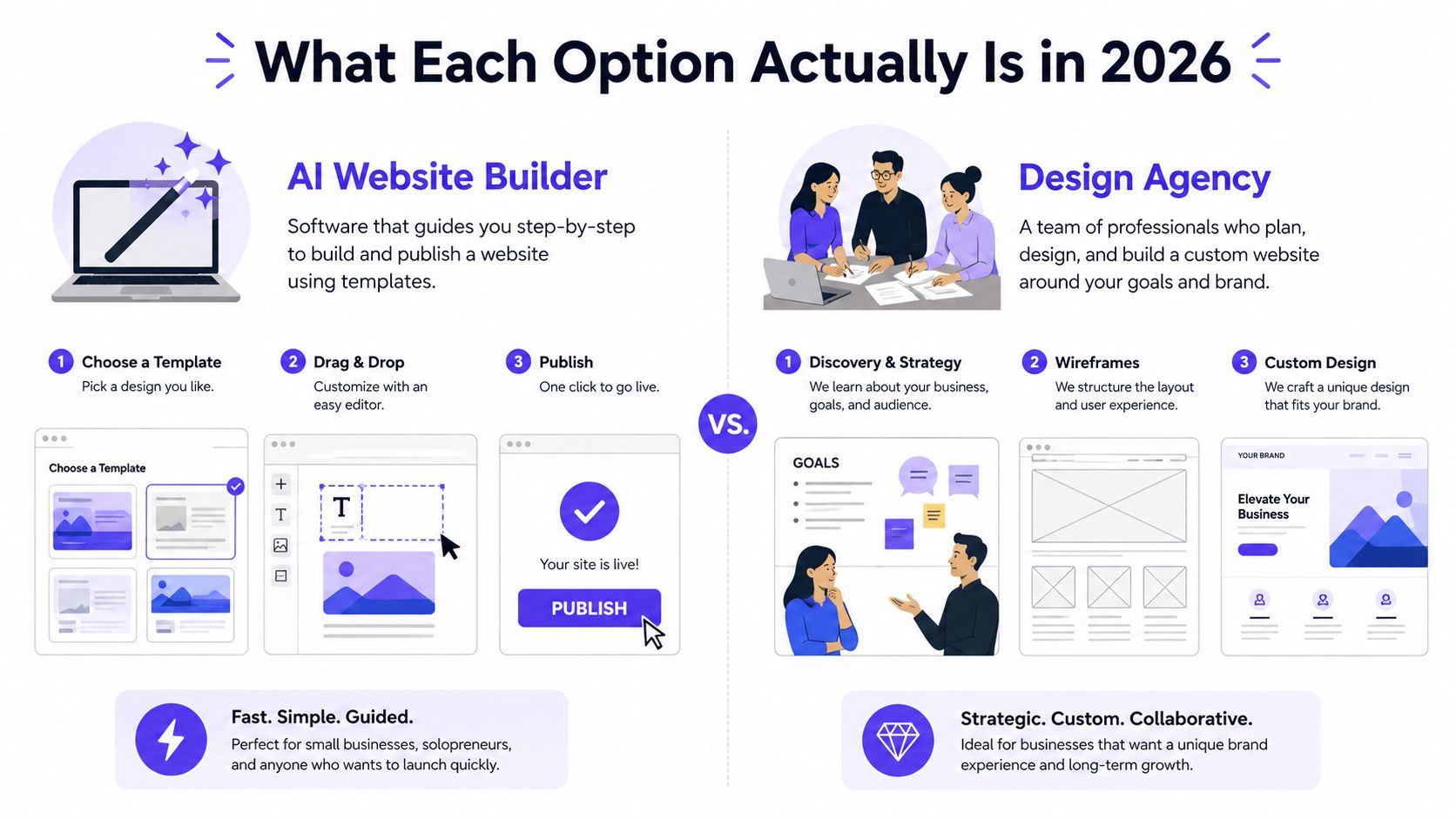
The founder experience day to day
An AI website builder in 2026 usually feels like guided setup with a smart assistant attached. You answer a few questions, pick from a template-heavy system, let the tool generate copy and layouts, then adjust things in a hosted editor until the page is good enough to publish. It is built for a quick, usable draft, not for a long design conversation.
A design agency or hybrid studio feels different from the first login. There is discovery, a strategy pass, design iteration, frontend build work, and handoff around what lives in files, code, and systems. For a founder, that usually means one partner can replace the need to separately hire a product designer, a brand designer, and a frontend developer.
Practical rule: if you want a website you can ship and forget, a builder can work. If you want a surface that shapes how people perceive the company, you need a team that thinks beyond the page.
The day-to-day difference shows up in the boring parts, which is where most decisions get made. With a builder, you spend your time inside a preset editor, making fast edits within the system's guardrails. With a studio, you review concepts, give feedback on structure, and end up with a custom result that does not feel boxed in by the platform.
That matters because founders rarely ask for “a website.” They ask for a homepage that feels credible in a pitch, a product launch surface that supports sales, and a brand expression that does not collapse into sameness. Those are different problems, and they do not all belong to the same tool.
For founders who want a clean comparison, the useful question is ownership. Do you need a placeholder asset that gets the company online, or a commercial growth asset that can carry demos, inbound, and scrutiny as traffic intent rises? For the cost side of that decision, the web builder cost breakdown for 2026 gives the right frame.
The distinction is simple. An AI builder gives you speed and control inside a system. A design agency gives you a site shaped around your brand, your sales motion, and the amount of revenue the site has to carry.
Cost, Speed, and the Actual Budget Tradeoff
Where the money really goes
AI website builders spread fast because the economics are hard to ignore. Hostinger's roundup of market data puts the category at $3.24 billion in 2026, up from $2.69 billion in 2025, with growth projected to $17.43 billion by 2035. The practical reason is simple. AI builders usually launch in hours to days at around $10 to $30 per month, while agency work usually takes 4 to 8 weeks and costs several thousand dollars or more. Hostinger's AI website builder statistics
The full cost gap gets wider once you look past the first launch. One independent comparison estimates a 3-year total cost of roughly $684 to $1,440 for an AI builder versus $8,000 to $20,000+ for a web designer or agency, assuming hosting, maintenance, and periodic redesigns. Another neutral benchmark places agency-built websites at $2,000 to $10,000 upfront with ongoing maintenance, while AI builders run about $15 to $30 per month and can produce a professional draft in 30 seconds to 5 minutes. The web builder cost breakdown for 2026 gives founders a clean way to size up that spread.
Cheap is not automatically smart. The right choice depends on what the site has to carry. A Seed-stage company trying to test a category can make real progress with the low-friction route. A Series A team with live demand, a long sales cycle, or investor traffic on the domain needs a homepage that holds up under scrutiny and does not look interchangeable.
The hidden cost shows up later. If an AI site has to be rebuilt, you are not just paying for a redesign. You are also spending time on migration, reworking content structure, and risking SEO equity during the move. The bigger hit comes when a plain homepage sits in front of real demand for months and undercuts the first impression before sales ever gets a chance.
For founders who want the budget question framed cleanly, the decision is not about cheap versus expensive. It is about whether the website is a placeholder asset or a commercial growth asset. If you are still proving the category, the lower-cost route can be enough. If the site has to support demos, inbound, and board-level confidence, the budget belongs on a custom build.
That is where AI builders and agencies split cleanly. An AI builder buys speed and control inside a system. A design agency buys a site shaped around your brand, your sales motion, and the amount of revenue the site has to carry.
Quality, Brand, and the AI Slop Problem
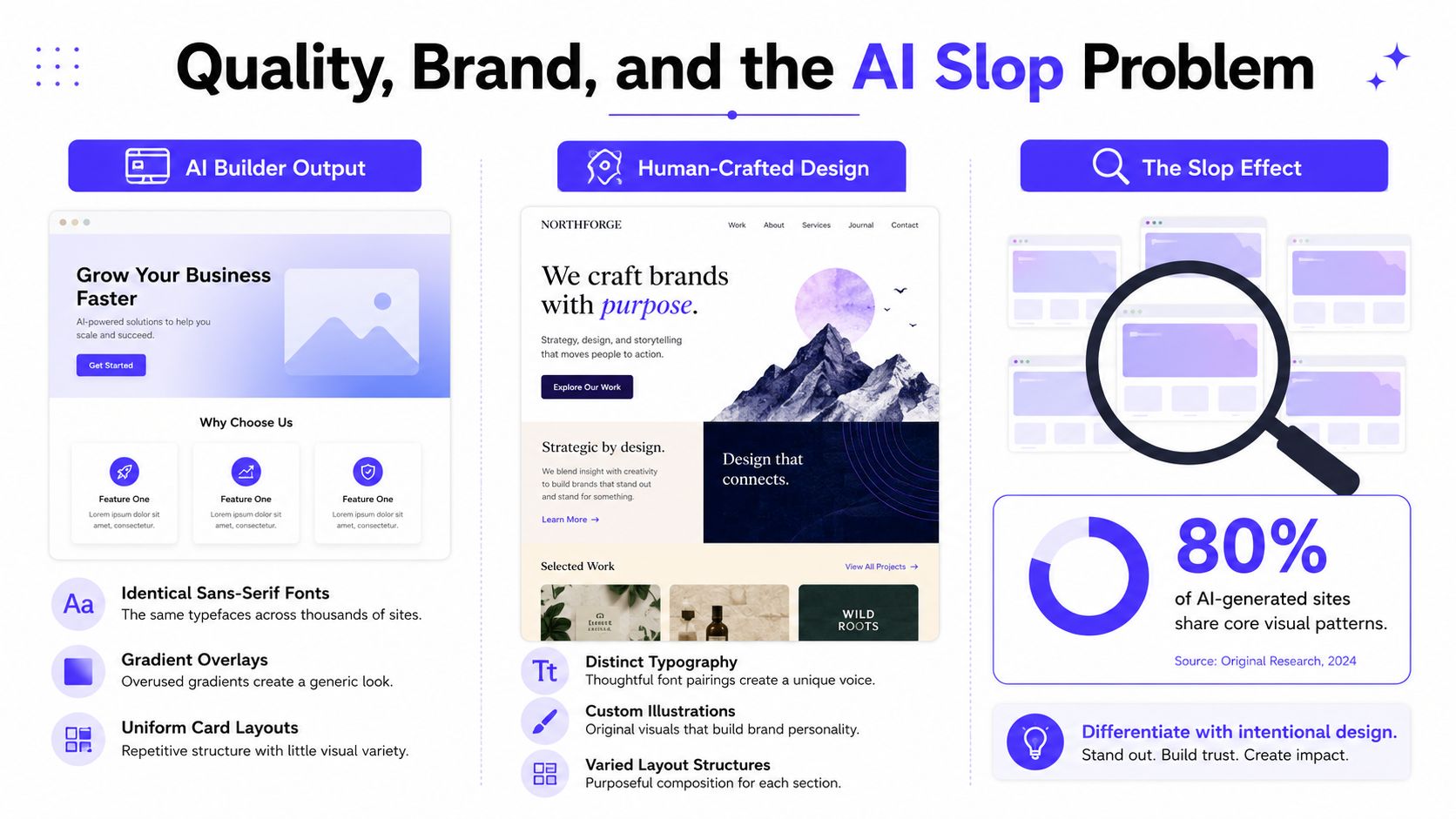
Why sameness hurts trust
AI builders tend to converge on the same visual habits. You see the same sans serif fonts, the same glassy gradients, the same card rows, the same hero structure, and after a while the site feels familiar in the wrong way. In crowded categories like AI SaaS, Web3, and fintech, familiarity reads as generic, not polished.
That's the AI slop problem in plain English. The site isn't broken. It's just indistinct. When the market is full of companies promising intelligent software, financial trust, or category innovation, a generic surface makes it harder to believe there's anything special underneath.
A studio or agency wins where details matter. Custom motion can make a product feel calmer and more expensive. Distinctive typography can make a brand feel confident instead of borrowed. Product-aware information architecture helps visitors understand what matters first, which is a real issue on complex SaaS and fintech pages. Accessibility and performance tuning matter too, because the site has to work for real users, not just pass a screenshot test.
AI gives you a site. A good agency gives you a brand surface that survives scrutiny from investors, design hires, and design-aware buyers.
That doesn't mean custom design is always the right answer. If the page is internal, behind a login, or not doing customer-facing work, AI output is often fine. The mistake is romanticizing custom design for its own sake. Not every page deserves a studio budget, and not every product needs a flagship homepage.
For a deeper look at the pattern, this AI slop web design guide is worth a skim. The test is simple. If the site needs to differentiate the company in a market where buyers are already skeptical, the cost of sameness is real.
SEO, Performance, and Conversion Architecture

Where the funnel breaks
SEO and conversion are one question from the founder's seat. If the site doesn't get found, or doesn't convert once it's found, the rest is decoration. AI builders usually handle the basics well enough, but they're typically lighter on technical SEO flexibility, custom rendering control, and URL structure choices that support serious content growth.
Agencies earn their fee by designing the path, not just the page. That means conversion-focused information architecture, CRM and booking integrations, analytics that reflect the funnel, and the kind of A/B testing setup that lets the team learn instead of guess. One comparison notes that AI builders usually offer basic forms and email connections, while agencies can set up CRM, lead routing, analytics, and custom integrations, which is exactly where the gap turns into revenue impact. Astucia's AI website builder vs web design agency comparison
For an AI SaaS homepage, that difference shows up in whether demo requests flow cleanly into the right pipeline. For a Web3 waitlist, it shows up in whether the page captures signal you can use later. For a fintech onboarding flow, it shows up in whether the site feels trustworthy enough to support a sensitive decision without friction. The page itself might look fine either way, but the mechanics underneath are not the same.
If you're trying to decide, use the site's job as the filter. A campaign landing page may be fine on a builder if the message is simple and the traffic is temporary. An enterprise fintech site with compliance pressure and multiple handoffs usually deserves the custom route. If your homepage has to carry real revenue decisions, the architecture matters more than the subscription price.
For teams exploring the SEO side of this more seriously, Nuwtonic's AI SEO Platform is a useful reference point on the tooling side. And if you're looking at how AI fits into a broader build workflow, this guide to integrating AI in website work gives a practical view of where the tools belong.
Scenario | AI builder fit | Agency fit |
|---|---|---|
Pre-seed validation | Strong | Usually unnecessary |
Series A launch | Mixed, depends on traffic intent | Strong if the homepage has to persuade |
Rebrand | Weak | Strong |
Campaign landing page | Strong for fast tests | Strong for high-stakes campaigns |
Enterprise fintech site | Weak | Strong |
Which Route Fits Your Stage and Scenario
The default by stage
If you're pre-seed and the site is mostly there to prove the idea exists, use the AI builder. You need momentum, not ceremony. If investors are clicking your domain in the next 30 days, though, the public surface needs to feel intentional, and that's where a studio starts making sense.
If you're at Series A and the homepage is doing real work for sales, recruiting, and credibility, lean toward an agency or hybrid studio. If the product is still early but traffic is spiky, the trigger is not the stage alone. It's the amount of trust the site has to earn in one visit.
A few clear defaults help:
Pre-seed validation: Start with AI for the first live version, especially if the goal is testing the market, not building a category-defining brand.
Series A launch or rebrand: Go custom if the launch has press, investors, or customers all landing on the same page.
Ongoing campaign pages: Use AI for short-lived experiments, unless the campaign is tied to a premium offer or a serious sales motion.
Enterprise-facing fintech site: Choose custom, because trust, clarity, and system integration matter more than saving a few weeks.
Product-led growth homepage: Pick the route that can carry signup conversion cleanly, which often means custom once the traffic is real.
If you want a more specific filter, ask three questions. Does the site need to explain a complex product? Does it need to hand leads into a CRM or booking flow? Will people judge the company's maturity from the homepage alone? If the answer is yes to two or more, the builder is probably too small for the job.
For teams comparing studio options, 925 Studios' guide to the best AI product design agencies is a relevant benchmark. The right choice isn't the one with the lowest price tag, it's the one that matches how much revenue the site has to carry.
The Hybrid Playbook and a Decision Checklist
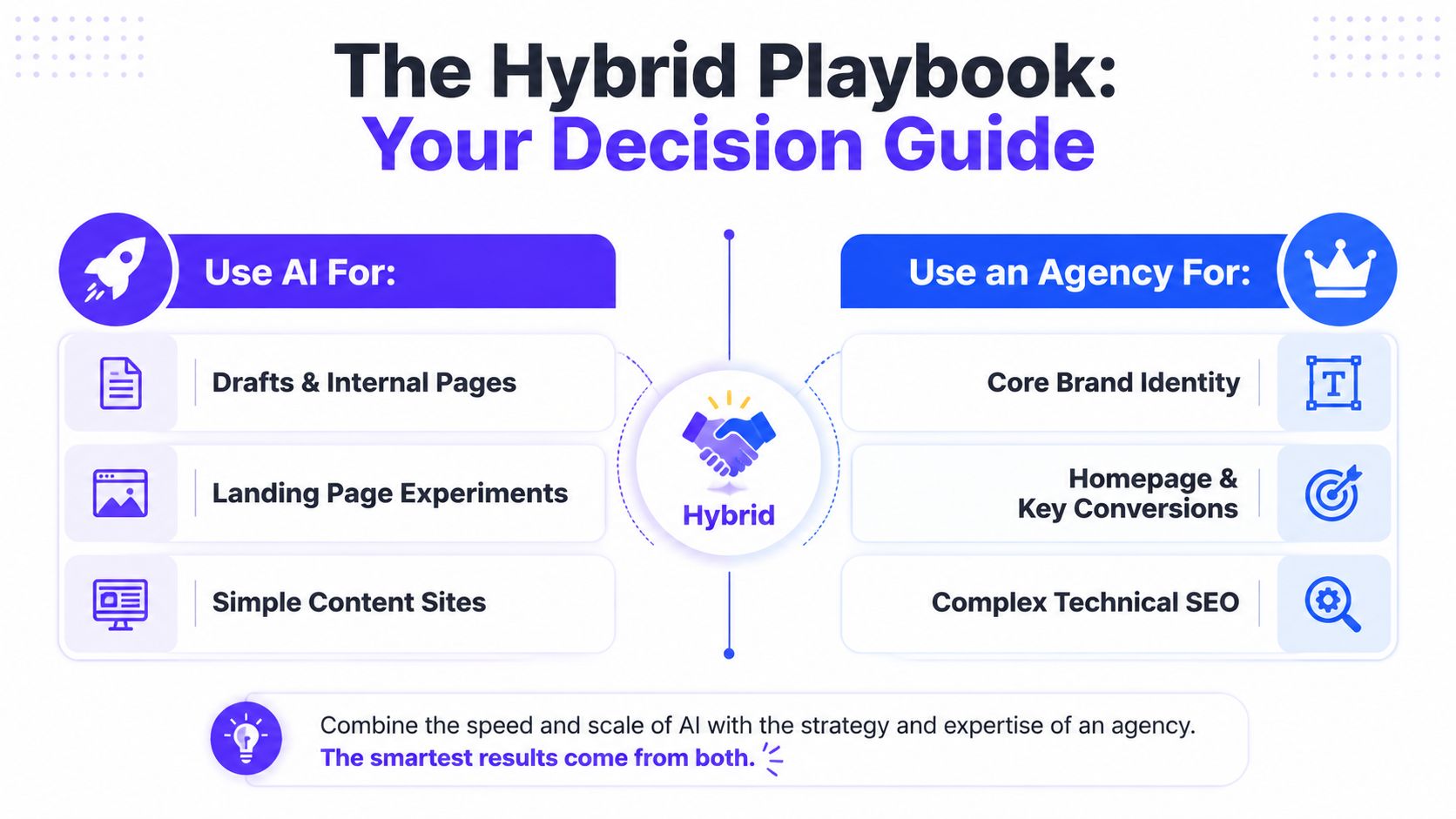
Use AI where it helps, use a studio where it matters
The smartest pattern isn't all-or-nothing. Use AI for drafts, internal pages, landing page experiments, and simple content sites. Use a studio or agency for the public homepage, the product UI, the brand identity, and anything that carries trust, differentiation, or conversion pressure.
That hybrid model works because the strengths are different. AI is excellent when the brief is loose and the stakes are low. A studio is stronger when the brief is strategic and the website has to hold up under scrutiny. You don't need one vendor to do everything badly when two approaches can split the work by function.
Here's the screenshot-ready checklist:
Stage: Are you validating, scaling, or rebranding?
Traffic intent: Are people casually browsing, or showing up ready to decide?
Sales cycle: Is the site just informing, or pushing a real buying process?
Customization depth: Do you need unique structure, motion, or layout logic?
Integrations: Does the site need CRM, analytics, routing, or booking handoffs?
Brand sensitivity: Will buyers, investors, or partners judge the company by the page?
Default recommendation: if the site is public and revenue-facing, don't cheap out on the surface that people actually see.
In a hurry, the rule is easy. Pre-seed and testing, start with AI. Series A and beyond, move the homepage and key conversion surfaces into custom hands. If the product is still changing weekly, keep low-risk pages in AI and invest in the surface that can't look temporary.
925 Studios fits naturally for some teams. It's one creative partner for website design and development, product design, and brand identity, so the team isn't juggling three separate hires when the site needs to do more than exist. That's not the right answer for every founder, but it's the right shape for companies where the website, product, and brand all have to look like they belong to the same business.
Founder Questions Worth Answering Out Loud
Migration, ownership, timing, and red flags
If you start with AI and move later, don't treat migration like a lift-and-shift. Keep the copy structure that works, preserve important URLs where you can, and avoid changing the whole information architecture at once. The more the new site mirrors the old one in what matters to search and navigation, the less messy the move tends to feel.
If an agency is overcharging, the tell is simple. They're quoting a custom price for work that looks like a basic page build, or they're selling process without explaining what gets shipped. A serious team should be able to tell you what's being designed, what's being built, and what you're taking ownership of at the end.
Ownership should be clear before work starts. With a builder, you usually own the content but live inside the platform's system. With an agency, ask for the design files, the code, and the assets you're paying for, in writing. If they hesitate, that's your warning.
Agency timing should be honest too. A normal custom engagement takes weeks because strategy, design, and implementation each need time. If someone promises a full custom website in a tiny window, ask what they're skipping. If the answer is “nothing,” assume they're cutting corners somewhere.
The easiest test is this. If the answer depends on speed alone, use AI. If the answer depends on trust, conversion, and differentiation, use a studio. That's the line most founders already know, they just need to admit it.
If your site has outgrown the placeholder phase, 925 Studios builds the kind of website and product surface that can carry real revenue, not just look presentable in a demo. We work with AI SaaS, Web3, and fintech teams that need one creative partner for brand, product design, and frontend delivery, and we'll help you decide whether your next move should be an AI draft or a custom build. Visit 925 Studios and start the conversation.

Let’s keep in touch.
Discover more about high-performance web design. Follow us on Twitter and Instagram.

