
Web3 Design Agency vs In-House: A Founder Decision Guide

Yusuf
Founder and lead designer at 925studios
You're staring at the same fork most Web3 founders hit after the first live version ships. The product is real, the brand still feels half-finished, and every week you spend arguing about whether to hire a designer or bring in an agency is another week your team isn't tightening the funnel, cleaning up the site, or making the wallet flow easier to trust.
The wrong debate is “agency or in-house?” The true debate is whether you want to buy a single hire, buy a small senior team, or keep burning runway while you figure out who owns product design, brand, and frontend. For founders also thinking about investors, a resource like Gritt.io helps you find investors can be useful alongside the design decision, because capital timing and product execution usually move together.
Criterion | Agency | In-house |
|---|---|---|
Upfront commitment | Lower risk, easier to test | Slower to commit, harder to reverse |
Ramp-up | Already staffed and ready | Hiring, onboarding, and productivity take time |
Skill coverage | Usually broader across design, brand, and build | Strong if you hire well, narrow if you don't |
Control | Less day-to-day control, more leverage | More control, more management burden |
Best fit | Short runway, unclear scope, urgent delivery | Stable roadmap, repeated work, long-term ownership |
What matters is the operating model behind the work. A Web3 product doesn't just need screens. It needs someone who can shape the story, design the flow, and make sure the frontend ships cleanly enough that users trust the wallet connection, the transaction step, and the brand around it.
Table of Contents
The Core Decision Behind Web3 Design Agency vs In-House
A founder is staring at two options. One is a product designer candidate who looks strong on paper but still needs recruiting time, onboarding, and a manager to keep the work moving. The other is an agency proposal that says it can carry product, brand, and frontend to the finish without adding headcount.
The decision is not about who draws prettier screens. It is about who can keep enough distance to make clean decisions while still moving fast enough to support the next launch, raise, or GTM push.
What you're buying
If you hire in-house, you are buying ownership. That works when the roadmap is stable and the work repeats. If the product changes every week, that ownership can turn into internal drag fast.
If you hire an agency, you are buying a team that already knows how to execute together. That matters in Web3 because the work usually spans more than one lane. You need someone thinking about user trust, someone thinking about visual identity, and someone making sure the interface holds up during implementation.
A founder choosing between those models should look at the business shape, not the org chart. If the next six months depend on shipping a clear product story, tightening the onboarding path, and making the site feel credible to users who are still cautious, the decision is about delivery capacity and ramp-up cost, not resume prestige.
The better lens is total cost of ownership. That means salary or retainer, recruiting, onboarding, management time, tool stack, and the cost of fixing work that was assigned to the wrong person. In Web3, that cost shows up fast when wallet activation stalls, users drop before connecting, or cohort retention slips because the first experience feels confusing.
For teams trying to map those trade-offs against product spend, 925 Studios breaks down Web3 product design cost in practical terms, which is the right frame before you hire. If the budget is tight and the product still needs positioning, interface, and frontend judgment, a short agency engagement often buys better signal than a rushed full-time decision.
Why this choice gets harder in Web3
Web3 teams do not just need design. They need someone who can move across product, brand, and build without turning every handoff into a problem. That is why this comparison works best as a total operating model decision.
The mistake is hiring for a title before you know the workload. A startup can bring on an in-house designer and still end up outsourcing frontend, brand, and overflow product work anyway. At that point, the founder has paid for one person and still needed outside help.
The core issue is coverage. A strong in-house designer can own the core product, but many Web3 teams still need extra strength in motion, landing pages, wallet flows, launch assets, and implementation support. An agency can cover more of those lanes on day one, which is often the better move when speed matters more than building a permanent design bench.
Practical rule: if you cannot clearly describe the next three shipped outcomes, do not lock yourself into a full-time hire yet.
A short agency engagement is often a cleaner test of fit than a rushed headcount decision. Founders use that phase to validate messaging, positioning, and UI direction before they commit to a permanent design function. That is better use of runway than guessing wrong and rebuilding the same work twice.
What an In-House Web3 Designer Costs and Delivers
The salary number is the bait. The actual bill shows up once you add benefits, recruiting, software, equipment, and the time a senior teammate spends managing the hire instead of shipping product. For a mid-level designer, the U.S. labor-cost baseline puts the median annual pay at $95,380 for web developers and digital designers and $98,090 for web and digital interface designers, with private-industry benefits averaging about 30% of total compensation. That pushes a single in-house designer to roughly $140,000 all-in before tooling, recruiting, and management overhead. That benchmark comes from the in-house versus agency website cost breakdown, which separates salary from benefits and other overhead.
The hidden cost isn't just salary
The salary is only one line item. A separate industry comparison puts a fully loaded in-house web role at $175,000–$285,000 per year and notes that recruiting can run $15,000 to $25,000 per hire, plus $2,000 to $5,000 per year for software and hardware. It also points to a vacancy period of about 44 days before a senior designer is productive, with the path from posting to full productivity taking 36 days just to start and 5–8 months to reach full productivity. That is a painful delay if the product needs help now. Those figures are from this agency versus in-house design comparison.
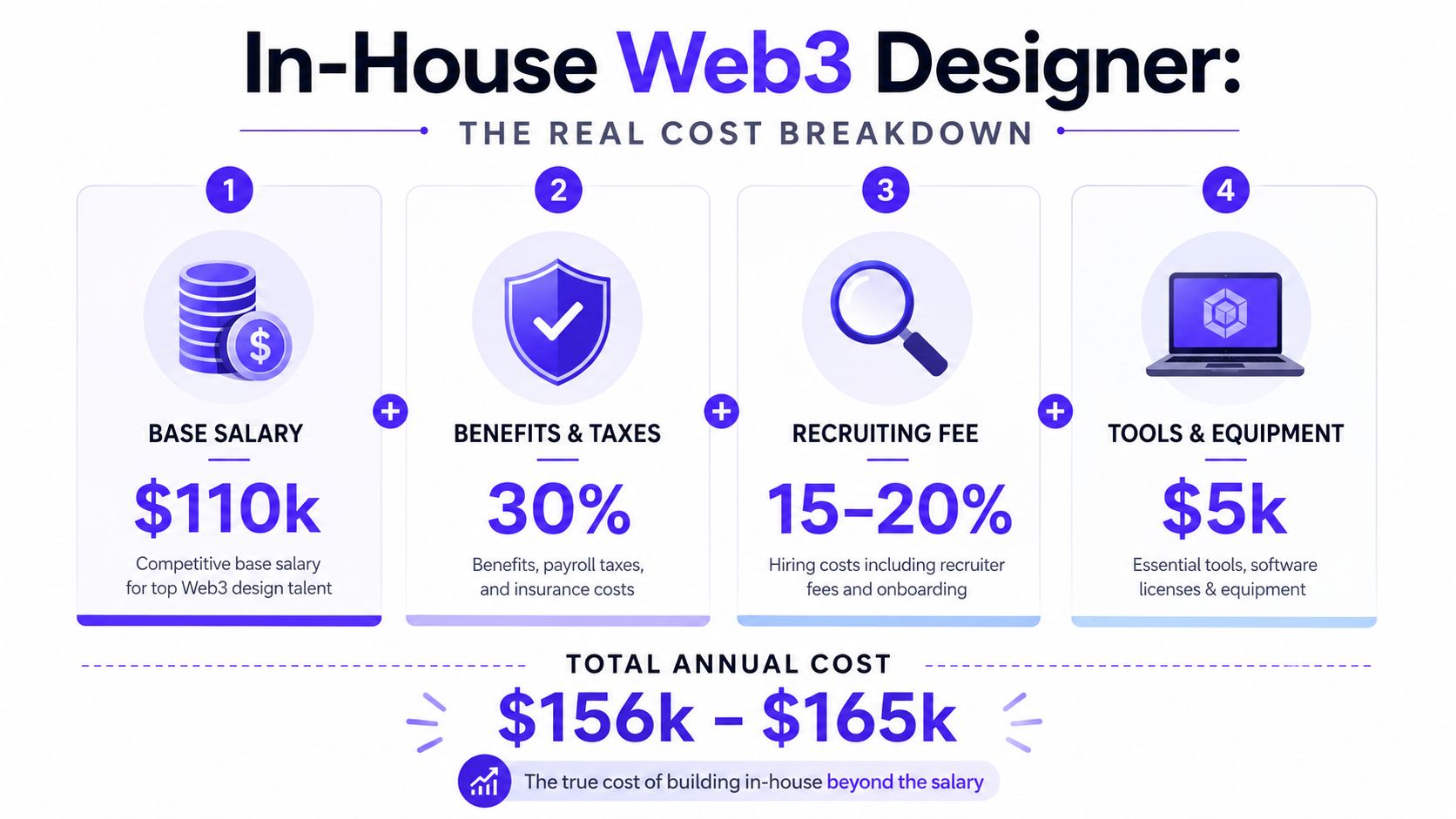
Founders often miss the scope of the job. In a Web3 startup, an in-house designer rarely stays inside one lane. That person gets pulled into product direction, brand cleanup, frontend QA, and founder feedback loops, because the team needs one person to absorb gaps across the stack. That can work if you want a long-term internal function, but it is a slow way to buy specialized coverage when the company is still defining its shape.
What that runway buys you
An in-house hire gives you consistency. The same person learns the product thoroughly, absorbs team context, and becomes a permanent owner of the design language. That matters if your product has recurring design work, a stable roadmap, and enough surface area to keep one person busy without constant context switching.
It is weaker when you need senior judgment across several disciplines at once. A founder who hires too early often ends up with a team that knows the product well but still needs outside help for brand, frontend, or heavier strategic work. That is the expensive middle ground, because you are paying for a seat and still buying outside coverage.
If you want a cleaner frame for what a full internal function costs in a Web3 setting, this Web3 product design cost guide is worth reading before you post the role. For teams trying to keep delivery moving, the guide to streamlining agency workflows is also useful context, because the core issue is not the job title. It is whether one hire can cover wallet activation, onboarding flow, launch assets, and the product work that keeps cohorts from dropping off.
What a Web3 Design Agency Sells You
A good agency is more than a pair of Figma hands. It gives you product design, brand thinking, and frontend delivery in one place. That matters because Web3 founders rarely lose on one isolated design task. They lose when the story, the interface, and the build drift apart, and nobody owns the gap.
Agency pricing usually looks cleaner than the internal cost, which is why the headline number can be misleading. The better comparison is total cost of ownership, not a single rate card. The quote has to be weighed against onboarding, scope control, internal review time, and the work you avoid in recruiting and management. For a broader market view on how teams compare agency and internal cost, this agency versus in-house website cost reference is a useful starting point.
What gets bundled into the engagement
You are usually not buying one specialist. You are buying a working team that can cover interface design, visual identity, and build support without forcing you to coordinate three separate contractors. That is a real advantage for startups with limited management bandwidth.
That bundle matters even more in Web3, where the work stretches across wallet activation, onboarding, token or product launch assets, and the product flows that keep cohorts from dropping off. A decent agency is set up to handle those pieces together instead of passing them between disconnected freelancers.
The source material on outsourcing also notes that agencies can be cheaper than equivalent in-house work once ramp-up time and idle capacity are included. It also says many companies use outside talent or a hybrid model, which tells you this is a standard operating choice, not an edge case. Those points are covered in this in-house versus agency versus freelance web guide.
A founder does not need more meetings. A founder needs one team that can finish the job without creating new handoffs.
That is the core appeal of an agency. The team is already staffed, already used to cross-functional work, and less likely to stall because one missing hire is blocking the rest of the project.
The overhead founders ignore
The agency quote often looks simpler than the internal bill, but the comparison is not quote versus salary. It is quote versus total cost of ownership. That includes onboarding, scope management, internal reviews, and the time you would otherwise spend recruiting and supervising an employee.
The ramp-up penalty matters too. A new in-house hire needs time to learn the product, absorb the company context, and figure out how decisions get made. An agency arrives with that learning curve already paid for across other clients and other launches. That is why Web3 teams often get faster movement at the start of a project, even when the long-term plan still points to an internal design function.
If you want to separate serious partners from polished sales decks, the guide to streamlining agency workflows is useful context because the way an agency runs its work says a lot about whether it can deliver under pressure. The better firms have an operating system, not just a nice pitch.
If you are surveying the market, the short version is simple. The agency is selling delivery capacity, broad skill coverage, and lower execution risk. If you want a tighter list of what to look for, this review of Web3 design agencies is a practical place to start.
Comparing Agency and In-House Side by Side
The comparison gets easier when you stop talking in slogans. Agencies are not automatically better. In-house is not automatically “more strategic.” The decision comes down to where the work sits, how much senior coverage you need, and how much risk you can tolerate if the first hire or first engagement misses.
Agency vs In-House at a Glance
Criterion | Agency | In-House |
|---|---|---|
Total cost | Lower-risk entry point, no full-time overhead | Higher true cost once salary, benefits, recruiting, tools, and management are included |
Time to first shipped work | Usually starts in days and can deliver in 8 to 16 weeks, depending on scope | Hiring and ramp-up stretch the timeline before useful output arrives |
Day-to-day control | Less direct control, but less management burden | More direct control, more internal coordination required |
Web3-specific expertise | Easier to buy senior experience across product, brand, and frontend | Depends heavily on who you hire and what they've already shipped |
Multi-disciplinary coverage | Usually stronger by default | Often fragmented unless you build a larger team |
Strategic distance | Easier to keep an outside view | In-house teams can get too close to the product and lose perspective |
The biggest overlooked point is perspective. In-house teams can get trapped inside the company story. They know every internal debate, every exception, and every founder opinion, which can make it harder to see the product the way a new user sees it. A strong outside partner can cut through that noise and keep the design pointed at conversion, trust, and clarity.
That doesn't mean the agency always wins. It means the better question is not “who designs better?” It's “who can stay strategically distant enough to make good calls while still shipping fast enough for the business?”
The model that wins is the one that matches the complexity of the work, not the ego of the founder.
If you need one person to own a narrow stream of recurring work, in-house can be the right answer. If you need a coordinated push across UX, brand, and frontend, the agency model usually gives you more benefit, especially when the team is still changing shape.
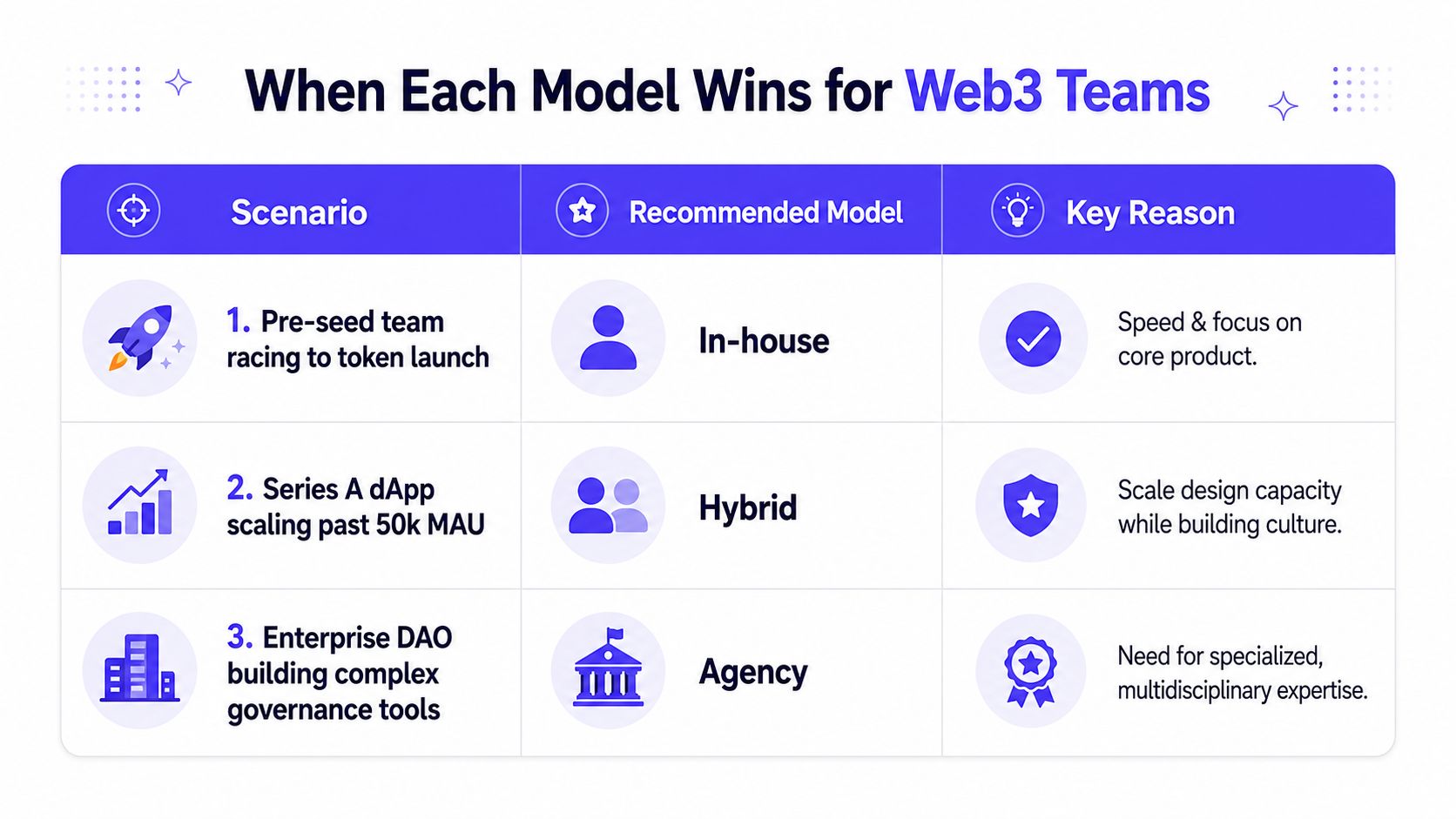
When Each Model Wins for Web3 Teams
A token launch in motion, a dApp that is starting to scale, and a post-Series A company all need different design coverage. The core question is not which model sounds cleaner on paper. It is which setup can handle the work without creating hidden costs in time, hiring, and missed product momentum.
Pre-seed and token launch
If you are pushing toward a token launch or a first public product drop, the agency model usually wins. You need focused execution, fast iteration, and a team that can keep the product page, onboarding, and visual identity aligned without turning launch prep into a recruiting project.
This stage is where total cost of ownership matters most. A founder who hires too early pays for salary, tools, management time, and a ramp-up penalty before the designer can make a real dent in wallet activation or first-week retention. A short agency sprint keeps the fixed cost down and gets you to shipped output faster.
That is also the right moment to test fit instead of making a permanent bet. One hiring guide recommends a 6 to 8 week growth sprint with an agency first when a founder wants to validate fit before hiring in-house, and it frames the first engagement as a test, not a long-term commitment. See this web design hiring guide for the full breakdown.
Scaling dApp or wallet product
Once a dApp or wallet product starts serving a larger user base, the decision shifts. The core product work should stay close to the team, but the agency can absorb overflow, help with a redesign, or handle the brand and frontend pieces that an internal team cannot cover alone.
This model works because Web3 products rarely need only one kind of designer. A wallet flow needs product judgment, onboarding needs conversion thinking, and the launch surface still has to look credible. If your internal team is strong on product but thin on brand or frontend, an agency fills those gaps faster than another round of hiring.
Post-Series A and ongoing design ops
Once the company has several workstreams running at once, design becomes operational. You are no longer shipping one interface. You are keeping product, marketing, and brand aligned while the business keeps moving.
At that point, the right setup depends on coverage, not ego. If the internal team has enough context and bandwidth, in-house can make sense. If it does not, a senior agency partner can sit beside the team and cover the functions that would otherwise require several separate hires. For 925 Studios, that often means one creative partner covering product designer, brand designer, and frontend developer responsibilities in a single engagement.
Checklist for Evaluating Agencies and In-House Hires
Don't evaluate a design choice by vibe. Evaluate it by how much uncertainty you're removing. The checklist is different for agencies and employees, because the risks are different.
If you're looking at an agency
Lock down IP ownership: Make sure the contract says the work belongs to you. If that isn't explicit, don't sign.
Define scope boundaries early: If the partner is designing product, brand, and frontend, get clear on what's included and what isn't.
Set milestones before kickoff: You want visible checkpoints, not one giant black box.
Use a trial sprint first: A 6 to 8 week engagement is a smart way to test fit before you commit long term, especially if the roadmap is still in flux.
If you're comparing how the first engagement should run, this Web3 UX onboarding guide is a useful companion because the first shipped experience often decides whether users ever come back.
If you're hiring in-house
Inspect shipped work, not just portfolios: Ask what they launched, not just what they mocked up.
Plan the 90-day ramp: The role won't be productive on day one, so budget time for onboarding and alignment.
Budget the tooling properly: Software and hardware add real cost, and skipping that creates false savings.
Check whether the hire can span product and brand: A pure screen designer may not be enough if the business needs broader coverage.
The cleanest way to think about it is this. Agencies need contractual clarity. In-house hires need operational patience. If you're missing either one, the model will underperform no matter how good the candidate looks.
Founder rule: if the role needs constant explanation, it's probably too early for a full-time hire.
That's why many teams use agencies first, then hire once the work becomes repetitive enough to justify permanent ownership. It's a rational sequence, not a compromise.
KPIs That Matter for Either Model
Web3 design should never be judged by how polished the homepage looks or how many screens the team shipped. Judge it by whether users activate, transact, and return. The model you choose has to support those outcomes, because every extra handoff, delay, or unclear decision adds cost before product value shows up.
The KPI set that matters most starts with daily active wallets, cost per wallet acquisition, transaction retention rates, and cohort retention at 7, 30, 60, and 90 days. In a wallet-based product, those numbers tell you whether design is pushing users from first visit to first wallet connection, from connection to first transaction, and from first transaction to repeat use. If your onboarding looks good but activated wallets stay flat, the design is not doing its job.
What to track in the first 90 days
If the agency or in-house team says the new design is working, ask what changed in wallet activation. For a DeFi app, that might mean more users connect a wallet and complete a first swap. For a marketplace, it might mean more users finish wallet setup, list an item, or buy on-chain without dropping off midway. If onboarding improved but transaction retention did not move, the problem is probably trust, friction, or unclear next steps.
Raw wallet connections are too shallow on their own. A connected wallet is not the same thing as an activated user. A user can connect, leave, and never come back. Real value comes from repeat action, cohort return, and segment-level behavior, such as whether first-time users come back after their first staking action or their first mint.
A strong team, whether internal or external, should connect design work to on-chain behavior. They should be able to show the path from landing page to wallet connection to transaction to repeat use. If they cannot explain where users drop off in that chain, they are measuring output, not product performance.
Who is better positioned to move the numbers
Agencies usually help fastest when the problem is structural. They can tighten onboarding, clarify the value proposition, and reduce friction across a whole flow in one pass. That matters when the product is losing users before they ever reach a wallet action, because the fix is often spread across the homepage, signup, wallet prompt, and first transaction step.
In-house teams usually have the edge when the insight depends on deep product context and repeated iteration. They see the support tickets, the user questions, the drop-off patterns, and the product roadmap all at once. That makes them better suited to improve specific points in the flow, like a confusing signature request, a weak gas explanation, or a reward screen that fails to bring users back.
The right setup depends on what is broken right now. If the issue is broad and visible, use a partner who can fix the whole surface. If the issue is narrow and keeps repeating, build the capability internally.
Frequently Asked Questions on Web3 Design Hiring
Can I start with an agency and hire later?
Yes, and that's often the smart move. Use the agency to validate the product story, the brand direction, and the first version of the onboarding flow. Once the work becomes repeatable, hire in-house to own the ongoing stream.
What does a realistic agency trial sprint look like?
A solid trial sprint is usually a 6 to 8 week project with a defined scope, clear deliverables, and a checkpoint at the end where you judge both quality and communication. Don't run it like a vague exploration. Give it a real business outcome, then decide whether to extend.
When should I switch from agency to in-house?
Switch when the company has enough repeated design work to justify a permanent owner and the roadmap is stable enough that the role won't spend half its time guessing. If you're still changing positioning every other week, hiring too early just creates overhead.
How do I avoid wasting work if I change models?
Keep everything documented. That means source files, component decisions, content structure, and rationale. If the agency did the first pass, your internal hire should be able to take over without rebuilding the same system from scratch.
Is hybrid actually worth it?
Yes, when the company needs both continuity and surge capacity. Internal teams keep context. Outside teams add bandwidth and senior perspective. That's usually the best answer once the product, brand, and growth needs stop fitting into one person's week.
If you want one partner to cover product design, brand, and frontend without forcing you to build the team first, 925 studios works with AI SaaS, Web3, and Fintech startups that need shipped interfaces, not just concepts. Talk to us if you're deciding between a hire and a partner, and want a clear opinion on which path fits your runway, your roadmap, and your next launch.


Let’s keep in touch.
Discover more about high-performance web design. Follow us on Twitter and Instagram.

