
Design Agency vs Design Subscription: What Fits You?

Yusuf
Founder and lead designer at 925studios

Your product ships. Your marketing team keeps asking for new landing pages. Sales wants a deck that doesn't look like it was assembled in a rush. Meanwhile, the website, the app, and the pitch materials all feel like they came from different companies. That's usually the moment founders realize they don't have a design problem, they have a design operating model problem.
Model | Typical monthly cost | Engagement structure | Best for |
|---|---|---|---|
Design agency | $8,000–$25,000+ per month for B2B work, or $25,000–$250,000+ per project | Project-based or retainer-based, with discovery, scope, revisions, and final delivery | Strategy-heavy work, product redesigns, brand systems, cross-functional ownership |
Design subscription | $3,000–$10,000 per month | Flat monthly access to a queue of design requests, with fast turnaround | Continuous execution, marketing assets, product support, recurring creative output |
If you're deciding between a design agency and a design subscription, don't start with price. Start with the kind of work your startup keeps producing every week.
Table of Contents
The Design Bottleneck Every Funded Startup Hits
The first sign is never a budget line. It's the Slack message that says the deck still isn't ready, the landing page needs another version, and the product flow is blocked because nobody has cleaned up the design system. A founder hires one strong generalist or leans on an overworked marketer, and for a while that holds. Then the company starts shipping more, and the design work multiplies faster than the team can absorb it.
When the surface area grows faster than the team
That's the moment a Seed or Series A founder starts looking at hiring product designers for startups and realizes the issue isn't just headcount. It's coordination. Product needs UX. Marketing needs campaign assets. Sales needs polished collateral. The brand needs consistency across all of it, and each request lands with its own deadline.
Practical rule: if every team is asking for design and each request needs a different skill set, one designer is no longer a strategy. It's a bottleneck.
A lot of founders try to solve this by hiring in-house too early. That can work, but it takes time, money, and management attention. The cleaner move, especially for startups still finding product-market fit or ramping after a round, is to buy senior design capacity without locking into a full internal team.
The real choice founders face
The market splits into two paths. A design agency is built for project work, deeper strategy, and coordinated delivery across brand and product. A design subscription is built for ongoing output, fast request handling, and steady throughput. Both can help, but they solve different problems.
If you need a product redesign, a new visual language, or a major website overhaul, an agency is usually the right shape. If your team needs a steady stream of landing pages, ad creative, decks, and product edits, a subscription model fits the rhythm better. The mistake is forcing one model to do both jobs badly.
The important shift is mental. You're not just buying design, you're choosing how your company wants design to flow. One model is optimized for defined outcomes. The other is optimized for the queue.
How Design Agencies and Design Subscriptions Work
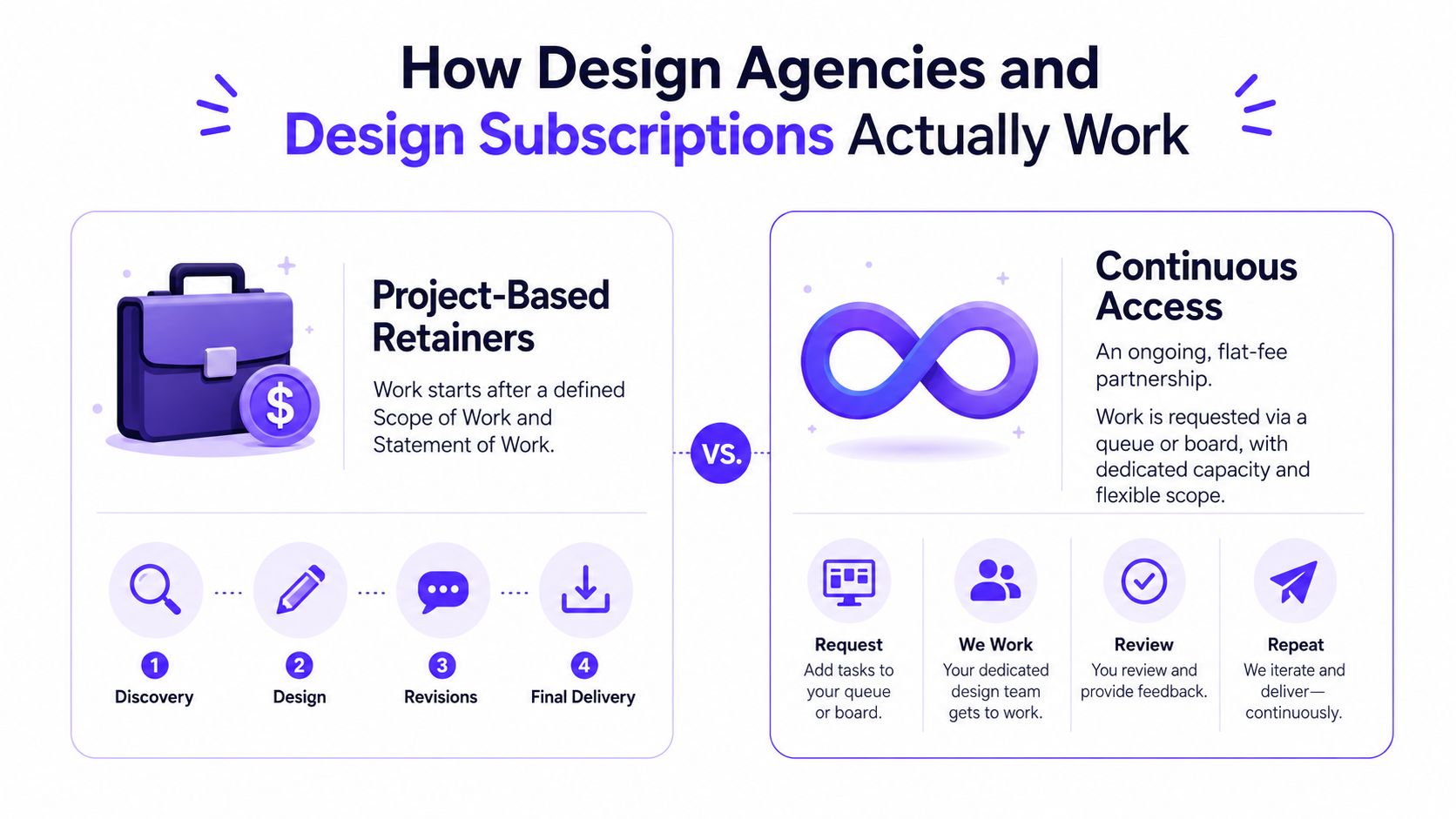
A design agency starts with scope. Discovery, stakeholder calls, a proposal, and a statement of work usually come first, before anyone opens Figma. That gives you clarity on what gets delivered and who owns what. It also adds friction. If the brief shifts halfway through, you are usually back in scope review, timeline review, or both.
Project work versus queued work
A project-based agency engagement is built for a finish line. A common example is an eight-week product redesign, where the team spends the early phase on discovery and scoping, then moves into design, revisions, and final handoff. That structure fits work that needs research, alignment, and shared ownership across functions. It is also why agencies are commonly associated with 8 to 20 week engagements and $10,000–$50,000+ per project in publicly cited pricing ranges (rno1.global).
A design subscription works in the opposite rhythm. You send requests through a shared workspace, the team pulls from a queue, and the work gets handled continuously. Turnaround is often framed as 24 to 48 hours, or 1 to 2 business days, depending on the service (designpal.io), atico3.com. That model is built for repeatable execution, not long discovery cycles.
What changes week to week
With an agency, you are buying a defined engagement and a group of people who can cover research, systems, product design, and implementation planning. With a subscription, you are buying continuous access to design output. The work is narrower, but the throughput is higher.
A subscription only helps if your team can keep the brief clear. If the brief keeps changing, the queue starts to feel like drag instead of forward motion.
If you want a closer look at how this plays out in UX work, the pricing and workflow differences are laid out clearly in this UX agency pricing guide. The short version is simple. Agencies are better when the problem is structural. Subscriptions are better when the problem is volume.
For SaaS teams, that matters because work does not arrive evenly. Product changes, marketing requests, and sales support all come in waves. A subscription handles the waves. An agency handles the rebuild.
Real Costs and Hidden Expenses for Startups
Most founders compare a monthly subscription fee to a project quote and stop there. That is the wrong comparison. You need to compare the invoice, the internal time, the delay cost, and the rework cost. Otherwise, the cheapest-looking option can become the most expensive one.
The choice founders face
Industry comparisons say a design subscription can cost 25% to 60% less than an agency engagement for comparable senior output (designpixil.com). One benchmark puts a subscription plan at roughly $41,000 per year versus $164,000–$213,000 per year for a fully loaded senior product designer hire. The same source cites the specialized design services market at $158.2 billion in 2024 and $229.5 billion by 2029, which points to a broader outsourcing market that is still expanding.
For SaaS-specific comparisons, subscriptions are often placed around $3,000 to $6,000 per month, while agencies are listed at $15,000 to $60,000 per project or $5,000 to $15,000 per month (clearly.design). That spread is real, but the invoice is still only part of the picture.
The hidden costs that blow up the math
A project agency engagement can absorb a lot of internal time before anything ships. Someone on your side has to gather context, review concepts, align stakeholders, and manage approvals. A subscription cuts down on the formal kickoff, but it still needs a disciplined requester who can keep priorities straight. If your team is sloppy, you will pay for it in wasted cycles.
Hidden expense: the wrong model rarely fails on design quality first. It usually fails because your team spends too much time translating business needs into usable briefs.
That is why the cheapest model can cost more in practice. If an agency delivers polished work but misses the fast-moving context of your product team, you will redo parts of it. If a subscription gives you speed but no strategic framing, you will get output that looks fine and underperforms in the market.
For a tighter look at where those hidden costs usually show up in early-stage teams, this breakdown of cheap design tradeoffs is worth reading. The core lesson is blunt. Do not buy only for price. Buy for the shape of the work you need.
Model | Typical Monthly Cost | Engagement Structure | Best For |
|---|---|---|---|
Design agency | $8,000–$25,000+ for B2B monthly retainers, or $25,000–$250,000+ for projects | Defined scope, discovery, revisions, milestone delivery | Product redesigns, brand systems, strategic website work |
Design subscription | $3,000–$10,000 | Flat monthly access, queue-based requests, continuous output | Marketing assets, ongoing product updates, recurring creative needs |
Impact on Product Velocity and Brand Quality
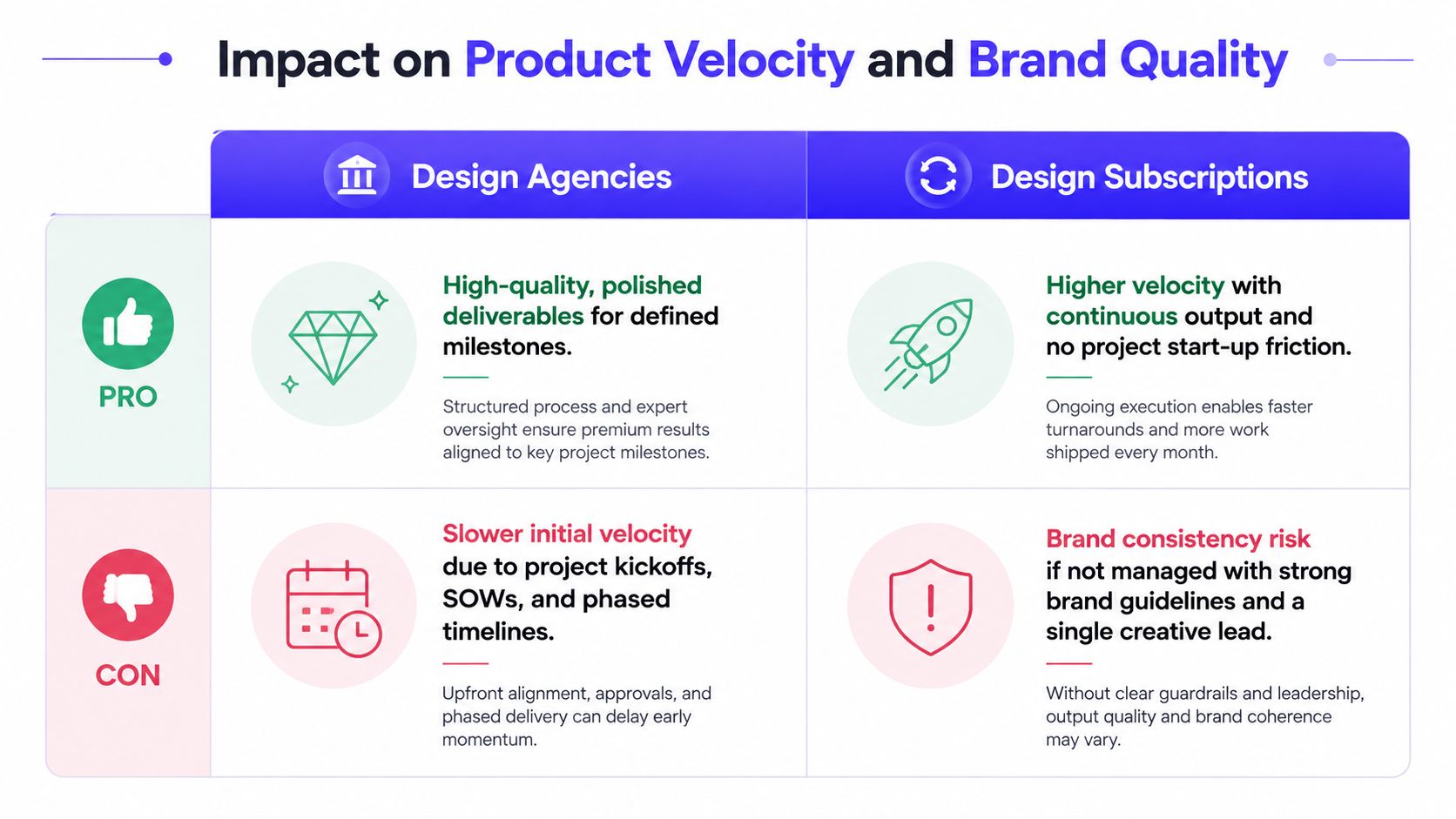
Speed and quality pull against each other less than people think. The core tradeoff is between depth and throughput. Agencies usually win when the work needs judgment, research, and a clean strategic frame. Subscriptions usually win when the team needs more output, more often.
Where agencies raise the ceiling
A fintech redesigning a dashboard doesn't just need prettier screens. It needs the structure of the product to make sense under pressure, especially when users are managing money or compliance-sensitive workflows. That's where agencies tend to shine. They can bring research, systems thinking, and a broader view of how product and brand should work together.
The same is true for a company doing a major site refresh. If the homepage, product, and positioning all need to be aligned, an agency can hold the bigger thread. That's why agencies are usually the right move for work that has a lot of interdependence and not a lot of room for error.
Where subscriptions keep the machine moving
A subscription is the better fit for a Web3 team that needs weekly social assets, a SaaS company iterating on onboarding, or a startup that keeps needing landing-page variants for paid campaigns. It's designed for continuous output. The model is less about big reveals and more about making sure the next request doesn't sit untouched for ten days.
The tradeoff is consistency. If your brand guidelines are thin or your internal direction changes every week, a subscription can drift. The work still gets done, but the surfaces start to feel disconnected unless one person is clearly steering the visual language.
Practical rule: use an agency when the work changes the story. Use a subscription when the story is set and the team needs to ship more of it.
For a product-led startup, that usually means agencies belong on the big bets, product reframe, website overhaul, design system foundations, while subscriptions are better for the steady drumbeat of growth work. If you try to use a subscription to solve a deep positioning problem, you'll get polished output without clarity. If you use an agency for every banner and email, you'll burn budget on the wrong layer.
The right answer is rarely all one or all the other. It's usually split by workstream.
Onboarding and Day-to-Day Collaboration Differences
Agencies make you slow down before they speed up. Subscriptions let you move immediately, but they depend on tighter internal discipline. That difference shows up on day one.
How the first two weeks usually feel
An agency engagement typically opens with kickoff workshops, stakeholder interviews, and a scoping phase. That's useful if you need alignment across product, brand, and leadership, because it pulls assumptions into the open before the work begins. It's also a time cost, and founders often underestimate how much attention they'll have to give before the first real deliverable appears.
A subscription usually feels lighter. You join a shared workspace, post requests, and start getting work back. The model is easier to start, which is why it fits teams that already know what they want and just need reliable execution. For teams trying to structure that setup well, this onboarding guide for UX agency work maps the early collaboration period in a way that's useful even if you don't hire an agency.
What the daily rhythm looks like
With an agency, feedback often runs through a smaller group of people on both sides. That can keep quality high, but it also means the project timeline can get jammed when multiple stakeholders want input. With a subscription, the handoff is usually faster, but the requester has to be much clearer. If the brief is vague, the queue gets messy.
That's also where AI tools can help early-stage teams stay organized. A practical overview of AI tools for early-stage SaaS startups can help founders reduce some of the internal overhead around drafts, structure, and review prep. The design partner still needs human judgment, but the team can do a better job feeding the system.
Managing context without losing momentum
The day-to-day pain point most founders don't talk about is context switching. Agencies ask for more upfront context, then manage the project structure for you. Subscriptions ask for less setup, but they reward teams that can keep priorities clean and stable.
If you have a clear design lead internally, either model can work. If you don't, the choice gets sharper. An agency can absorb more structure. A subscription can absorb more volume. Neither can fix a company that changes direction every three days.
One thing founders should remember is that the collaboration model matters as much as the output model. The wrong process can make good designers look slow and make fast designers look careless.
Decision Checklist for Seed to Series B Teams
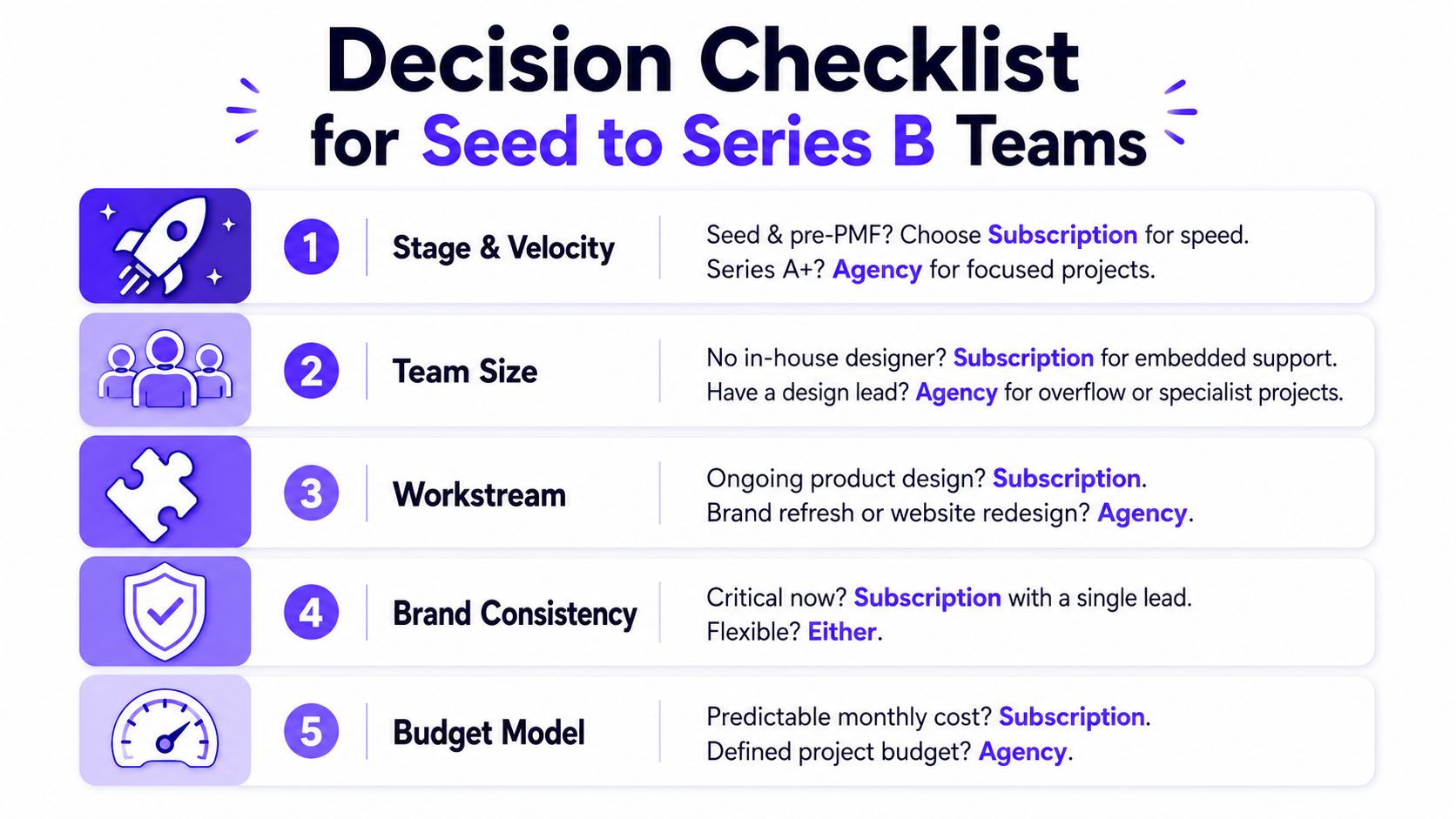
Most startups don't need a philosophical debate. They need a simple decision tree. If the work is strategic, cross-functional, and high-stakes, lean agency or embedded partner. If it's repeatable, tactical, and ongoing, use a subscription. If your company has both kinds of work, split the spend.
The five questions that settle it
Is the work strategic or tactical? If it changes positioning, product structure, or the core experience, that's strategic. If it's a variant, a banner, or an asset update, that's tactical.
Does it need research or cross-functional coordination? If product, marketing, and leadership all need to agree, a project-based model usually fits better.
How fast does it need to ship? If it has to move every week, subscriptions win on flow. If it can live inside a defined project window, an agency is safer.
How important is brand consistency across surfaces? If the company's visual language is still fragile, you need tighter control and a single lead, no matter which model you choose.
What's the budget ceiling? Predictable monthly spend points toward a subscription. A defined project budget points toward an agency.
That framework lines up with the operational split in SaaS, fintech, and AI startups, where product UX, design systems, landing pages, and marketing assets move at different speeds. The question isn't agency versus subscription in the abstract. It's which workstreams should stay strategic and which should move into a production layer (925studios.co).
What the hybrid model looks like in practice
Most articles get lazy here. They pretend the decision has to be binary. It doesn't. A Seed-stage startup can put product discovery and brand foundation into one strategic engagement, then push campaign assets and sales collateral through a subscription. A Series A team can keep product work steady while feeding growth requests into a queue. A Series B team can use a stronger partner for the redesign and keep marketing output moving without rebuilding the whole team.
That hybrid structure is often the cleanest answer for startups that are scaling unevenly. You don't need the same kind of design support for a homepage refresh and a core product workflow. Treat them differently.
Bottom line: don't force one model to carry your whole company. Split the work by type, not by habit.
Recommended Next Steps for Your Design Budget
If you're Seed-stage and just closed funding, put the first serious dollar into the work that shapes how the market sees you and how users understand the product. That usually means brand foundation plus the first wave of product UX. If you're Series A and growth is the pressure point, keep product quality protected and route recurring marketing work into a subscription layer. If you're Series B and planning a major product redesign, use a strategic partner for the heavy lift, then keep the ongoing production work from starving the rest of the team.
A clean way to split the budget
Start with a list of every design request from the last month. Label each one strategic or production. Strategic work includes product direction, system-level design, and anything that needs research or leadership alignment. Production work includes landing pages, ad creative, decks, email graphics, and repeatable updates.
Then make the budget match the list. Put your strongest design partner on the strategic layer. Put your highest-volume recurring work into the production layer. If you only buy one service, you'll either overpay for simple work or underinvest in important work.
925 Studios fits that split because it covers product design, brand identity, and frontend build in one creative partner, which is the kind of setup many funded startups want instead of stitching together three separate hires. It's a practical option when you need one team to carry the work from strategy through shipped pixels.
If you're deciding between a design agency and a design subscription, don't guess. Audit your workstreams this week, sort them by strategic or production value, and assign your budget accordingly. Then talk to a partner who can handle the mix. Visit 925 Studios if you want one embedded team for product, brand, and build instead of juggling disconnected vendors.


Let’s keep in touch.
Discover more about high-performance web design. Follow us on Twitter and Instagram.

