
Fintech Design Cost: What Founders Actually Pay in 2026

Yusuf
Founder and lead designer at 925studios

A fintech UI/UX design engagement usually lands around $20,000 to $50,000, and that's only one slice of a broader build that often totals $80,000 to $300,000+. If you're scoping a wallet, lending flow, or neobank MVP right now, that's the budget reality you should anchor to.
You probably already felt the gap between the first quote and the second. The app looks clean in the pitch deck, then compliance, KYC edge cases, payment integrations, and handoff work show up, and the number stops looking “simple” fast.
Table of Contents
What Fintech Design Really Costs in 2026
A Seed-stage founder usually starts with a clean ask. “We need a polished app, onboarding, and a few core money flows.” The first quote lands at $40,000, and that feels manageable. Then the scope expands to identity checks, failed-verification states, payment rails, compliance reviews, and the number climbs toward $180,000.
That jump is not padding. It happens because fintech design cost is tied to regulated behavior, trust, and error handling, not just screen count. A 2026 estimate puts many fintech builds around $90,000 to $300,000+, with MVPs often budgeted at $80,000 to $150,000, feature-complete platforms at $200,000 to $350,000+, and enterprise systems at $400,000+ when multi-region support and heavier regulatory requirements enter the scope (Cleveroad's 2026 fintech app cost breakdown).
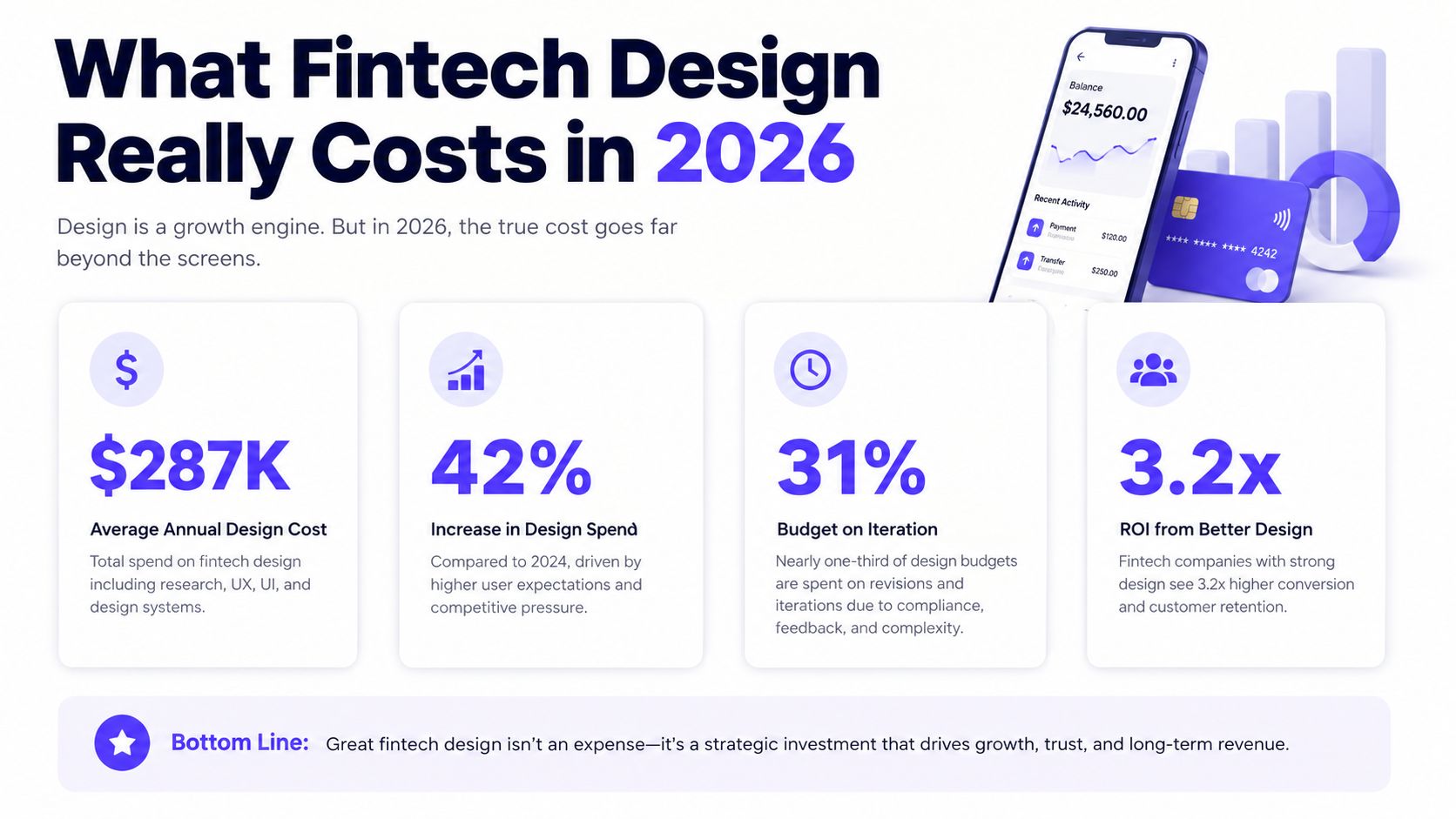
Why the same scope gets two very different quotes
Two teams can scope the same product and return wildly different numbers because one quote includes the hard parts and the other leaves them out. The actual cost sits inside compliance-heavy flows, trust cues, failure states, and the extra design passes needed before engineering can build safely.
Practical rule: if a quote looks cheap, check whether it covers the unhappy path. In fintech, the happy path is the easy part.
That is why design in this category is not a commodity line item. The same cost pressure shows up in other industry breakdowns as well, with compliance, KYC/AML, and security taking a large share of overall spend. Founders feel that pressure first in design, because every recovery state, verification branch, and handoff to engineering has to be resolved before a product can move money or prove identity without friction.
What Fintech Design Actually Covers
Fintech design is much closer to designing a cockpit than designing a poster. A cockpit has visible controls, but the core job is keeping the user safe when conditions change. That's what a solid fintech engagement does, it guides money movement, reduces user mistakes, and gives engineering a blueprint they can ship.
The work behind the screens
A real engagement usually starts with product research and flow mapping, then moves into user journeys for onboarding, transfers, payments, lending, or account setup. It also has to cover KYC screens, trust cues, secure authentication, error states, empty states, and the parts of the experience that only appear when the user gets stuck.
That's the difference between “designing screens” and designing a product. One Faberwork breakdown on from wireframes to final product makes the same point in a broader product context, wireframes, flows, and handoff matter because polished visuals don't rescue a broken structure. In fintech, the structure has to hold up under regulation and user anxiety.
What founders should expect to see in scope
A complete fintech design scope normally includes:
Research and discovery, so the team understands the business rules before drawing screens.
Primary user flows, especially the path from sign-up to first successful transaction.
Error and failed-verification states, because identity checks don't always pass on the first try.
A design system, so new features don't get rebuilt from scratch every time.
Engineering handoff, with annotated states and behavior that developers can ship without guessing.
If a proposal only mentions “Figma files,” it's incomplete. If it doesn't mention edge cases, it's worse than incomplete, it's risky. Fintech users don't judge you on the clean path alone, they judge you on whether the product behaves like it was built by people who expect real-world failure.
The Five Factors That Drive Fintech Design Cost
A cheap-looking fintech product can still be expensive to design. The bill shows up in the places founders overlook, failed verification states, compliance edge cases, third-party handoffs, and the amount of structure needed so users trust the product when something goes wrong. A simple P2P app and a neobank are not the same job, even if the interface style looks similar. One needs a clean send-money flow. The other needs onboarding, account states, card management, transaction history, support surfaces, and many more paths that can break.
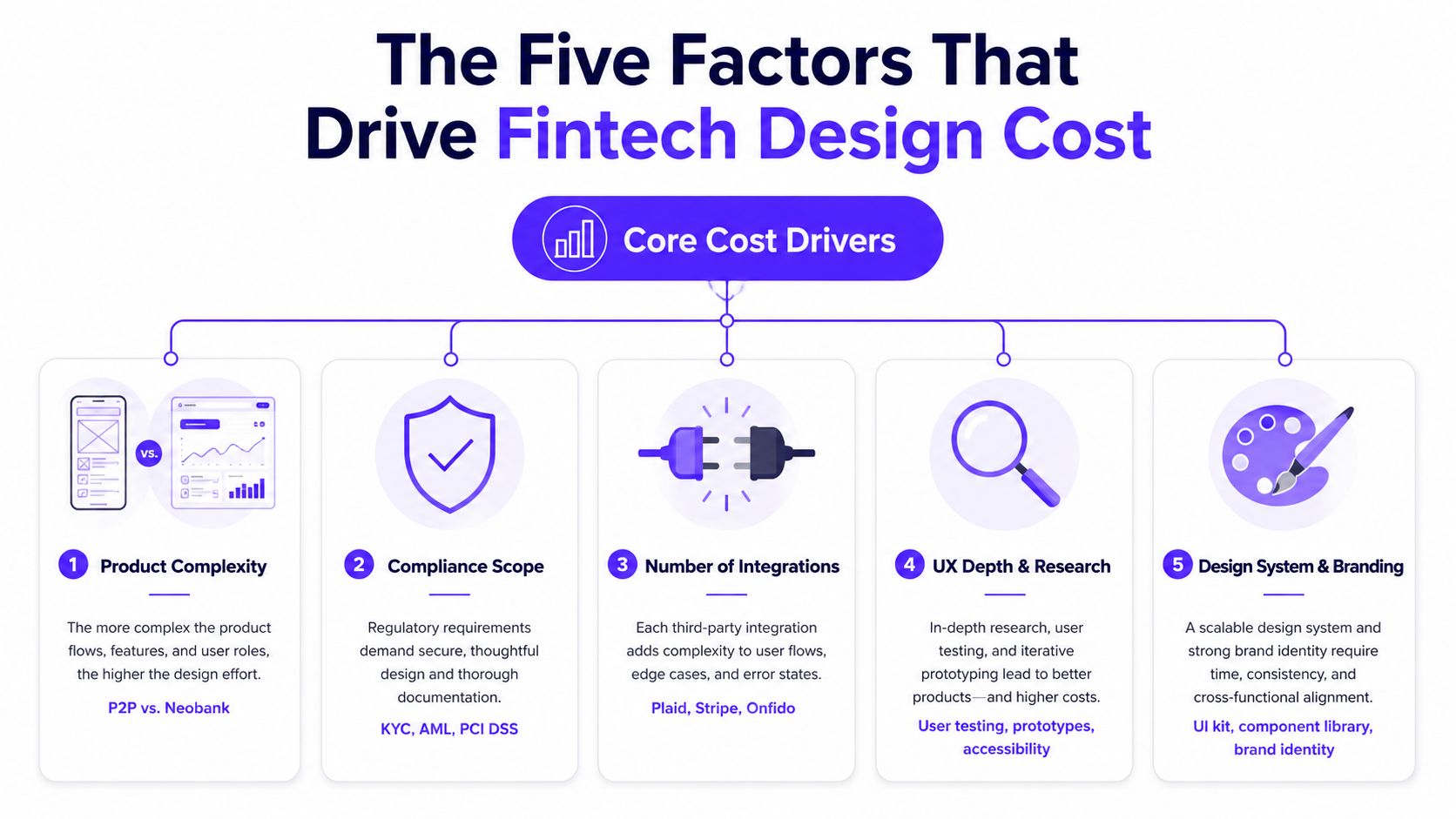
Compliance scope and integrations push the number up fast
Compliance is the biggest hidden multiplier. One budgeting breakdown assigns 15% to 25% of a fintech build to compliance and security (Saigon Technology). Another budget split gives the same 15% to 25% range to compliance and security, with 30% to 35% for backend and API integration and 10% to 15% for design and research (Anything). The point is not the exact percentage. The point is that the design team has to map KYC, AML, and PCI-sensitive flows before anyone signs off on a screen, and that work adds time fast.
Integrations are the other place where quotes drift. A third-party integration can add $20,000 to $60,000 per integration (Fuselab Creative). That cost shows up in design, not just development, because the team has to define vendor states, failure behavior, fallback paths, and the exact experience when a provider stalls or rejects data. If your product depends on Plaid, Stripe, or Onfido-style connections, those edge cases belong in scope from day one.
Research depth and design-system size matter more than founders expect
Research depth changes the budget because regulated products do not survive on assumptions. The more user groups, edge cases, and workflows you need to validate, the more time the team spends on discovery before a screen is final. That is also why experienced fintech product designers often charge $100 to $250 per hour and why focused conversion work, like an onboarding fix, can run $15,000 to $50,000 (WANDR Studio).
Design-system size matters too. A reusable component library, brand rules, and many state variants cost more up front, but they stop every new feature from being rebuilt by hand. That work is not decorative. It protects consistency across the product, reduces rework, and keeps future releases from turning into custom one-off design bills.
Pricing Models and How to Choose One
The pricing model should match how clear your scope is. If you know exactly what has to ship, fixed price is cleanest. If the product is still moving every week, hourly or retainer models are more honest. Outcome-based pricing sounds attractive, but it's rare in fintech because compliance, product risk, and handoff complexity make the brief too fuzzy for many teams.
Fintech Design Pricing Models Compared | Best For | Typical Range | Risk for Founder |
|---|---|---|---|
Fixed price | Narrow scopes like a landing page or onboarding fix | Often used for clearly bounded design work | Scope creep if the product changes midstream |
Retainer | Ongoing product teams that need steady design throughput | Better fit for continuous delivery than a one-off quote | Paying for capacity you don't fully use |
Hourly | Discovery, research, and early problem-solving | Useful when scope is still forming | Budget drift if decisions are slow |
Outcome-based | Redesigns tied tightly to a business metric | Rare in regulated fintech work | Hard to define fairly before launch |
If you want a cleaner breakdown of engagement structures, the ux agency pricing models explained article is a useful companion. It's worth comparing model choice before you compare studio rates, because the wrong model makes any price look expensive.
For budgeting context outside design, the contextual phrase 2 article from Jumpstart Partners is a decent reminder that pricing only makes sense when the scope is specific. The same logic applies here, vague scope always inflates risk.
Sample Budgets by Stage and Product Type
A Seed team shipping a payment product should not budget like a Series B neobank. The scope, the compliance load, and the number of handoffs are different. A thin product can survive with a tighter design brief. A regulated platform cannot.
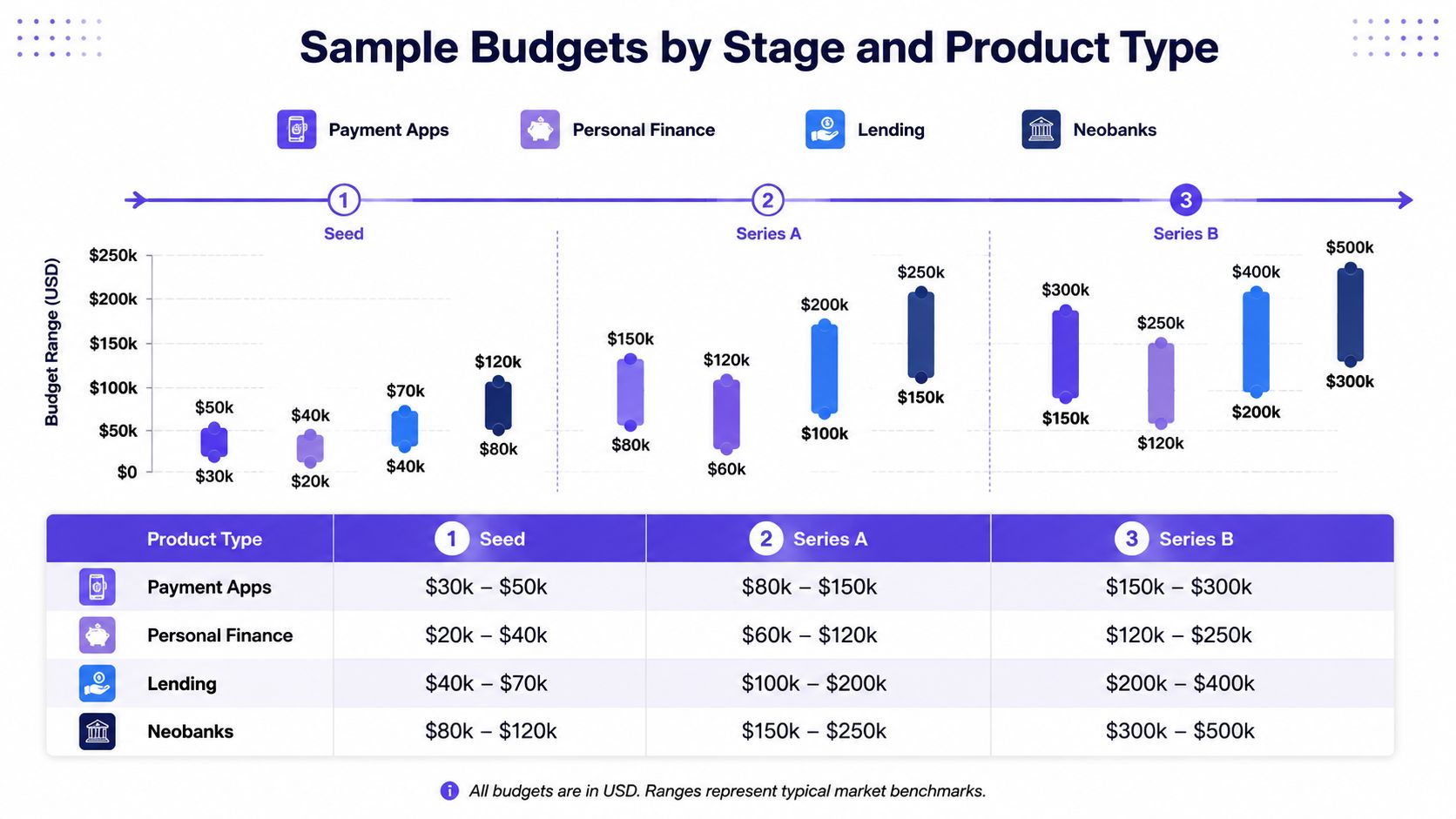
Stage matters because the hidden work expands fast. Seed budgets usually buy the first trust layer, onboarding, a core transaction flow, and a small set of failure states. Series A starts adding more verification branches, support states, and internal review screens. By Series B, the design budget often shifts toward system consistency, vendor coordination, and edge-case coverage that never shows up in a glossy pitch deck. If you are comparing design-only quotes against full delivery estimates, the gap gets obvious once compliance, banking rails, and implementation handoffs enter the brief.
A 2026 guide from Palmidos says fintech app development can start at $80,000 for a thin payments wrapper and rise to $2.5M+ for a regulated neobank, with many projects falling in the $300K to $900K MVP range. The same guide says another 25% to 40% is often added for compliance and banking line items that early quotes leave out. TechExactly places a fintech MVP at $50,000 to $90,000 and a production-ready app with PCI DSS and KYC/AML at $150,000 to $300,000+. Treat those ranges as a warning, not a target. Once verification fails, a bank API breaks, or a compliance reviewer asks for an extra state, the budget moves quickly.
Budget ranges by product type
Product type | Typical budget range | What usually drives it |
|---|---|---|
Payment or P2P transfer apps | $50,000 to $120,000 | Straightforward money movement, but still needs strong trust and failure handling |
Personal finance apps | $40,000 to $100,000 | Budgeting views, data display, and simpler compliance load |
Lending apps | $80,000 to $200,000 | More forms, more decision states, more verification logic |
Neobanks | $150,000 to $350,000 | Full account lifecycle, deeper compliance, and many more edge cases |
A practical saas ui ux design cost budget guide makes the same point from a different angle. Interface work and product build work need to be planned together, or the handoff cost shows up later. In fintech, that cost is higher because a screen decision affects trust, compliance, and engineering effort at the same time.
A Seed-stage P2P app can stay near the lower end if the first release stays narrow. A Series A lending platform needs more states, more review steps, and clearer proof that users understand what they are agreeing to. The visible UI may look similar on day one. The budget does not.
The Hidden Costs Most Quotes Leave Out
A polished happy path is cheap to design. The budget climbs when you price the messy parts, failed verification, fallback states, vendor handoffs, and the review steps that keep a fintech product usable when something breaks.
Failed states cost more than founders think
KYC is the clearest example. A studio can mock up a clean identity-check screen quickly, but the harder work shows up when the document is rejected, the selfie does not match, the address cannot be verified, or the user drops off halfway through. One agency pricing guide explicitly recommends asking for a walkthrough of a shipped KYC flow that includes the failed-verification state, and that is the right question to ask every vendor you interview (Fuselab Creative).
Accessibility gets underquoted too. If the product has to work across low-bandwidth states, screen readers, and inconsistent device quality, the design work gets harder, not easier. The same is true when your audience includes first-time users or customers with fragmented identity proofing, because the happy path is not the only path that matters.
Ask vendors which screens are included, then ask which failure states are missing. The missing list usually tells you more than the headline price.
Vendor management and subcontracting are real budget items
Third-party integrations are not just a development concern. They affect design because every provider brings its own rules, edge states, and branding constraints. If an agency is outsourcing parts of the work, you need to know who owns what, who handles revisions, and who is responsible when a flow does not line up between design and implementation.
The same pricing guide notes that reputable offshore firms can quote $15,000 to $60,000, while a US-based banking UX agency project typically runs $50,000 to $200,000 (Fuselab Creative). The price gap is not just geography. It usually reflects research depth, QA, compliance awareness, and how much of the ugly edge-case work is included.
Design-only budgets hide delivery risk
A design-only quote can look cheap and still leave you exposed. If the team stops at static screens, someone else has to translate those decisions into behavior, states, and developer-ready logic. That handoff is where a lot of teams lose money.
Full delivery budgets cover more than visuals. They include the decisions that make the product shippable, the state mapping, the interaction rules, the review cycles, and the back-and-forth that keeps compliance, product, and engineering aligned. That is why a narrow quote often becomes a wider spend once the work reaches implementation.
For founders comparing options, this note on the hidden cost of cheap design for startups is worth reading before you sign anything. It explains why a low sticker price often leaves out the work that keeps fintech products from breaking in production.
How to Lower Cost Without Sacrificing Quality
The fastest way to waste money is to design too much too early. Start with the smallest product that proves users trust you and can move money safely. Anything else is decoration until that's true.
Cut scope, not standards
Reuse an existing design system instead of inventing a custom component library on day one. That saves time on both design and implementation, and it keeps the product from turning into a one-off build that nobody can extend cleanly later. If you're choosing between a custom rewards layer and a solid onboarding flow, ship the onboarding flow first.
Bundle design and frontend with one partner when you can. That reduces handoff friction, duplicate decision-making, and the kind of rework that comes from a designer handing static screens to a developer who has to infer behavior. For startups that need one creative partner across product design, brand, and frontend, 925 Studios fits that model in practical terms, it covers the work a founder usually ends up splitting across three hires.
Spend early on the right kind of research
Run lightweight research with real users before expensive screens are locked. A small amount of early discovery usually protects a much larger build budget later, because you catch confusing flows before they turn into compounding revisions. That's especially true in fintech, where a bad assumption about trust or verification gets expensive fast.
For founders comparing budget and investment timing, the small business technology investment boost explained piece is a useful reference point. The takeaway is simple, smart spending is about sequencing, not just cutting.
You can also defer non-core features to phase two. Rewards, referrals, and polished extras make sense only after the core money movement and compliance path is working. If you need to push back on a vendor quote, push back on the features that don't help someone sign up, verify, and transact safely.
A Short Checklist to Estimate Your Fintech Design Budget
Before you ask for quotes, write down five things, scope clarity, compliance requirements, integration count, design system needs, and timeline. Then decide which pricing model matches that reality, fixed price, retainer, or hourly. If the scope isn't clear, the quote won't be either.
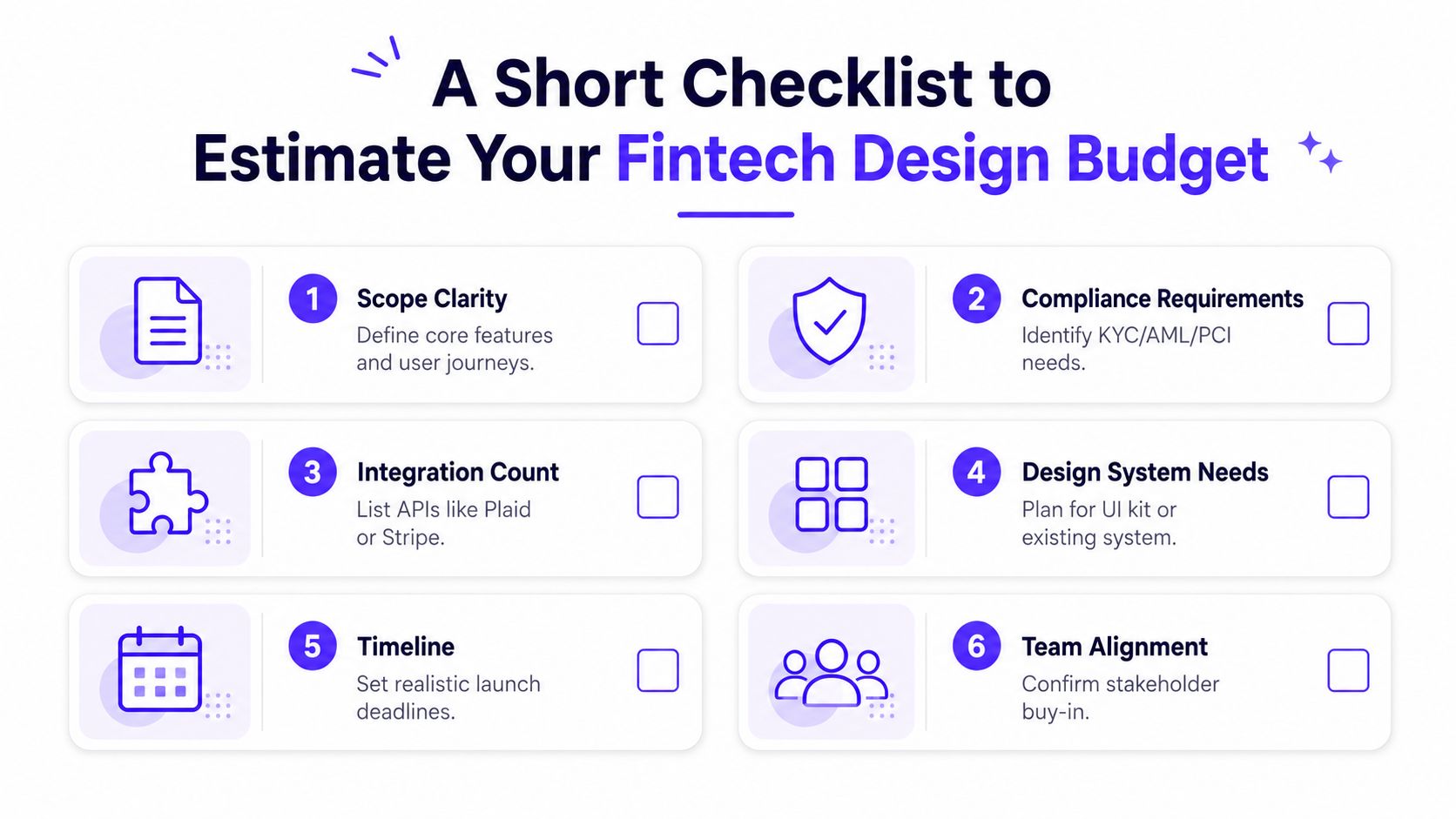
The smartest next step is to define the smallest version of the product that proves trust and handles money safely, then scope design from there. If you want one partner that can cover product design, brand, and frontend without forcing you to coordinate three separate hires, 925 Studios is built for that kind of engagement.
If you're scoping a fintech product and want a direct, no-fluff estimate, talk to 925 Studios. We'll help you define the smallest trustworthy version of the product, map the design work to the build, and tell you where the money goes. Start at 925 Studios and bring the rough scope you have today.


Let’s keep in touch.
Discover more about high-performance web design. Follow us on Twitter and Instagram.

