AI Website Builder vs Design Agency for Funded Startups

Yusuf
Founder and lead designer at 925studios

A Seed to Series B founder can launch an AI site in under 30 minutes for roughly $0 to $30 a month, or pay $5,000 to $50,000+ for a design agency build that usually takes 6 to 8 weeks. The right answer is almost never either/or, it's deciding which pages can be commoditized and which ones have to carry trust, pipeline, and credibility.
Table of Contents
The Core Choice Founders Are Facing in 2026
A founder in fintech, AI SaaS, or Web3 is usually not choosing between “good” and “bad” websites. The decision is more specific. You are deciding which surfaces can be treated as standard and which ones have to carry fundraising conversations, sales qualification, and first-pass credibility in a market where buyers dismiss weak signals fast.
A homepage is the first test. A pricing page is the second. A product page sits somewhere in between. If any of those pages looks generic, rushed, or misaligned with the business, the company itself can feel less credible than it is.
That matters most in crowded categories. AI SaaS, Web3, and fintech all force buyers to compare quickly and distrust easily. In those markets, the site is not a brochure. It is part of the pitch.
A template-heavy AI build can be fine for pages that just need to exist. A serious founder should be more selective about the pages that face investors, prospects, and partners. Those pages have a higher cost when they miss, because they shape how the company is judged before a conversation even starts.
The comparison gets sharper at execution time. Published comparison data shows AI website builders can produce a functional site in under 30 minutes or within hours to a day, while agency projects typically take 4 to 8 weeks or 6 to 8 weeks and often cost $5,000 to $50,000+ depending on scope, with agencies usually chosen for custom conversion architecture, brand differentiation, and technical SEO, while AI builders are optimized for speed and low upfront cost (comparison data on AI builders and agencies).
That gap matters because the cheapest option is rarely the expensive part. The expensive part is a homepage that makes a funded startup look early, a pricing page that weakens demo requests, or a product site that fails to support the story you need to tell.
Page ownership is the right question
Founders keep asking whether they should use a builder or hire an agency. The better question is which pages can be standardized without hurting the business, and which pages need to do real work for trust and conversion.
Low-stakes pages can often live on the fast, inexpensive side. Internal drafts, throwaway campaign pages, and temporary content do not need heavy treatment. Public-facing pages that influence investor perception, buyer confidence, or sales motion are different. Those pages should be judged by the consequence of a miss, not by how easy they are to ship.
That is the cut founders need to make. Use speed where the site is mostly functional. Spend real attention where the site has to stand in for the company, especially in markets where credibility is part of the buying decision from day one.
How AI Builders and Agencies Actually Compare
The AI builder market is growing fast, but growth doesn't mean replacement. The global AI website builder market is projected to reach $3.24 billion in 2026, up from $2.69 billion in 2025, and is forecast to grow to $17.43 billion by 2035 at a 20.55% CAGR (market projection). That tells you the category is scaling as a cheaper, faster option, not that it's automatically the right answer for a funded startup.
The tradeoffs that actually matter
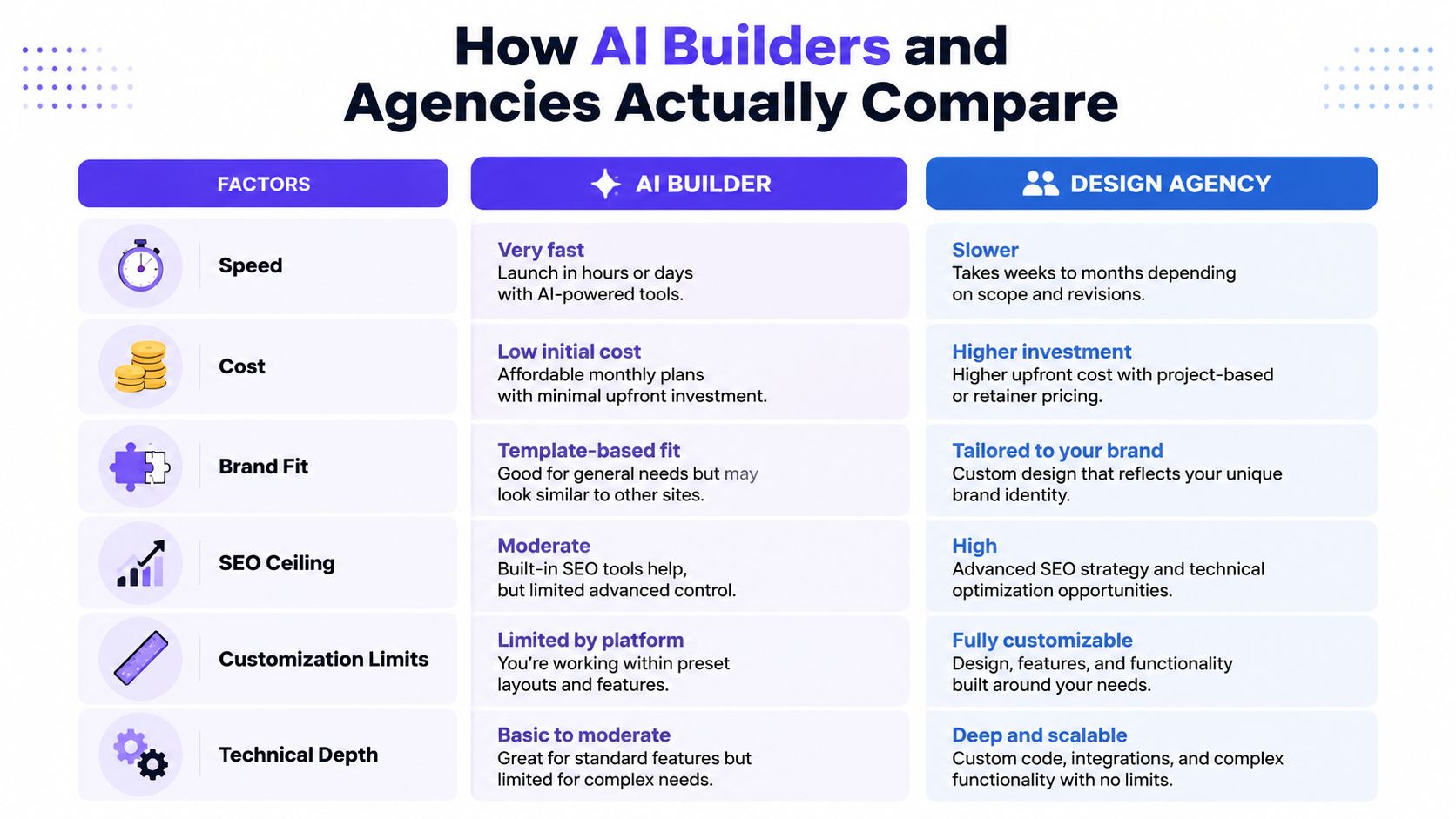
AI builders win when the job is fast, narrow, and disposable enough to iterate. Agencies win when the site has to hold up under scrutiny, support custom behavior, or fit a real sales motion. The divide isn't “good versus bad,” it's “good enough for this page versus worth building properly.”
One comparison noted an AI builder reached an LCP under 2.5 seconds in a tested setup, while the same source set and related reviews describe AI sites as limited in schema, advanced SEO structure, and custom functionality, whereas agency-built static or custom sites are commonly described as capable of 95+ performance scores across audit categories and full technical tuning (performance comparison). That's enough to know the ceiling isn't the same.
Read the comparison like a founder
AI builders are strong when you need a fast launch, a low monthly bill, and a page that can be edited without slowing the team down. Agencies are stronger when you need a sharp visual system, deeper site structure, or a build that maps cleanly to CRM flows, lead routing, and search strategy. That's why the agency model still exists, despite the rise of AI tools.
Here's the part most comparisons skip. The market is expanding, but category growth doesn't erase the work of making a homepage credible, a pricing page legible, or a product story distinct. A faster tool can still produce the wrong page.
If the page is going to be compared against competitors, or used by sales, don't optimize for launch alone. Optimize for trust.
What AI Website Builders Do Well and Where They Break
AI builders are useful when the ask is simple and the pressure is low. They're good at getting a landing page up fast, testing headlines, and giving a founder something real to share before the deck, ads, or product story are fully settled. That's a legitimate advantage, and it's why the category keeps pulling in demand.
Where they shine
AI builders are strong for speedy launch, fast copy experiments, and simple marketing surfaces. They're also a decent fit when you need to validate a message, test an offer, or put a temporary page in front of traffic without burning agency budget. For an early-stage company, that's often enough.
They're also useful when the page isn't trying to do much beyond capture attention and hand off a lead. If you're launching a single-purpose page for a waitlist, event, or simple campaign, an AI builder can be the right tool. A good example of this kind of focused page is the lead generation approach in Breaker builds lead generation sites, which is a useful reference if you're thinking about narrow conversion surfaces instead of a full brand system.
Where they break
They break when the job gets specific. A fintech pricing page with real packaging logic, a SaaS homepage that needs to speak to multiple buyers, or a Web3 site that has to project credibility under scrutiny can't live on generic structure for long. AI builders also struggle when the site needs advanced schema, deeper SEO structure, or integrations that don't fit neatly into a platform's default setup.
The other failure mode is sameness. An AI-generated homepage can look polished and still read like every competitor in the category. That's a bad trade if you're trying to stand out to investors, buyers, or partners who've already seen ten similar companies this week.
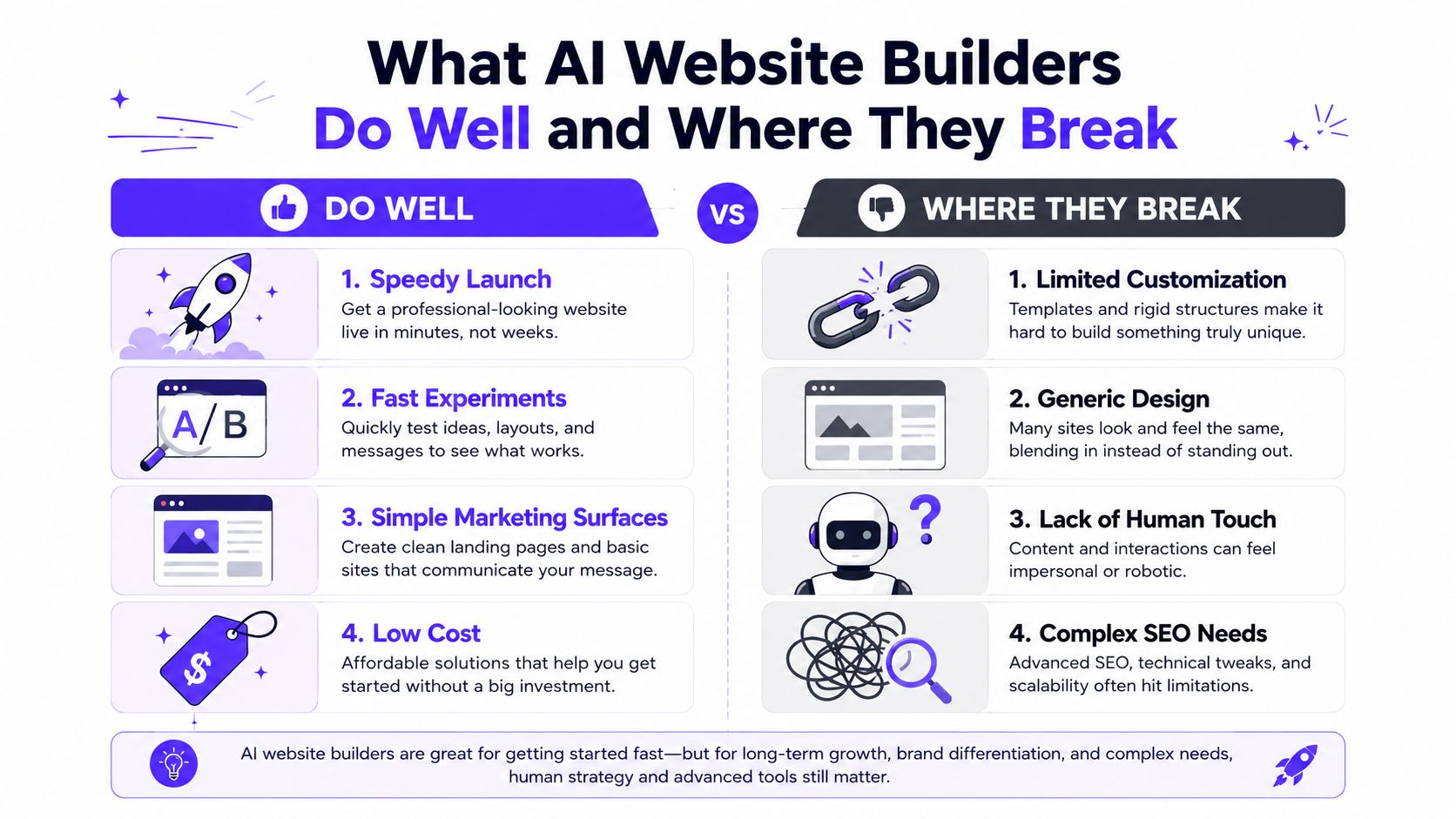
A good shortcut is to assign AI only to surfaces where “functional” is enough. The moment the page has to explain a category, defend a price, or make your company look inevitable, the tool starts to matter less than the strategy behind it.
What a Design Agency Actually Delivers for a Funded Startup
A design agency is not just a slower way to get a website. For a Seed to Series B team, it's usually one creative partner that replaces three hires, a product designer, a brand designer, and a frontend developer. That matters because funded startups don't just need pages, they need a visual system, a conversion plan, and code that won't collapse when the team starts scaling.
What the engagement usually includes
A good engagement starts with discovery, not mockups. The team defines the ICP, the sales motion, the message hierarchy, and the pages that matter most. Then the work moves into design, where the homepage, product UI, and supporting system get shaped together so the brand feels coherent instead of stitched together.
The build phase matters just as much. A real agency doesn't hand you pretty comps and disappear, it ships clean front-end work tuned for SEO, performance, and conversion. That's the difference between a design exercise and a shipped asset the team can use.
For founders comparing outside help, the 925 Studios guide on when to hire a design agency for a startup is a useful reference point because it frames the work as a product and brand problem, not just a visual refresh.
What agencies do that AI tools usually can't
AI tools can draft surfaces, but they don't think through your market position. A strong agency maps the homepage to the actual ICP, builds a visual language that can survive competitor comparison, and structures the site around the sales motion instead of a generic template. That's especially important when the homepage has to support fundraising, sales qualification, and credibility in a crowded category.
The best teams also leave with something reusable. A design system and a codebase that match the brand let the startup extend the site without rebuilding from scratch every time the messaging changes. If you're working with a partner that understands startup pressure, the site should come out of the engagement stronger, not just prettier.
One practical note. Agencies are also the better fit when you need a team that can think about outreach and pipeline together, including tools like AI outreach for agencies that support the broader growth motion around the site. That's not the site itself, but it's part of the same operating reality.
The Hidden Cost of Choosing the Cheap Option
The cheapest website is the one that never has to prove itself. The moment the site has to convert, rank, explain, or reassure, the sticker price stops being the full cost. That's why the question isn't just whether the AI option is cheaper, it's when cheap turns expensive.
When rebuilds cost more than the first build
A weak homepage doesn't just look off. It can weaken sales qualification, make paid traffic less efficient, and force the team to explain things manually that the website should've made clear. If the messaging is generic, the design feels templated, or the page can't support the actual funnel, the company pays for that in missed opportunities, not just frustration.
That's the hidden cost a neutral source points to when it asks when the “cheap” option becomes expensive, especially once conversion, SEO, integrations, or compliance matter (comparison on hidden costs). For funded AI SaaS, fintech, and Web3 teams, that question isn't academic. If the site underperforms, the business eats the cost through slower pipeline and more internal rework.
The rebuild tax is real
If you launch a generic site and then try to fix it after a funding round, you're usually paying twice. First you pay for the initial build, then you pay again to rethink the structure, rewrite the copy, and rebuild the design system around a more serious brand. The second pass is almost always more expensive because now the team has to undo decisions instead of making the right ones.
This guide on the hidden cost of cheap design for startups is worth reading if you're trying to put a real business frame around design spend. It's the right lens for founders who care less about aesthetics and more about what breaks when the site doesn't support the sales motion.
Founder rule: if the page is central to revenue, don't buy the cheapest version and hope to upgrade later. That usually becomes the most expensive version.
The practical takeaway is simple. Cheap is fine for throwaway pages, temporary experiments, and surfaces with low trust requirements. It gets expensive fast when the page is supposed to help you close, qualify, or raise.
The Hybrid Operating Model That Actually Works
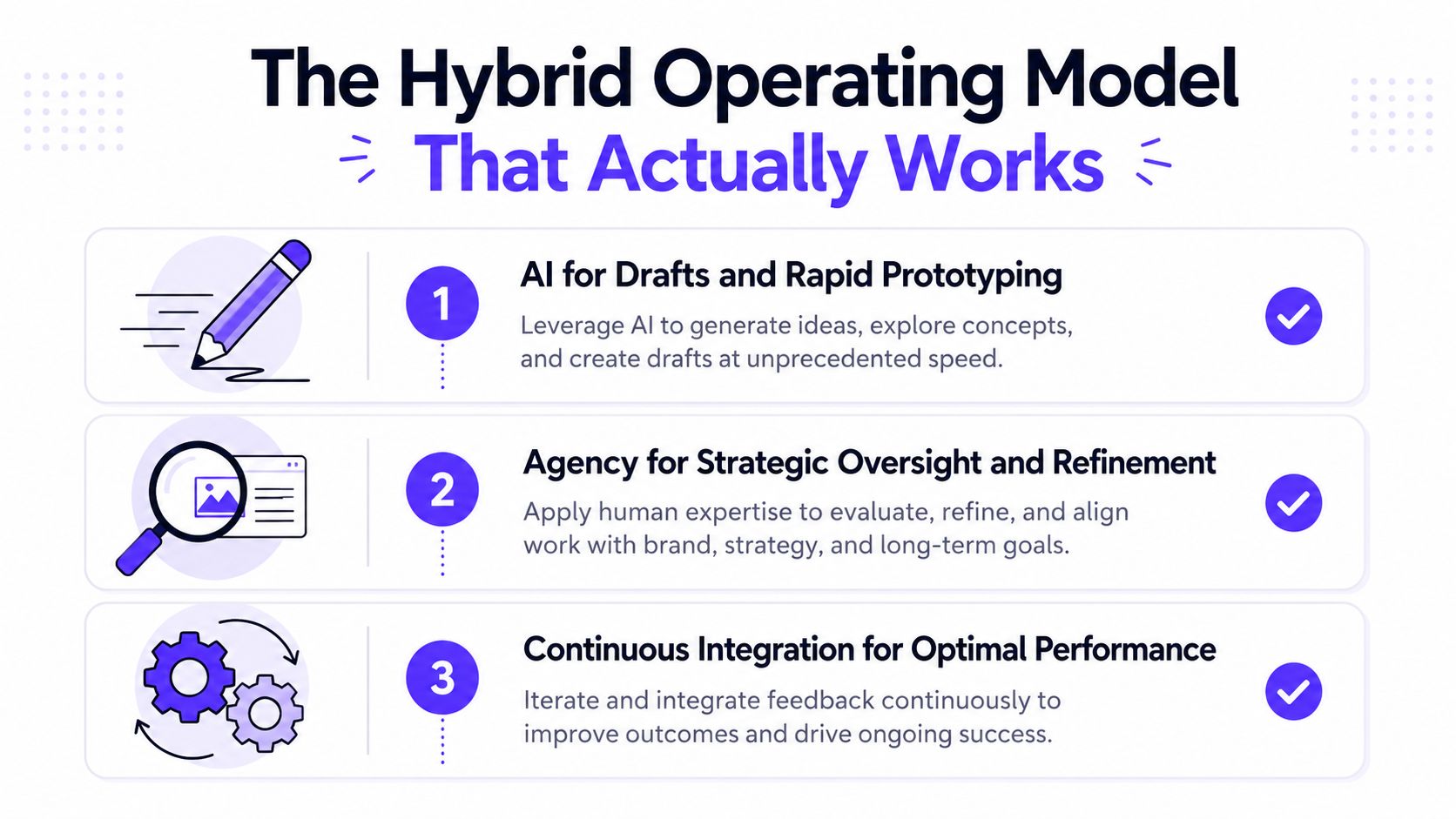
The smartest teams don't pick one side and pretend the tradeoff disappears. They split the work. AI builders handle the low-risk, fast-turn surfaces, and a studio handles the parts of the site that carry trust, differentiation, and conversion pressure. That's the operating model that best fits a growing startup.
What goes where
Use AI for drafts, internal pages, blog experiments, and simple landing pages. Those surfaces are good candidates for speed because they're meant to test an idea or support a narrow job. Don't spend agency money on pages that will be replaced next month.
Use a studio for the public homepage, product UI, brand identity, design system, and any page tied directly to conversion. If a page influences fundraising conversations, sales qualification, or partner confidence, it deserves human strategy. That's where a partner like 925 Studios fits, because it combines website design and development, product design, and brand work in one place rather than forcing you to coordinate separate hires.
A page-by-page assignment checklist
Public homepage: studio, because this is the company's first credibility test.
Pricing page: studio if the pricing is nuanced, AI if it's a temporary placeholder.
Blog or resource hub: AI, if the structure is simple and the goal is volume.
Internal docs or temporary campaign pages: AI, because speed matters more than polish.
Product UI or onboarding flow: studio, since this affects activation and retention.
Lead capture pages: either one, depending on whether the offer is generic or strategic.
The workflow matters too. Draft fast with AI, then hand the strongest version to a designer who can tighten the hierarchy, clean up the visual system, and make sure the site feels like one company across every surface. For teams building from Figma into a live site, this Figma to live website AI workflow is a practical bridge between quick exploration and polished execution.
The video below is a good mental model for how the hybrid process should feel, quick draft first, human refinement second, then a clean handoff into production.
Page or Surface | Recommended Owner | Why |
|---|---|---|
Public homepage | Studio | It carries credibility, positioning, and first-impression risk |
Pricing page | Studio | Packaging logic and conversion clarity matter here |
Blog content | AI | Simple structure and volume work well with automation |
Internal experiments | AI | Low-stakes, fast, and easy to replace |
Product UI | Studio | It affects retention, trust, and usability |
Campaign landing pages | AI or Studio | Depends on whether the offer is temporary or strategic |
Three Startup Scenarios and the Right Call for Each
The answer changes with stage. A pre-seed team doesn't need the same level of polish as a Series B company going into a public launch, and a Web3 brand with reputation risk has a different bar than a founder testing a wedge.
Pre-seed AI SaaS validating a wedge
If the company is still validating the message, use AI first. You want the page live, the offer clear, and the feedback loop short. A light design polish is enough if the goal is to learn, not to impress.
Series A fintech with compliance pressure
In these situations, the argument for an agency strengthens. A fintech launch needs trust signals, a clear product story, and a page structure that won't fall apart under scrutiny. If the site has to support compliance conversations, the homepage and product UI should be handled by a studio, not a template-first workflow.
Series B Web3 company outgrowing a template
This is the classic hybrid case. The company probably has enough traction to justify a serious brand refresh, but still needs fast iteration on lower-stakes surfaces. Use AI for internal content and campaign pages, then put the homepage, core product story, and design system into a proper studio engagement.
If the site has to help you raise, close, or recover trust, treat it like a company asset, not a marketing afterthought.
The pattern is simple. AI is fine when the page is temporary or low-stakes. Agency work is worth it when the page has to carry weight in the market. Hybrid is the right call when both are true at the same time.
How to Decide and What to Ask Before You Spend
Start with four questions. Where does this site sit in the funnel, who owns it after launch, what's the rebuild cost if it fails, and what does the brand need to survive side-by-side comparison with competitors? If you can't answer those clearly, you're not ready to buy.
A short decision checklist
Assess business goals. Speed matters for experiments, uniqueness matters for trust-heavy pages.
Evaluate budget. Think about upfront cost and the ongoing cost of fixing the wrong choice later.
Consider scalability. If the site has to grow with SEO, integrations, or a changing product story, don't trap yourself in a brittle setup.
Check page importance. The homepage and pricing page deserve more care than a throwaway campaign asset.
FAQ
Can AI handle complex integrations? Not well when the stack gets specific. Simple forms and common plugins are fine, but custom CRM routing, product logic, and regulated workflows are where agencies or developers earn their keep.
What defines good brand fit? The site should look like the company you want buyers to trust, not just a clean layout. If it could belong to five competitors, it's too generic.

If your homepage, product UI, or launch site needs to do more than look finished, 925 Studios can handle the design, build, and brand work in one place. We help AI SaaS, Web3, and fintech teams decide which pages can be commoditized and which ones need a stronger hand, then turn that into a site that supports the business. Visit 925 studios if you want a creative partner that can replace scattered hires with one focused team.


Let’s keep in touch.
Discover more about high-performance web design. Follow us on Twitter and Instagram.