What Is Design Strategy: Connect Business to Product

Yusuf
Founder and lead designer at 925studios

Design strategy is the plan that connects a product's design to business goals and user needs, and it can produce outsized financial returns when teams treat it like a business system instead of decoration. Every $1 invested in UX design can yield $100 in return, a 9,900% ROI, which is why design strategy belongs in growth conversations, not just design reviews.
The most popular startup advice on this topic is wrong. Shipping more features isn't a strategy. It's activity.
Founders in AI SaaS, Web3, and Fintech hear the same drumbeat early on. Move fast. Launch the next feature. Keep the roadmap full. But a busy team can still build the wrong thing, explain it poorly, and lose users who never reached the point of value. A product can look modern, have a strong tech stack, and still fail because nobody made the connection between what the company needs to achieve and what the customer needs to feel, understand, and do.
That's where design strategy changes the game. It doesn't slow product teams down. It stops them from wasting cycles.
If product design is the work of shaping screens, flows, and interactions, design strategy is the work of deciding what those screens and flows must accomplish for the business. For a founder, that means fewer random bets, sharper positioning, cleaner onboarding, and a product that earns trust faster. That matters even more in technical categories, where buyers already carry skepticism. In Fintech, they need confidence. In AI SaaS, they need clarity. In Web3, they need a reason to believe the product solves a real problem, not just a novel one.
Table of Contents
Introduction Shipping Features Is Not a Strategy
A startup can ship every week and still drift.
That usually happens when the roadmap is full of outputs but thin on outcomes. The team launches a new dashboard widget, adds another AI workflow, redesigns a pricing page, and pushes a referral feature. Everyone is moving. Few people can answer a simple question, what changed in the business because of that work?
For founders, confusion often starts. Feature shipping feels like momentum because it is visible. Revenue retention, conversion quality, and trust are harder to see in the moment. So teams default to what they can point at in Slack. The result is familiar. Sales says prospects don't get the product fast enough. Marketing says the message is muddy. Product says adoption is weaker than expected. Support says users keep getting stuck in the same places.
Shipping is not the same as solving. If users don't understand the product's value, every extra feature can make the problem worse.
Design strategy is what closes that gap. It gives the team a way to decide what should exist, what should wait, and what needs to be removed. It forces design decisions to serve business goals instead of internal opinions. It also gives founders a cleaner way to align product, marketing, and engineering around the same result.
A helpful way to think about it is the difference between tasks and outcomes. If your team needs a stronger lens for bridging strategy and execution, this piece from The OKR Hub is worth reading because it shows why deliverables alone rarely move a company forward.
In practice, strong design strategy looks less glamorous than many founders expect. It often means saying no to edge-case features, simplifying onboarding, rewriting navigation labels, and tightening the story your product tells. Those choices don't always make launch posts more exciting. They do make the business easier to understand, easier to buy from, and easier to stick with.
Design Strategy in Plain English
This term is often overcomplicated.
Design strategy is a plan for how design will help a company hit business goals while meeting real user needs. It is the bridge between what the company wants to achieve and what customers require from the product.
Design strategy is a comprehensive plan that outlines how a product's design will simultaneously accomplish business objectives and user needs.
If product design is the blueprint for one house, design strategy is the city plan. A blueprint tells you where the kitchen goes. A city plan decides where roads, parks, housing, and utilities should sit so the whole place works. Founders need both, but the city plan comes first because it shapes every local decision after that.

The real job of design strategy
In plain terms, design strategy answers questions like these:
What business goal matters most right now, activation, trust, retention, or expansion
Who is the product really for, not the broad market, but the buyer or user with the clearest pain
What must users understand quickly for the product to earn a second session, a trial conversion, or a sales call
What principles should guide product and brand decisions so the team stops debating basics every week
This is why design strategy isn't a mood board exercise. It's a decision system. The strongest teams document it, refer back to it, and use it to settle trade-offs before they become expensive.
The formal definition from Goodside's explanation of design strategy for SaaS gets this right. It frames design strategy as the plan that connects business objectives with user needs, which is exactly why it matters to founders. It keeps design tied to growth metrics instead of taste.
What this looks like in a startup
A founder building an AI copilot for finance teams might decide that the core business goal is paid conversion from demo to pilot. That design strategy then pushes the product toward a few practical choices:
Show the product's value early, not after setup
Reduce ambiguity in the interface, because finance buyers don't reward cleverness
Use brand and product language consistently, so the marketing site and the app feel like the same company
Design trust into the workflow, especially around permissions, outputs, and review steps
That overlap between product, brand, and execution is why many teams also need a broader view of creative strategy in startup growth, not just isolated design tasks.
What Design Strategy Is Not
A lot of startup teams use one phrase to mean four different jobs. That's where expensive confusion starts.
Design strategy is not UI design. It is not UX design. It is not brand identity. Those disciplines work together, but they solve different problems.
Where founders usually mix things up
A founder says, "We need design strategy," but what they mean is one of these:
Make it look better, which is usually a UI issue
Make it easier to use, which is usually a UX issue
Make us feel more premium, which is usually a brand identity issue
Help us decide what the product should communicate and prioritize, which is where design strategy belongs
The distinction matters because each one produces different outputs. If the problem is weak positioning, a polished interface won't rescue it. If the problem is a messy onboarding flow, a better logo won't fix it. If the team has no shared rules for how design should support growth, isolated screen work won't hold up for long.
A clean interface can hide a weak strategy for a while. It can't fix one.
Design Strategy vs. Related Disciplines
Discipline | Primary Goal | Key Question | Example Output |
|---|---|---|---|
Design Strategy | Align design decisions with business goals and user needs | What should we design, for whom, and why does it matter to the business? | Prioritized design principles, value proposition alignment, decision framework |
UX Design | Make the product easy to understand and use | Where do users get confused, hesitate, or drop off? | User flows, wireframes, onboarding improvements |
UI Design | Make interfaces clear, consistent, and visually usable | How should the product look and behave on screen? | High-fidelity screens, component styling, interaction states |
Brand Identity | Shape how the company is perceived | What should people feel and remember about us? | Logo system, typography, color palette, visual guidelines |
Founders in AI SaaS, Web3, and Fintech encounter this problem particularly because their products carry significant complexity. A crypto wallet, a treasury dashboard, or an AI operations tool can look polished and still confuse buyers. In those categories, design strategy decides how much complexity to reveal, when to reveal it, and what trust signals need to be built into the experience.
A useful shortcut is this. If you're deciding how something looks, that's probably UI. If you're deciding how something works, that's probably UX. If you're deciding what it should communicate about the company, that's probably brand. If you're deciding how all of those choices support the company goal, that's design strategy.
The Core Components of a Strong Design Strategy
A strong strategy usually rests on three things. Market reality. User understanding. Clear design principles.
Miss one, and the work drifts.
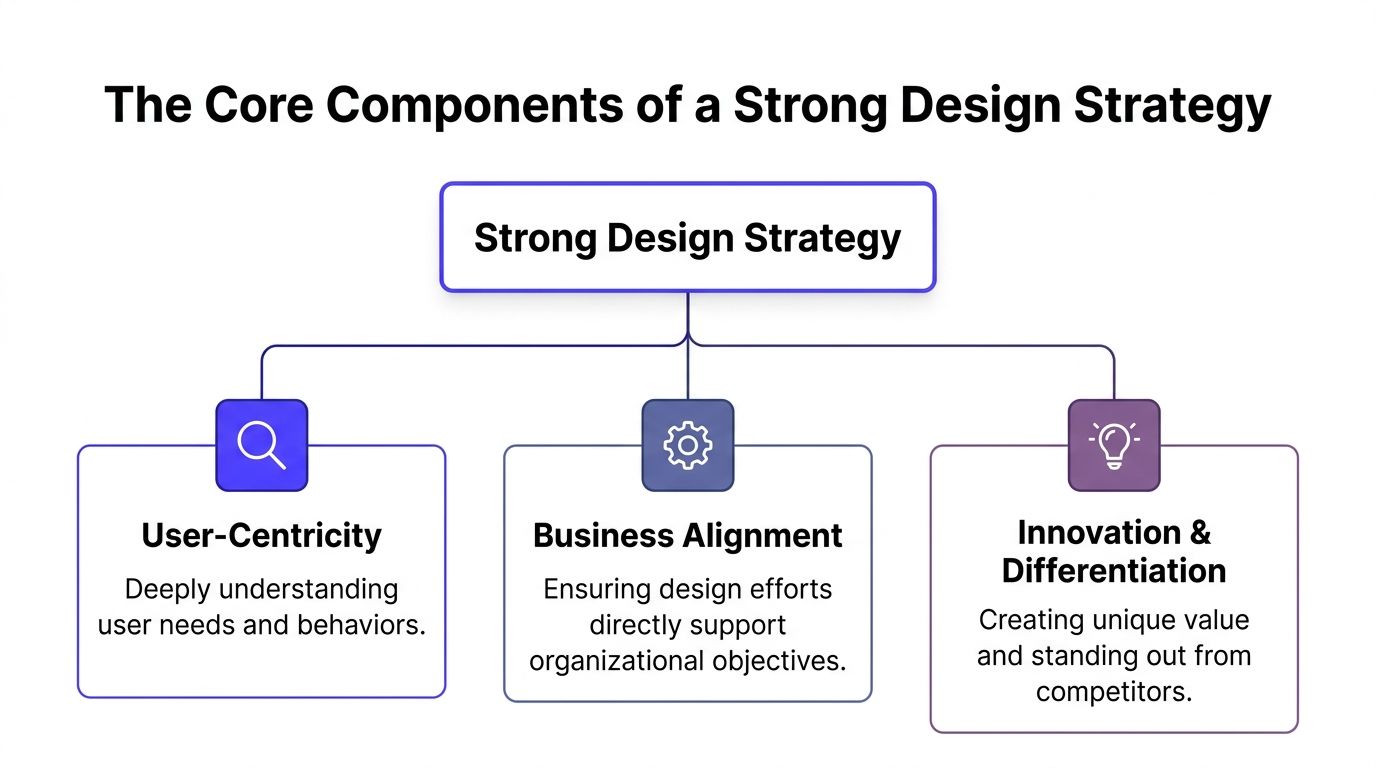
Market reality and business goals
Start with the market, not the mockups.
A lot of startup teams begin by asking what they can build. The better question is what kind of position they can own. In crowded categories, broad messaging weakens design strategy because it gives the product no center of gravity. If your AI SaaS says it's for every ops team, or your Fintech platform says it's for every modern finance company, design choices get fuzzy fast.
The sharper route is to identify the most severe pain point in a specific segment and connect that pain directly to your strongest feature. JourneyEngine's take on SaaS positioning makes this point well. Differentiation gets stronger when companies target the highest-severity customer pain instead of trying to serve everyone at once.
For a Web3 startup, that might mean focusing less on protocol novelty and more on the ugly operational problem the product removes. For a Fintech founder, it might mean deciding that trust and audit clarity matter more than feature breadth. Those are strategic choices before they are design choices.
A practical test helps here:
Business goal first. Are you trying to improve activation, support sales, increase expansion, or reduce churn?
Category pressure second. What does your market already overpromise?
Design implication third. What should the interface and brand emphasize because of that reality?
User insight and value proposition
Once the market target is clear, the next question is simple. Why should this user care now?
Weak teams lean on generic personas and broad claims. Strong teams get specific about the moment of friction. What task is painful today. What doubt stops a buyer from switching. What makes a first-time user hesitate in the product.
In SaaS, users need to reach value quickly. If they can't tell how the product helps them, they leave. Greensighter's guidance on SaaS UX puts it plainly. Users should be able to get to any feature within three clicks, and dashboards should use a less-is-more approach so people can make decisions faster, as outlined in this SaaS UX design guide.
Practical rule: If the first session creates confusion instead of clarity, the rest of your product has to fight uphill.
For an AI workflow tool, the value proposition might not be "AI-powered automation." That's too broad. It might be "review and approve recurring vendor workflows without manual back-and-forth." That's concrete, easier to design around, and easier to sell.
Design vision and operating principles
The last part is turning insight into rules the team can use.
These principles don't need to sound clever. They need to remove debate. Good ones are short, memorable, and tied to the business. Examples:
Clarity over novelty
Show value before setup
Guide high-risk actions
Reduce options when trust matters
Those principles should influence product decisions, marketing pages, onboarding, and front-end implementation. That's one reason teams often benefit from thinking about design strategy alongside product strategy for startups. The two are different, but they should agree on where the company is going and what the product must do to get there.
How Startups Can Implement Design Strategy Today
Most startups don't need a six-month initiative to start doing this well. They need a tighter operating rhythm and a few decisions written down.

Map the moments where trust breaks
Open the product, sign up as a new user, and go through the first-run experience like a skeptical buyer.
Don't ask whether the interface is attractive. Ask where a smart customer would hesitate. In AI SaaS, that often happens when the system asks for data access before explaining outcomes. In Fintech, it happens around permissions, money movement, and unfamiliar terms. In Web3, it happens when the user sees wallet actions with unclear consequences.
Write down:
Where users pause
Where labels are too vague
Where the product asks for commitment before proving value
Where marketing promises don't match the in-product experience
If your team also needs a broader growth lens, this playbook for B2B SaaS founders is useful because it connects product, messaging, and go-to-market decisions in one place.
Write a few principles your team can actually use
It's common for teams to have too many preferences and not enough principles.
Pick three to five rules that reflect your positioning and user reality. Keep them simple enough that a designer, engineer, marketer, and founder would interpret them the same way. A good principle changes real behavior. "Delight users" is too vague. "Use plain language before advanced terminology" is useful.
A founder can test whether a principle is real by checking if it settles arguments. If it doesn't help the team choose between two options, it isn't strong enough.
Good design principles reduce meetings because they remove repeat debates.
A short workshop can help. Put your latest onboarding, pricing page, dashboard, and one sales deck side by side. Then ask where the company is inconsistent. Those gaps usually reveal the principles you need.
Later in the quarter, a short walkthrough like this can help teams make those principles operational:
Build the minimum viable design system
This is one of the most practical moves a startup can make.
A design system doesn't need to start as a giant internal library. Early on, it can be a shared set of colors, type rules, button styles, form patterns, table behavior, empty states, and core components in Figma and code. The point is consistency. That consistency lowers friction for users and saves time for teams.
The business case is stronger than many founders assume. Investing in a design system yields an average 135% ROI within five years, according to this design system ROI analysis. For a startup, that matters because repeated one-off design and front-end decisions become expensive fast.
Keep the first version small:
Start with frequent patterns. Buttons, inputs, modals, cards, nav, tables.
Define usage rules. When to use each pattern, not just what it looks like.
Match product and marketing where possible. Shared language and visual logic build trust.
This is also where many early-stage teams realize they don't need three separate hires to make progress. They need one senior partner who can connect product design, brand design, and front-end execution into one system.
Measuring the Business Impact of Your Design Strategy
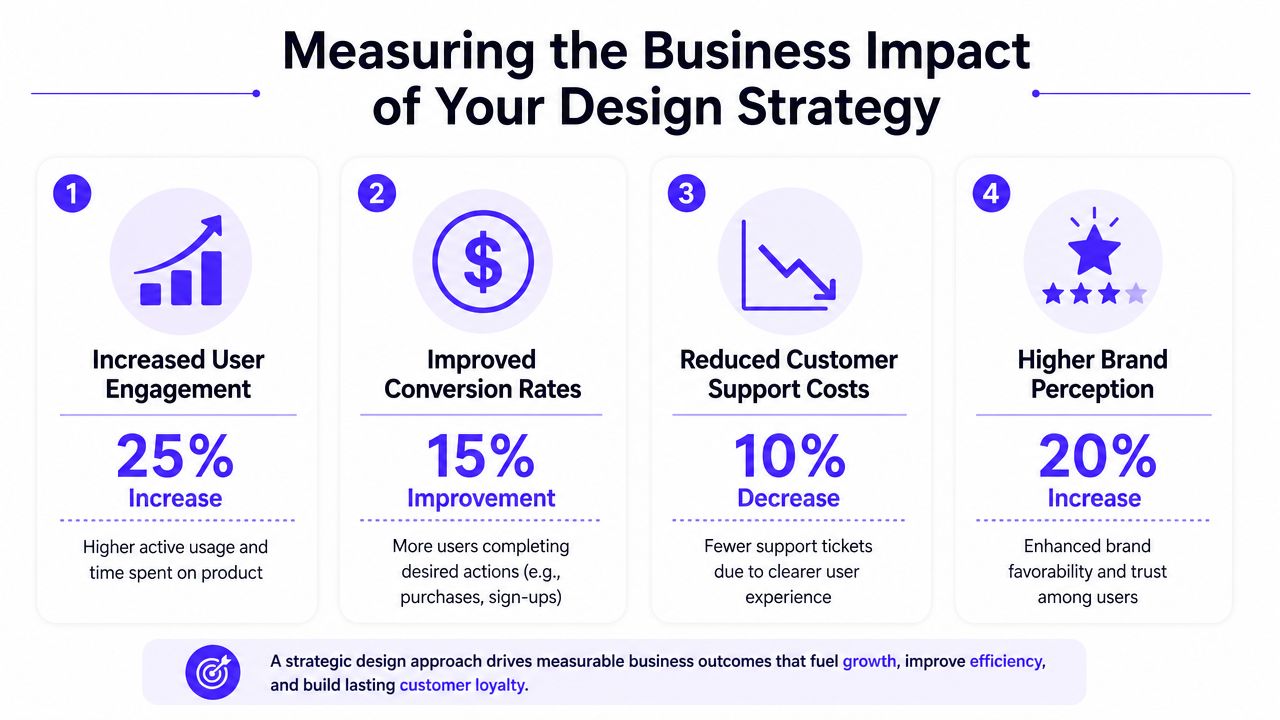
If design strategy is working, it should show up in the numbers founders already care about.
Not as vanity metrics. As movement in activation, retention, adoption, conversion quality, and the speed at which users understand value.
What should show up on the dashboard
A practical measurement setup includes three layers.
User behavior metrics. Task completion, feature adoption, friction points in onboarding, support-heavy workflows
Business metrics. Conversion, retention, expansion signals, sales-cycle clarity
Operational metrics. Design system adoption, handoff consistency, cycle time across product changes
This matches the broader view of design strategy as an organizational framework described in Monday.com's guide to design strategy, where design choices are tied to business, user, and operational KPIs instead of taste.
For startup leaders, the most revealing signals are often simple. Are more users reaching the product's core value without support. Are fewer sales conversations spent explaining basic product structure. Are users sticking after the first meaningful interaction. Those are design questions with business consequences.
Why CEOs should care
The financial case becomes hard to ignore.
Every $1 invested in UX design yields $100 in return, a 9,900% ROI, and companies in the top quartile of the McKinsey Design Index achieved 32 percentage points higher revenue growth and 56 percentage points higher total returns to shareholders over five years, according to Maze's roundup of UX statistics. That doesn't mean every redesign prints money. It means companies that manage design with business discipline outperform companies that treat it like surface polish.
There is another reason this matters for founders. Revenue retention improves when teams keep testing and refining the experience instead of treating launch as the finish line. The same Maze source notes that continuous UX testing can improve revenue retention by up to 10.8% over three years.
That's the real shift. Design strategy stops design from being a cost center you tolerate and turns it into a system that protects revenue, clarifies value, and reduces waste. If you want a more tactical view of that connection, this guide on how to measure UX design ROI at a startup is a useful next read.
A founder doesn't need to become a designer to lead this well. But they do need to treat design as a business lever. The startups that do this build products people understand faster, trust sooner, and keep paying for longer.
925 Studios helps AI SaaS, Web3, and Fintech teams turn design into shipped business value. We work as one creative partner that replaces three separate hires, a product designer, a brand designer, and a frontend developer, so founders can build clearer products, stronger brands, and polished interfaces without the overhead of building the whole team in-house. If that sounds like the gap you're trying to close, visit 925 studios.


Let’s keep in touch.
Discover more about high-performance web design. Follow us on Twitter and Instagram.