What Is Product Strategy: A Founder's 2026 Guide

Yusuf
Lead Designer 925 Studios
Product strategy is not a plan or a roadmap, it's a framework of choices that defines who you serve, what problem you solve for them, and how your product wins. That distinction matters because 78% of organizations say a poorly defined product strategy is the primary reason for product failure, while only 22% successfully launch with a clear, documented strategic roadmap.
Most advice on what is product strategy gets this backward. It tells founders to write a vision statement, build a roadmap, stack up features, and call it strategy. That's how teams end up shipping polished screens for a product nobody really needs, or building an AI feature that demos well but never becomes part of a real workflow.
A real product strategy cuts things out. It tells your team what not to build, which customer to ignore for now, which use case deserves the best UX, and where your brand needs to feel sharp versus where “good enough” is enough. If you're building in AI SaaS, Web3, or Fintech, that discipline matters even more because uncertainty is high and your assumptions can break fast.
Table of Contents
Your Product Strategy Probably Is not a Strategy
If your “strategy” is a roadmap in Notion, a Jira backlog, or a slide that says “be the platform for X,” you don't have a strategy. You have artifacts. Those things can be useful, but they only become useful after the hard choices are made.
The biggest mistake founders make is confusing motion with direction. A busy team can ship every sprint and still drift. You see this all the time in startups that keep adding onboarding flows, dashboards, and AI assistants without ever deciding which user they want to win with first.
According to a 2024 Product Management Alliance study, 78% of organizations explicitly state that a poorly defined product strategy is the primary reason for product failure, while only 22% successfully launch products with a clear, documented strategic roadmap. This is the underlying problem. It's not usually a lack of effort. It's a lack of strategic clarity.
What false strategy looks like
A feature pile: “We need integrations, better analytics, and an AI copilot” is not strategy.
A vague mission: “We want to enable financial freedom” doesn't tell a designer or engineer what to build next.
A broad audience claim: “This is for everyone in operations” usually means it's for no one in particular.
An investor-friendly narrative: A pitch can sound coherent while the product decisions underneath are still contradictory.
Practical rule: If your team can't explain what you will deliberately ignore for the next phase, your strategy isn't sharp enough.
Product, UX, and brand go off track together. The interface gets cluttered because the product tries to serve three buyers at once. The messaging gets muddy because nobody can say what the product is best at. The onboarding gets bloated because the team keeps hedging instead of choosing. A lot of the early mistakes founders make around UX stem from this exact issue, which is why this breakdown of what founders get wrong about UX before Series A is worth reading alongside strategy work.
The same problem shows up in customer operations. If you haven't chosen your primary user and their core workflow, support, onboarding, and retention all become reactive. This guide to optimizing customer experience for B2B SaaS is useful because it shows how product decisions and customer experience are tied together, not separate workstreams.
The Core Components of a Real Product Strategy
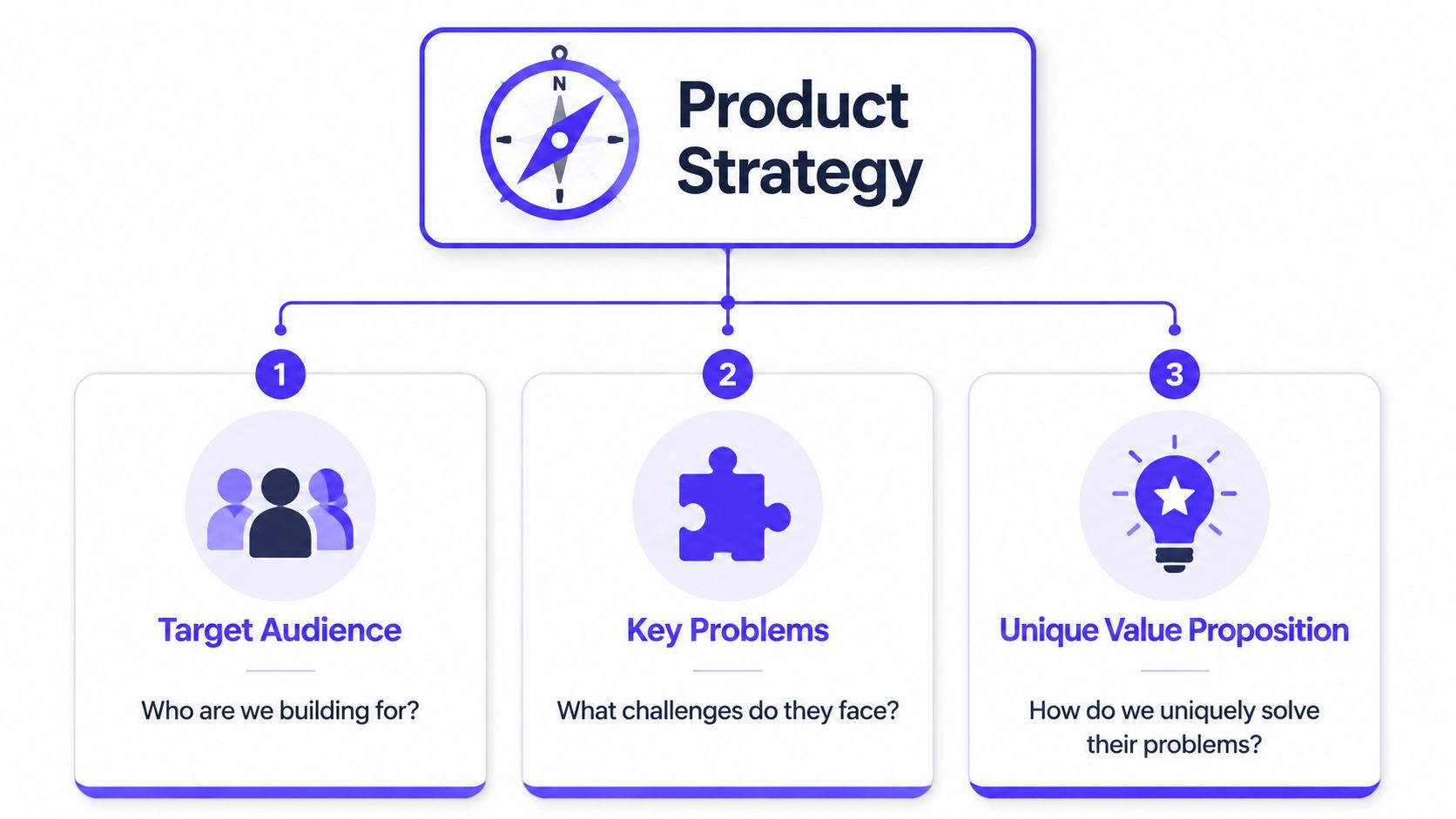
A real product strategy is a set of linked decisions. It's not just a statement about ambition. Productboard's definition gets the important part right. Product strategy is a decision framework that ties customer problems, market positioning, and measurable business outcomes together, and it should drive pricing, distribution, resource allocation, and KPIs, not just feature prioritization, as outlined in Productboard's product strategy glossary.
Start with a specific customer
The first component is who you serve. Not your total addressable market. Not every team that could possibly use your product. The specific buyer and user combination you are designing for first.
Stripe is a good example of focused strategic choices. Early on, the product was shaped around developers who wanted a cleaner way to accept payments. That choice affected everything, API design, docs, onboarding, product language, and brand perception. The product felt simple because the strategy was specific.
For founders, this choice should immediately change the work on screen:
If you sell to compliance teams, your UX should emphasize clarity, traceability, and confidence.
If you sell to growth teams, speed, visibility, and fast setup matter more.
If the buyer is different from the daily user, your product has to support both evaluation and repeated use.
Define the value and the business logic
The second component is the problem you solve better than alternatives. Many products get fuzzy at this point. They describe capabilities instead of outcomes. Customers rarely buy “AI-powered workflow orchestration.” They buy faster analysis, lower manual effort, better consistency, or fewer errors in a critical task.
The third component is how you're different. That doesn't always mean a breakthrough feature. Sometimes the wedge is distribution. Sometimes it's trust. Sometimes it's the fact that your product fits into a workflow the incumbent made painful. Shopify won a lot of loyalty by making ecommerce setup feel approachable. Not because online stores were a new category, but because the product made the job easier for the people it chose to serve.
A strategy also needs a business shape. How will the company benefit if the product works? Revenue, expansion, cost efficiency, retention, stronger market position, those outcomes need to be explicit. Otherwise teams end up optimizing for engagement in places where the business needs activation, conversion, or retention.
Good product strategy narrows the field. It tells you which customer pain deserves premium design attention, which workflow gets the shortest path, and which requests stay out of the next release.
Here's the simplest way to pressure test whether these components are real:
Component | Weak answer | Strong answer |
|---|---|---|
Customer | “SMBs” | “Finance leads at seed to Series B startups handling monthly cash planning” |
Problem | “Reporting is hard” | “They can't trust fast cash visibility across accounts and tools” |
Differentiation | “AI insights” | “A cash view that updates inside existing finance workflows with clear audit trails” |
Business value | “Grow revenue” | “Win on adoption, then expand through finance team usage and paid controls” |
If your answers stay broad, your product will too. One good way to spot that early is to review the actual experience, not just the strategy doc. A structured UX audit for your SaaS product often reveals whether the interface matches the customer and workflow you say you care about.
Product Strategy Is Not a Roadmap or a Vision
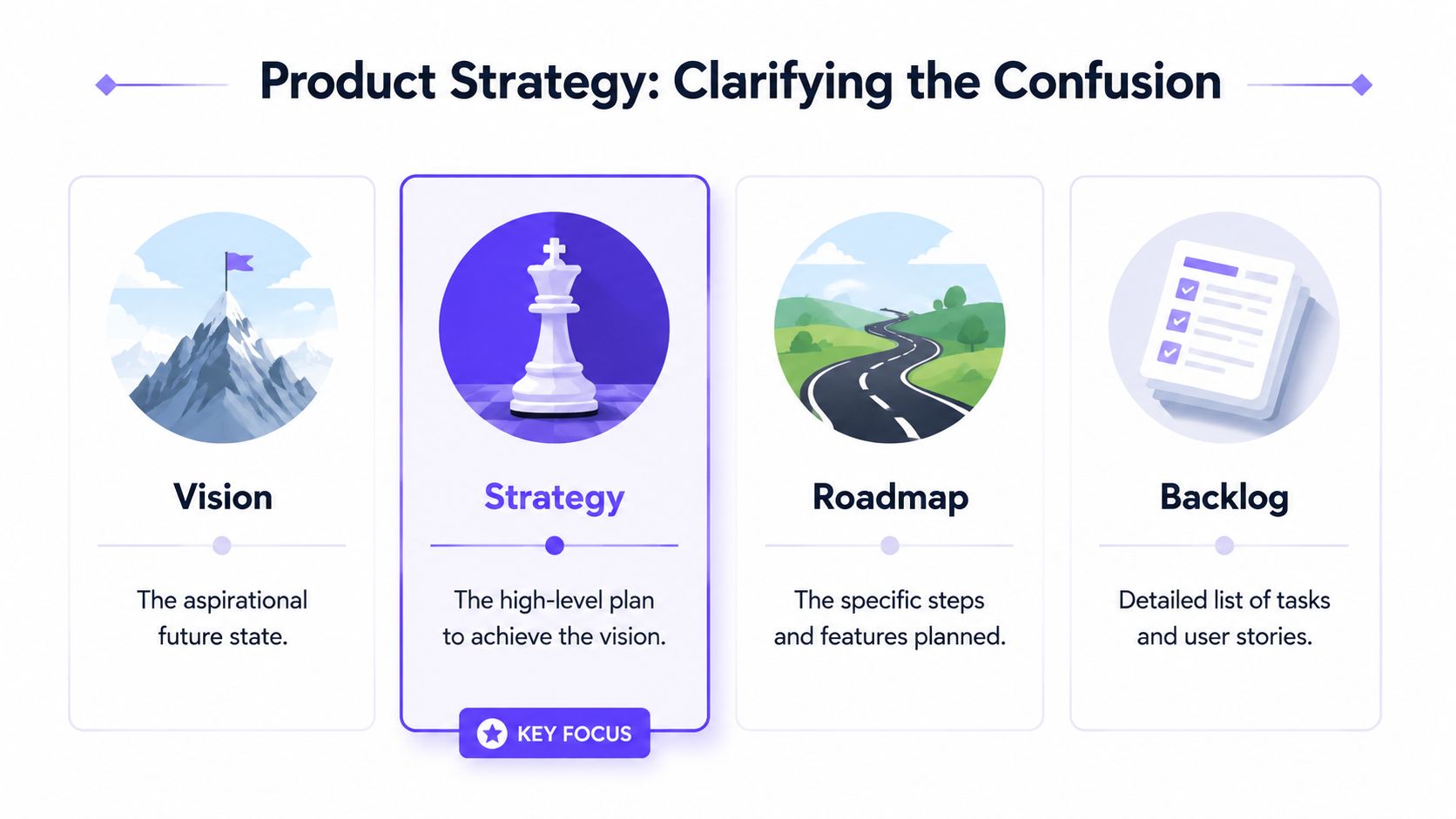
Founders often mix four different things together, vision, strategy, roadmap, and GTM. Once those blur, teams start using one artifact to answer the wrong question. Then product reviews get messy because everyone is debating a different layer of the problem.
The cleanest distinction comes from stronger definitions like ProductPlan's. Strategy is the set of choices about who to serve, why they will buy, and how the product creates business value. The roadmap is only one output of that strategy, as explained in ProductPlan's product strategy glossary.
This, not that
Thing | What it does | Example |
|---|---|---|
Vision | Defines the future you want to create | “Make business banking feel as clear as consumer banking” |
Strategy | Chooses where to focus and how to win | “Start with founder-led SMBs that need fast cash visibility and approval control” |
Roadmap | Sequences the work | “Ship multi-account sync, approval rules, then reporting exports” |
GTM | Gets the product to customers | “Sell through finance communities, partner channels, and outbound demos” |
A vision should stay broad enough to inspire. A roadmap should stay concrete enough to execute. Strategy sits in the middle and forces trade-offs.
That's why “we want to be the all-in-one platform” is usually a bad strategic statement. It pretends to be ambitious, but it doesn't help a designer decide whether onboarding should optimize for a first-time founder, a compliance lead, or an ops manager. It doesn't help engineering decide whether reliability matters more than breadth. It doesn't help marketing decide what claim should lead the homepage.
What founders should hand to a team
A good team doesn't need a speech. It needs constraints.
If product strategy is clear, design can simplify faster, engineering can reject edge-case work sooner, and marketing can explain the product in one sharp sentence.
What should a founder bring into a planning session?
A clear user choice: Who matters most right now.
A problem choice: Which painful job the product will own.
A differentiation choice: Why this option beats spreadsheets, incumbents, or internal workarounds.
A business choice: What success should look like in company terms.
Apple is useful here as a product discipline example. The company is known for polished execution, but the more important lesson is strategic restraint. Products feel coherent because the team doesn't try to expose every possible option in the interface. The strategy sets the boundaries first. The UI follows.
A Simple Framework for Creating Your First Product Strategy
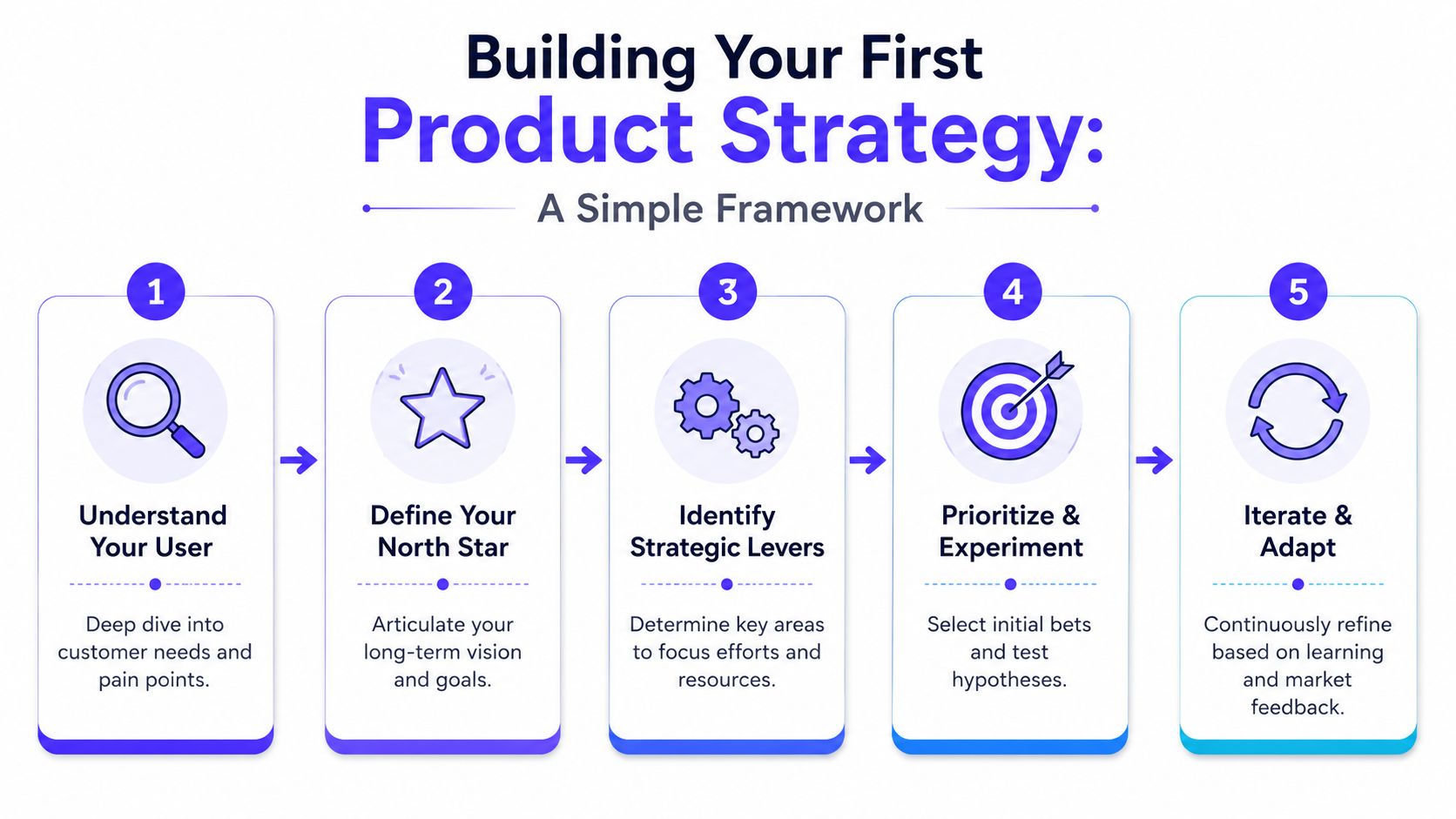
Most founders don't need a giant strategy process. They need one working page and a few honest decisions. The best strategy work is usually shorter than the deck people build to explain it.
Use this framework in a workshop with product, sales, design, and engineering in the room. SVPG's guidance is practical here. High-quality product strategy is built from product data and cross-functional insights, including acquisition funnel performance, retention factors, sales execution data, and customer feedback, because those inputs help teams identify the few strategic problems that matter most, as argued in SVPG's product strategy insights.
Start with the visual below, then use it to force decisions.
Four decisions that matter
Where will we play?
Define the market and segment in plain language. “AI for support” is too broad. “Internal support copilots for mid-market B2B SaaS teams with complex docs” is usable. This decision shapes which workflows deserve design depth and which integrations matter.How will we win?
Choose the wedge. It could be accuracy in a narrow workflow, simpler onboarding, stronger trust, lower switching cost, or a better operator experience. Don't list five wedges. Pick the one your team can build around.How will we make money?
Decide what business model and product behavior fit together. If your sales cycle is long but your product value appears quickly, maybe a self-serve trial supports the top of funnel while sales handles expansion. If trust is the hard part, a white-glove onboarding motion might fit better than a no-touch signup.What are the rules? This is the part founders skip. Set the firm boundaries and the exclusions. What won't you build? Which customer requests will you decline? What complexity are you unwilling to add yet?
A useful strategy line often sounds like this:
We serve [specific user] with [specific painful job], we win by [specific advantage], and we will not chase [tempting distraction].
That last clause matters more than people think. It protects the product from becoming a compromise between too many buyer types.
The video below is a good companion if you want another lens on translating strategy into product decisions.
How to pressure test it
Once the draft exists, don't admire it. Stress it.
Ask these questions:
Does sales recognize this customer? If not, the segment is probably theoretical.
Does support hear this problem repeatedly? If not, the pain may not be strong enough.
Can design point to the primary workflow in the product? If not, focus is missing.
Can engineering explain what complexity this strategy avoids? If not, the “what not to build” line is still too soft.
A strong strategy should also show up in the interface. If your strategy says the product wins on trust, the UI should reduce ambiguity. If it wins on speed, users shouldn't hit a maze of setup steps before they get value. If it wins on intelligence, the product should make outputs inspectable, not mysterious.
For teams that already shipped product, strategy work and UX review should happen together. A lot of founders discover that the underlying issue isn't only positioning. The workflow itself never matched the strategic promise in the first place.
Product Strategy Examples for AI, Web3, and Fintech
Theory gets useful when you can apply it under pressure. These three categories all deal with uncertainty, but the uncertainty is different in each one. AI has capability and behavior risk. Web3 has trust and adoption risk. Fintech has trust, compliance, and operational risk all at once.

Roman Pichler's framing is the right one for these markets. For AI-led products, the first step is to identify the biggest risk in the strategy and validate it before committing, because market conditions, model capability, regulation, and user behavior can shift fast, as described in Roman Pichler's guide to product strategy.
AI SaaS example
Say you're building an AI research assistant for revenue teams. The most common strategic mistake is starting too broad. Founders often want a general assistant that summarizes calls, drafts outbound, answers internal questions, and predicts churn. That sounds big. It usually ships as a mess.
The better strategic move is to identify the biggest risk and narrow around it. Maybe the key question is whether buyers trust AI-generated account research enough to use it before a meeting. If that's the risk, your first strategy isn't “build an AI sales platform.” It's “win pre-call preparation for account executives in a specific sales motion.”
That choice changes the product immediately:
Onboarding focuses on CRM and call data, not every possible data source.
UX prioritizes inspectable summaries with citations, not flashy chat.
Brand should signal competence and trust, not novelty for novelty's sake.
If you're thinking through agent-based workflows specifically, this piece on Samuel Woods' AI agent strategy is a useful companion because it pushes the founder to think about where an agent belongs in an actual SaaS workflow, not just as a demo layer.
Web3 example
A Web3 founder usually has a different problem. The technology may be the easy part. The hard part is deciding who should care first.
Take a wallet infrastructure product. You can say it serves developers, protocols, marketplaces, consumers, and enterprises. That's not strategy. A sharper choice might be serving teams that need embedded wallet UX without exposing users to unnecessary blockchain complexity.
That strategic decision shapes product and brand in obvious ways:
Strategic choice | Product effect | Brand effect |
|---|---|---|
Hide chain complexity | Cleaner onboarding and fewer wallet decisions upfront | Messaging focuses on ease and trust |
Serve developers first | Better docs, SDK flow, sandbox environment | Technical credibility leads |
Serve consumer apps first | More emphasis on recovery, safety, and education | Brand tone becomes more reassuring |
In Web3, one of the worst outcomes is building for crypto-native assumptions when your growth depends on mainstream behavior. The product then feels logical to insiders and confusing to everyone else.
Fintech example
Fintech punishes sloppy strategy because every decision touches trust. A budgeting app can get away with some rough edges. A treasury product, lending workflow, or compliance platform can't.
Suppose you're building software for small business cash management. You have at least three possible strategic paths. You can compete on visibility, on automation, or on control. Trying to lead with all three usually produces a cluttered dashboard and bloated onboarding.
A focused strategy might choose control first. That means the product is built for finance owners who need approvals, clear permissions, and confidence in what changed. That will affect everything:
Navigation becomes role-aware.
Language avoids cute copy and leans on clarity.
Interaction design shows status, history, and exceptions in ways users can trust.
This is also why early research matters so much in AI and financial workflows. Many products fail because the founder validates the concept but not the actual behavior in the interface. If your users won't trust the workflow, the strategy hasn't been validated. Consequently, why AI products fail without UX research is especially relevant.
Common Pitfalls and a Simple Strategy Template
Most bad product strategies fail in familiar ways. They aren't usually wrong because the founder lacks ambition. They fail because the choices stay blurry long enough for execution to drift.
The traps that keep showing up
Treating strategy like a one-time document: Markets shift, customer behavior changes, and products mature. If the strategy never gets revisited, the team starts defending old assumptions.
Confusing feature scope with strategic focus: More features can make a product less competitive if they dilute the core job.
Skipping the “not now” list: Without explicit exclusions, every stakeholder request sounds reasonable.
Using language that sounds good but directs nothing: If the statement can fit any startup in your category, it won't help your team ship better.
The clearest strategy documents are usually the shortest. They don't try to sound impressive. They try to make decisions obvious.
One-page product strategy template
Use one page. If it spills into a deck, you're probably mixing explanation with decisions.
Component | Your Answer (Be Specific) |
|---|---|
Target customer | |
Core problem to solve | |
Why this problem matters now | |
Alternatives customers use today | |
Unique value proposition | |
Why customers will choose us over time | |
Business outcome this product must drive | |
Pricing and distribution assumptions | |
Key risks to validate | |
What we will not build or serve right now | |
Key metrics and signals to watch | |
Strategic principles for design and engineering |
Fill this out with real language. No category jargon. No investor wording. If a product designer, engineer, and marketer can all read it and make better decisions the same day, it's working.
If you're building an AI SaaS, Web3, or Fintech product and need a team that can turn strategy into a sharper product, brand, and shipped frontend, 925 studios is built for that. We work as one creative partner across product design, brand design, and frontend development, so founders can move from vague direction to a product people understand and want to use.
Powered by Outrank app


Let’s keep in touch.
Discover more about high-performance web design. Follow us on Twitter and Instagram.