
SaaS Pricing Model: Strategies for Founders & AI Features

Yusuf
Founder and lead designer at 925studios
Most SaaS pricing advice starts in the wrong place. It tells founders to check competitors, copy the familiar tier names, and adjust the numbers until the page looks credible.
That's how teams end up with a pricing page that looks normal and performs badly.
A durable SaaS pricing model starts with customer value, not market theater. That matters even more in AI, fintech, and Web3, where costs can shift with usage, buyer scrutiny is high, and the wrong model can hurt conversion on the front end while crushing margin on the back end. A seat-based plan can be perfect for one product and terrible for another. A usage-based plan can protect margin, but if buyers can't predict the bill, they hesitate.
The founders who get pricing right usually treat it like product strategy. They choose a value metric customers understand. They package plans to create a clear upgrade path. They check whether the model supports retention and expansion, not just signups. Then they keep iterating when buyer behavior changes.
Table of Contents
Your First Step Is Finding Your Value Metric
Most founders reach for competitor pricing because it feels safe. It isn't. A pricing page borrowed from another company usually reflects their product shape, their customer mix, and their cost structure, not yours.
The better starting point is the value metric, the unit of consumption that most closely tracks customer value. The guidance is clear in this SaaS pricing model design framework from Alguna. Start with the metric, then validate it through customer mapping, revenue modeling at multiple price points, and qualitative interviews before you run quantitative experiments. That same guidance recommends testing whether prospects understand and accept the metric in under 30 seconds and validating it with at least 5 customer conversations before launch.
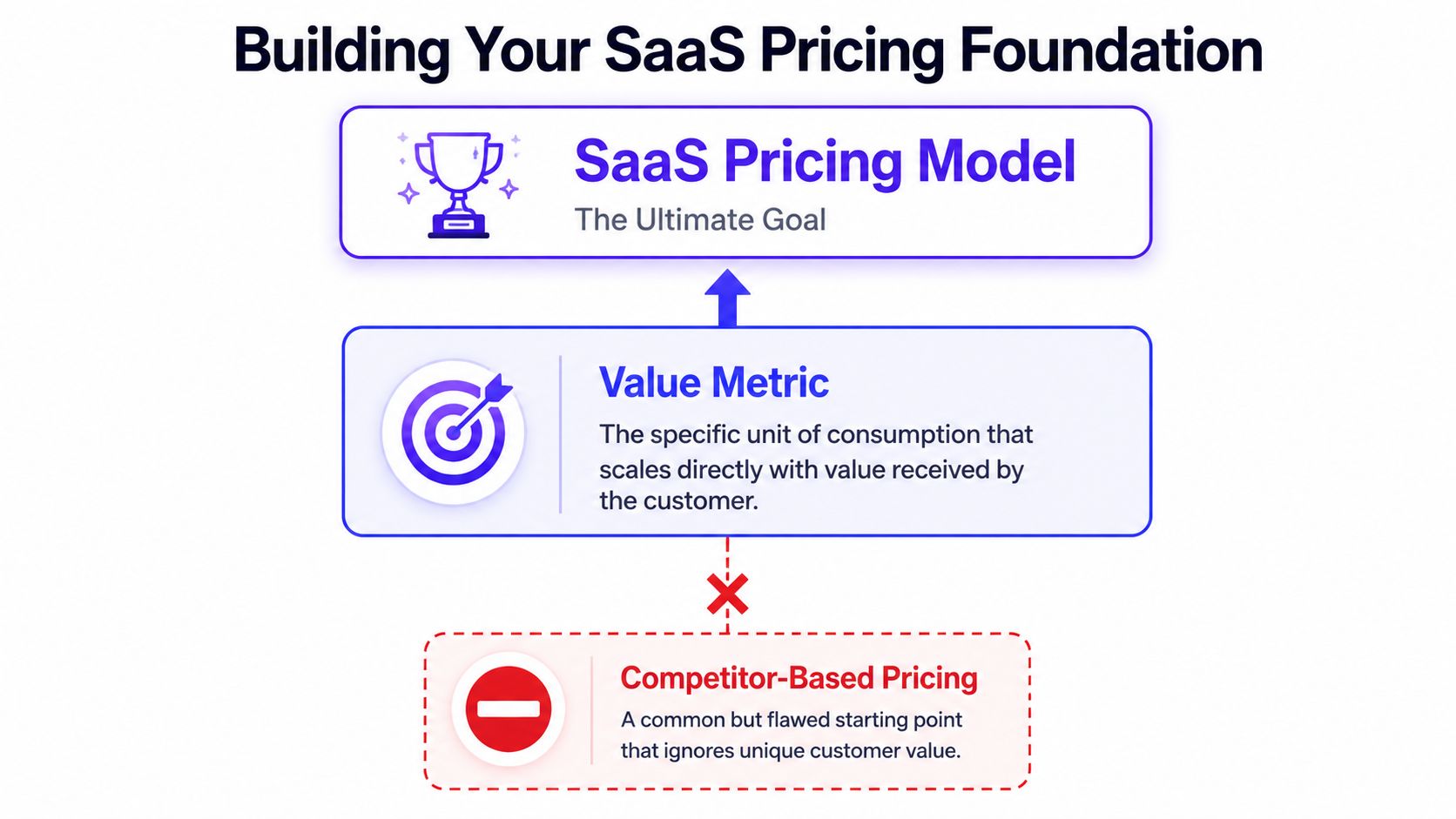
Start with the moment value shows up
Ask a blunt question. What does the customer buy from you?
Not features. Not your roadmap. Not your positioning line.
They buy an outcome that shows up through a repeated action. In Linear, that might be active team collaboration around issue tracking. In Ramp, the value is tied more directly to spend control, visibility, and workflows around finance operations. In an AI product, it may be documents processed, workflows completed, reports generated, or tasks automated.
A useful working list looks like this:
Per seat when value increases as more people need access and collaboration
Per transaction when the product sits in the path of money movement or approvals
Per project or workspace when the customer organizes work around bounded containers
Per API call or token when product cost and value both rise with technical consumption
Per asset monitored when users care about coverage breadth more than seats
If you want a live example of how an AI product frames packaging around monitoring needs, it's worth reviewing how teams Compare AI monitoring plans. Not to copy the page, but to study how the pricing unit shapes buyer expectations.
Practical rule: If a prospect needs a long explanation to understand what they're paying for, the metric is probably wrong.
Pressure test the metric before you design the page
Founders often pick the metric they can track most easily. That's a billing shortcut, not a pricing strategy.
Use a short validation pass before you commit:
Map the customer journey
Identify the first action that creates obvious value. If users invite teammates before they see results, seat pricing may be premature. If they get value only after processing data, usage may be closer to the truth.Check predictability
Buyers need to estimate future cost without anxiety. Fintech buyers especially won't tolerate a model that feels open-ended or hard to budget.Look for fairness across segments
If small customers subsidize power users, resentment shows up fast. If large customers can grow massively without paying more, your expansion path is weak.Test comprehension in conversation
Explain the metric plainly. Then ask the prospect to repeat it back in their own words. If they can't, don't launch it yet.Model the downstream effects
The same Alguna guidance recommends modeling churn and net revenue retention before launch. That's the right move because a metric can increase initial conversion while weakening long-term account quality.
A strong SaaS pricing model feels obvious after the buyer sees it. Getting there usually takes more discipline than creativity.
Designing Your Pricing Tiers and Packaging
A value metric tells you what to charge for. Packaging decides how buyers move through your product.
Many startups create accidental dead ends. They put all the attractive features in the cheapest tier to maximize trial conversion, then wonder why upgrades stall. Or they stuff the enterprise plan with vague promises and no real reason for a growing company to step up gradually.
Packaging is a system, not a card layout
The most useful way to think about architecture comes from this pricing model execution guide from Software Equity. It recommends breaking the model into metric, modality, period, granularity, discounts, and price point so teams can test the pieces instead of arguing over a single number.
That framing matters because packaging changes behavior in both directions. It affects upsells, yes, but it also affects downgrades, discount pressure, and which customer segments become unprofitable.
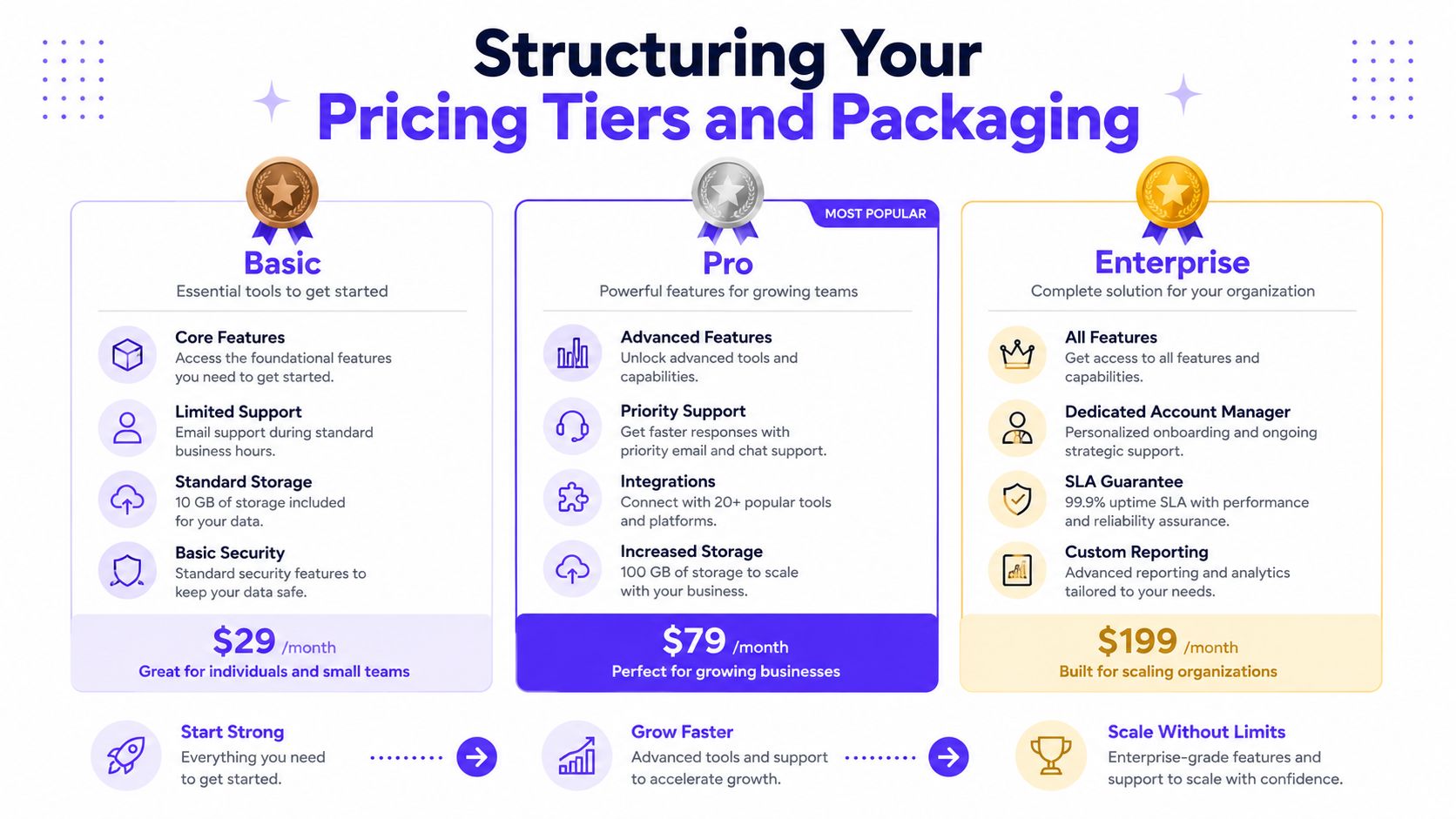
A simple way to structure tiers is the familiar Good, Better, Best pattern. It still works because it mirrors how buyers evaluate risk.
Tier | Best use case | What belongs here | What should stay out |
|---|---|---|---|
Entry | Individual users or very small teams | Core workflow, clear limit, basic support | Advanced controls, high-leverage collaboration features |
Growth | Teams with recurring usage | Features that improve speed, coordination, visibility | Fully custom procurement or security terms |
Enterprise | Large teams with procurement and governance needs | Admin controls, compliance, service expectations, custom onboarding | Commodity features buyers expect in lower plans |
The mistake is treating tiers like feature buckets. Good packaging creates behavioral movement. The entry plan should let people succeed, but not in a way that removes all reason to upgrade.
How to create an upgrade path people actually use
Notion is a useful mental model here. The product feels generous at the lower end, but the deeper collaboration, admin control, and organizational use cases naturally pull teams upward. That's the pattern to copy, not the exact feature list.
Three packaging moves tend to work well:
Gate by depth, not by basics
Don't cripple the product. Let customers experience the core workflow. Hold back the features that matter when teams depend on the product more heavily.Make the middle plan the operational default
Many buyers want a safe choice. A highlighted growth or Pro tier often works because it indicates that most serious teams typically begin with it.Use enterprise to solve complexity, not hide pricing mistakes
Enterprise shouldn't be a junk drawer for everything you couldn't place elsewhere. It should answer real buyer needs such as governance, procurement, security review, or service terms.
When packaging works, the customer doesn't feel pushed. They feel like the next plan fits the next stage of their business.
For AI and fintech products, feature placement also shapes support load and margin. If expensive compute or complex workflows sit in the wrong tier, you may get impressive signup volume and poor account quality. If the growth plan includes the right collaboration, reporting, or controls, expansion becomes easier because the product starts matching how teams buy.
The practical test is simple. Look at each tier and ask two questions. Why would someone buy this plan first? Why would they leave it later? If either answer is fuzzy, the packaging needs work.
Calculating Unit Economics and Key KPIs
A pricing model is still a hypothesis until the economics make sense. Founders often spend weeks polishing copy and card layouts, then realize the model doesn't support healthy accounts.
That's backwards.
Model the business before you polish the pricing page
Start with a simple spreadsheet. You don't need a finance team to do this. You need a few columns that force clarity.
Include these inputs:
Customer segment such as startup, mid-market, or enterprise
Plan type and expected mix across tiers
Average usage pattern tied to your value metric
Support and delivery burden by segment
Expansion path if the customer grows
Churn risk assumptions by plan and segment
Then pressure test scenarios. If you raise price but lose clarity, conversion may drop. If you lower price to win logos, you may attract buyers who churn quickly or never expand. If you include too much usage in the base plan, heavy accounts can become painful to serve.
A strong model doesn't optimize only for signup rate. It needs room for retention and expansion.
Here's a practical way to read it:
Question | Healthy signal | Warning sign |
|---|---|---|
Are buyers reaching the right tier? | Most customers choose the plan built for their segment | Most accounts cluster in a low tier and stay there |
Does usage align with margin? | Higher consumption leads to higher revenue | Heavy users outgrow cost assumptions without upgrading |
Can accounts expand naturally? | Growth in team size or workflow complexity increases revenue | Customers add value internally but pricing stays flat |
This is also where design teams can add real impact. If the product hides usage, limits, or plan logic, customers won't understand what they're buying. That creates billing anxiety, support tickets, and lower trust. The same principle shows up in product measurement too. Teams trying to connect experience quality to business outcomes will find useful thinking in this piece on measuring UX design ROI at a startup.
What to watch after launch
After pricing goes live, look beyond top-line revenue. The useful questions are operational.
Where does churn concentrate
If one segment leaves more often, the plan may be mis-scoped for that buyer.Which accounts need discounts to close
Repeated discounting usually means the package, not just the price, is off.What expands without sales intervention
Self-serve expansion is one of the clearest signs that the model fits customer value.
A pricing page can convert well and still produce weak revenue quality. Retention and expansion tell you whether the model is working.
For founders in AI and fintech, this discipline matters more because costs and risk aren't evenly distributed across accounts. A clean spreadsheet won't solve pricing on its own, but it will stop you from believing a pretty page means the economics are sound.
Pricing Models for AI and Usage-Based Products
A plain seat-based model works well when access is the product. It struggles when the product performs variable work on the customer's behalf.
That's the core pricing challenge in modern AI software. One team may have a handful of users who generate heavy model activity. Another may have broad seat adoption and light consumption. Charging both the same way looks simple on the page and messy in the margins.
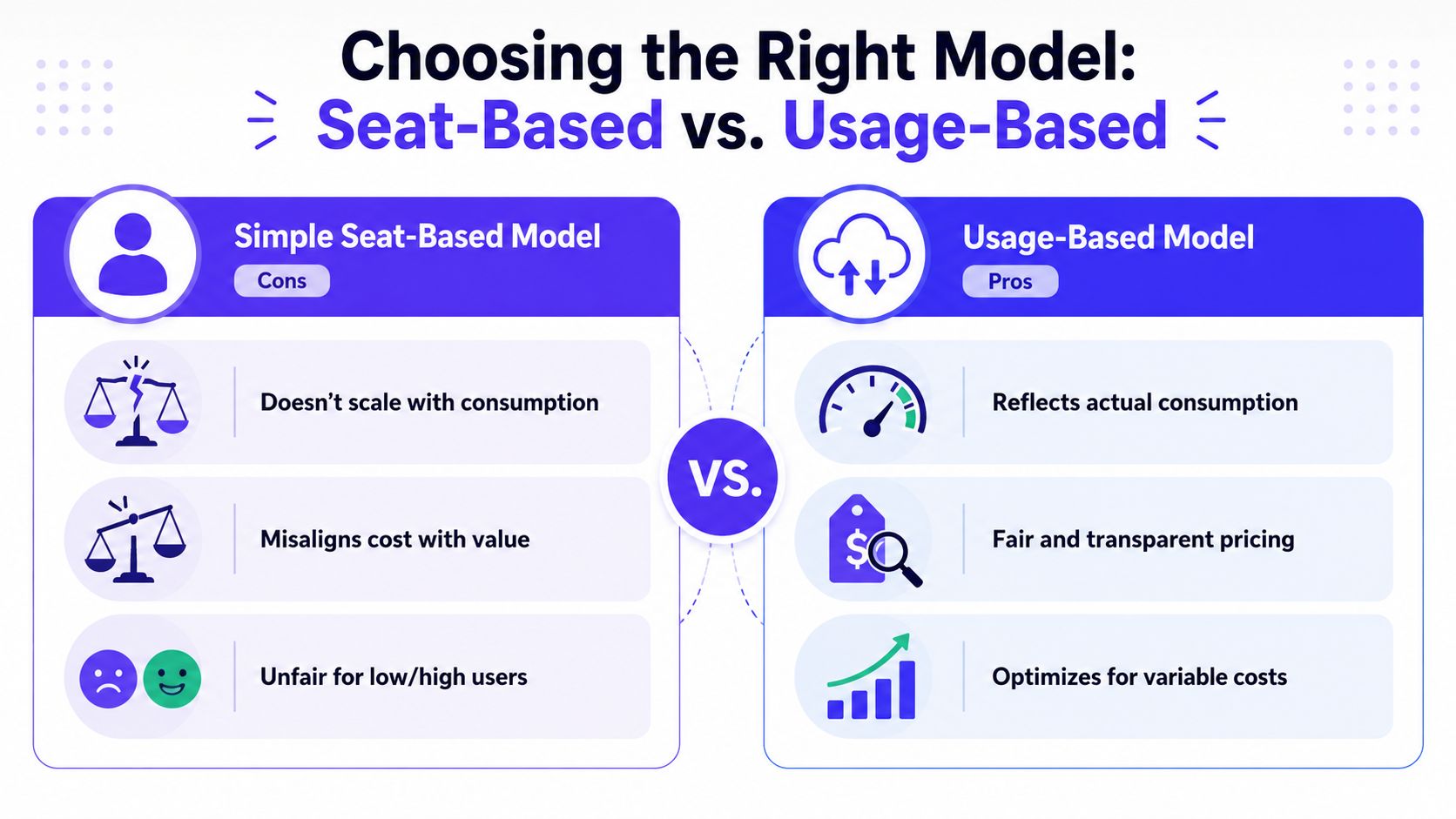
Why seat pricing breaks for many AI products
Recent guidance in this SaaS monetization view from Revenera points to a shift toward token- or usage-based monetization for AI capabilities because product cost can scale with inference volume rather than users. It also warns that adding usage complexity too early can hurt conversion. That's the right tension to pay attention to.
The question isn't seat-based versus usage-based in the abstract. The question is which metric customers can understand, predict, and accept as fair.
An AI writing assistant is a good example. If you charge only per seat, your heaviest accounts may become expensive fast. If you charge only by tokens, many buyers will hesitate because they don't want a bill that feels technical or volatile.
A lot of teams need to see this trade-off in product terms, not just finance terms. This breakdown of AI product interface examples that build trust is useful because trust in AI products often comes from making system behavior, limits, and outcomes legible.
Here's a helpful discussion of the broader model choices:
A hybrid model usually fits better
For many AI, Web3, and fintech products, a hybrid SaaS pricing model works better than a pure one.
That might look like this for a hypothetical AI writing assistant:
Base subscription for access, collaboration, templates, and team controls
Included usage credits so buyers can adopt the product without cost anxiety
Clear overage rules for higher-volume usage
Optional add-ons for advanced models, audit logs, or workflow automation
This structure does three jobs at once. It gives finance teams predictability. It protects your margin when usage spikes. It keeps expansion tied to actual customer success.
A clean hybrid model usually follows these design rules:
Keep the base plan legible
Buyers should know what they get before they calculate anything.Make usage visible in-product
If customers can't see consumption, they can't manage it. Hidden usage leads to support issues and procurement pushback.Set guardrails early
Overage thresholds, alerts, and plan comparisons reduce surprise.Reserve advanced capacity for higher-intent buyers
If premium model access sits in the wrong plan, costs rise faster than revenue.
Web3 and fintech teams often face a similar issue with transaction volume, wallet activity, risk scoring, or API throughput. The product performs work, not just access. When that's true, a hybrid structure gives you more control than forcing everything into a seat count.
The best model is the one customers can explain back to you without confusion and one your business can support as usage grows.
How to Test and Iterate on Your Pricing
Founders often treat pricing like branding. They launch it, announce it, and hope not to touch it again for a long time.
That's a mistake. Pricing is a product feature with direct effects on conversion, retention, support burden, and revenue quality. If the product changes, the packaging usually needs to change with it.
Treat pricing like a shipped feature
The practical rhythm is straightforward. Form a pricing hypothesis, test it with real buyers, watch behavior after launch, and revise what the data and conversations make obvious.
Given that buyer behavior moves faster than most pricing pages, the guidance in this pricing strategy analysis from Paddle highlights the operational question founders ask: when to move from simple tiered pricing to hybrid pricing, add-ons, or measured usage. It points to key signals such as low-tier adoption with weak upgrades, frequent discounting, and churn concentrated in specific segments.
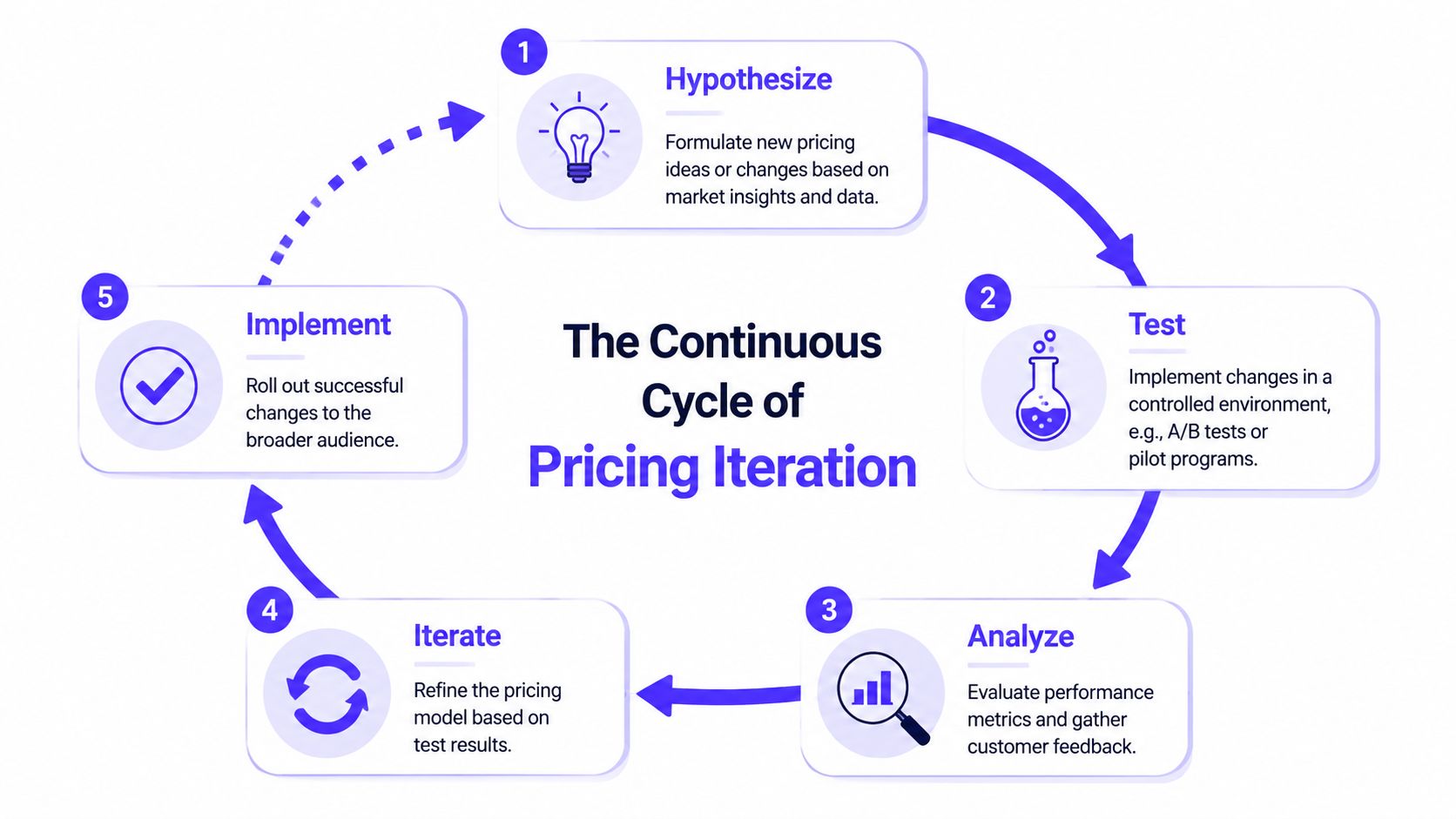
A lightweight pricing review can use this sequence:
Check sales friction
Listen for repeated objections. If prospects keep asking for custom terms, the public packaging may not match buying reality.Review plan migration
Watch whether customers move upward, downward, or nowhere. A static install base in the entry plan often means the ladder is broken.Compare segments, not just totals
Fintech startups, API buyers, and enterprise teams don't behave the same way. Segment-level patterns matter more than blended averages.
Pricing should evolve when customer behavior makes the current model expensive to defend.
Signals that your model needs to change
Not every problem is a pricing problem. Weak onboarding can look like price resistance. Poor positioning can look like discount pressure. But some signs are hard to ignore.
A broken or aging pricing model often looks like this:
The cheap plan attracts too many wrong-fit users
They sign up quickly, ask for a lot, and don't convert into durable accounts.Growth happens inside the customer, not in revenue
More users, more workflows, more reliance on the product, but flat account value.Sales keeps patching the page with exceptions
Once every deal needs a workaround, your architecture is behind the product.One segment churns for the same reason
If a cluster of customers leaves because the plan doesn't fit their usage pattern, listen to that pattern.
Founders sometimes wait for a full rebrand or major launch before touching pricing. That's usually too late. The better approach is controlled iteration. Test with a subset of new customers. Tighten packaging before you raise complexity. Make sure the product and the pricing page say the same thing.
A strong pricing system doesn't stay static. It stays understandable while the business grows more complex.
Designing a Pricing Page That Converts
A smart SaaS pricing model can still fail if the page makes buyers work too hard. Conversion drops when the page hides the metric, buries plan differences, or sounds like it was written by legal and growth at the same time.
A pricing page checklist that removes friction
The page should answer four buyer questions fast. What am I paying for? Which plan fits me? What happens if I grow? What should I do next?
That usually means a few concrete choices:
Lead with the pricing unit
Put the metric near the price, not in a footnote. If it's per seat, per workspace, or usage plus base fee, say it plainly.Name plans by buyer type or maturity
“Starter,” “Growth,” and “Enterprise” are easier to parse than clever brand names.Use a comparison grid that surfaces decision points
Don't list every feature. Show the differences that affect purchase intent, such as limits, collaboration, controls, support, and overages.Make the preferred plan visually obvious
A highlighted middle tier still works when it matches the buyer most likely to convert.Write buttons that finish the decision
“Start free,” “Book demo,” or “Talk to sales” works better than vague CTA copy.
If you want to study a live product that keeps the path simple, this free form app pricing page is worth reviewing for how directly it frames plan choice and action. For more layout patterns and breakdowns, this collection of SaaS pricing page examples that convert is also useful.
One last rule matters more than many realize. The page has to match the product experience. If the product feels modern and clear but the pricing page feels evasive, trust drops. In AI and fintech, that trust gap is expensive because buyers already expect complexity. Your job is to remove it.
If your team needs help turning a complex product into a clear, high-conversion pricing experience, 925 Studios can help. We work with AI SaaS, Web3, and fintech teams that need one creative partner across product design, brand, and frontend development, so the pricing strategy, interface, and page all feel like the same product.
Crafted with the Outrank tool


Let’s keep in touch.
Discover more about high-performance web design. Follow us on Twitter and Instagram.

