
Design and Build Services for Startups

Yusuf
Founder and lead designer at 925studios

A Seed-stage founder rarely needs just a website. In the same stretch of days, the team needs a sharper product flow, a brand that investors can recognize, and frontend work that turns approved screens into something people can use. The founder ends up coordinating three specialists, reconciling three opinions, and explaining the product three different ways.
That setup creates a predictable failure. The marketing site promises one experience, the dashboard delivers another, and nobody owns the gap between the Figma file and the shipped interface. Design and build services solve that gap by putting product design, brand, and frontend delivery under one accountable partner. For startups with a funded roadmap and shifting priorities, that isn't a luxury. It's a staffing decision.
Table of Contents
The Founder's Three-Hire Problem
A founder I've seen many times reaches the same moment after raising a round. The product works, but the interface feels unfinished. Investors want a sharper demo. Marketing needs a site. The team needs a brand identity that can survive beyond a logo in a slide deck.
So the founder opens a WhatsApp thread with three freelancers. One handles product UI, one handles the brand, and one builds the frontend. The product designer asks for user flows. The brand designer asks for positioning. The developer asks which file is final. Two weeks later, the investor demo is pushed, the brand kit still doesn't match the dashboard, and the founder is spending evenings resolving disagreements that should never have reached them.
The problem isn't that any of those specialists are poor at their jobs. The problem is that a startup needs three connected disciplines at once, while each hire is accountable for only one part. A product designer can make a polished dashboard without knowing how the landing page will convert. A brand designer can create a compelling identity without understanding wallet confirmation states or KYC friction. A frontend developer can build the approved screens while compensating for missing decisions.
The hidden cost is coordination
Separate hiring creates seams. Someone has to decide whether the product color system or the marketing palette is correct. Someone has to translate brand rules into reusable interface components. Someone has to review whether the build still matches the intended interaction after engineering constraints appear.
That someone is usually the founder.
Founders evaluating their next round and early team structure can use a seed funding investor database to understand how other investors evaluate product maturity and market readiness. The practical lesson is simple: fundraising doesn't remove execution gaps. It makes those gaps more visible.
Practical rule: If the same person has to run three kickoffs and arbitrate every handoff, the company hasn't bought capacity. It has bought coordination work.
A design and build partner replaces that coordination layer with one multidisciplinary team. The partner owns the relationship between the brand, the product, and the code. The founder still makes strategic decisions, but doesn't have to manage three production systems to get one coherent launch.
What Design and Build Services Actually Cover
A real design and build engagement should be easy to inspect in a contract. If the proposal says “creative support” without naming deliverables, responsibilities, and approval points, the scope is too vague.
Product design
Product design starts with user flows, not polished screens. The team maps what a user needs to do, where confusion is likely, and which states the product must support. Deliverables can include:
User flows and wireframes: The basic path through onboarding, activation, core actions, and error states.
High-fidelity UI: Detailed screens that show hierarchy, interaction states, responsive behavior, and content requirements.
Interactive prototypes: Clickable Figma flows that let founders, customers, and engineers review behavior before code is written.
For an AI SaaS product, that might mean a clearer dashboard, model setup flow, usage limits, and onboarding. For Web3, it includes wallet connection, transaction review, signing, and failure states. For Fintech, it includes trust signals, KYC screens, permissions, and explanations for sensitive actions.
Brand identity
Brand work should extend beyond a logo. A useful identity includes the logo system, color system, typography, voice, and pitch deck visuals. Those choices need to appear in the product and marketing site, not sit in a PDF that nobody opens after launch.
Frontend development
Frontend delivery turns approved design into a working experience. The scope may include responsive landing pages, React or Next.js builds, CMS integration, accessibility considerations, analytics implementation, and the states that are often missing from static design files.
Teams comparing a Figma file with a working interface may find this Figma to working app perspective useful, because the distance between design intent and implementation is where many projects lose quality.
Design systems
A design system connects the work. It can include tokenized components, Figma libraries, frontend components, naming rules, accessibility guidance, and documented patterns for common states. The system gives designers and developers one shared language, so a button, modal, input, or navigation pattern doesn't get reinvented in every feature.
A true partner owns the handoffs between these layers. They don't throw PDFs over a wall and call the job complete. For a founder explaining the model to a CTO, the line is straightforward: one partner, one timeline, one source of truth.
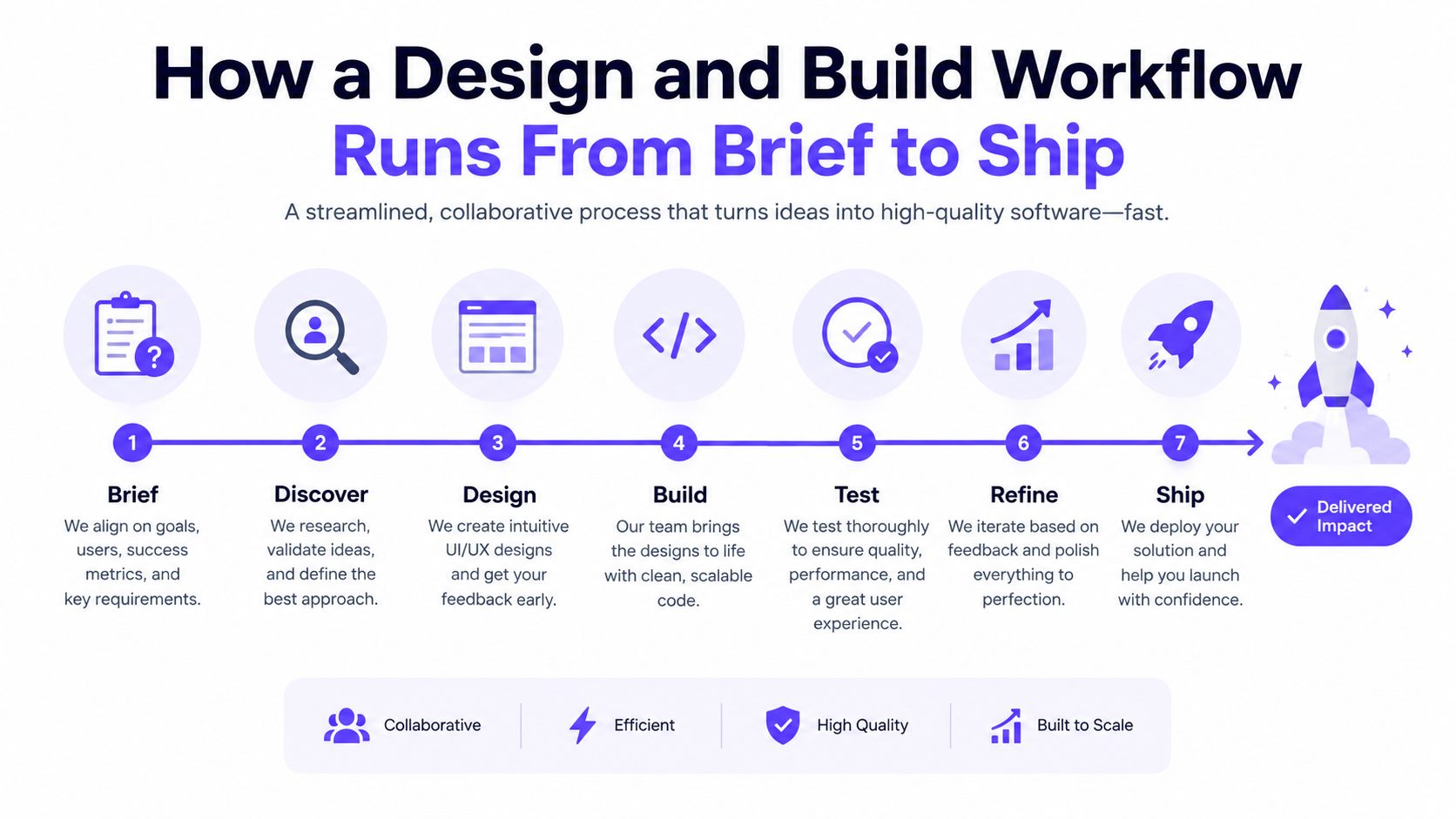
How a Design and Build Workflow Runs From Brief to Ship
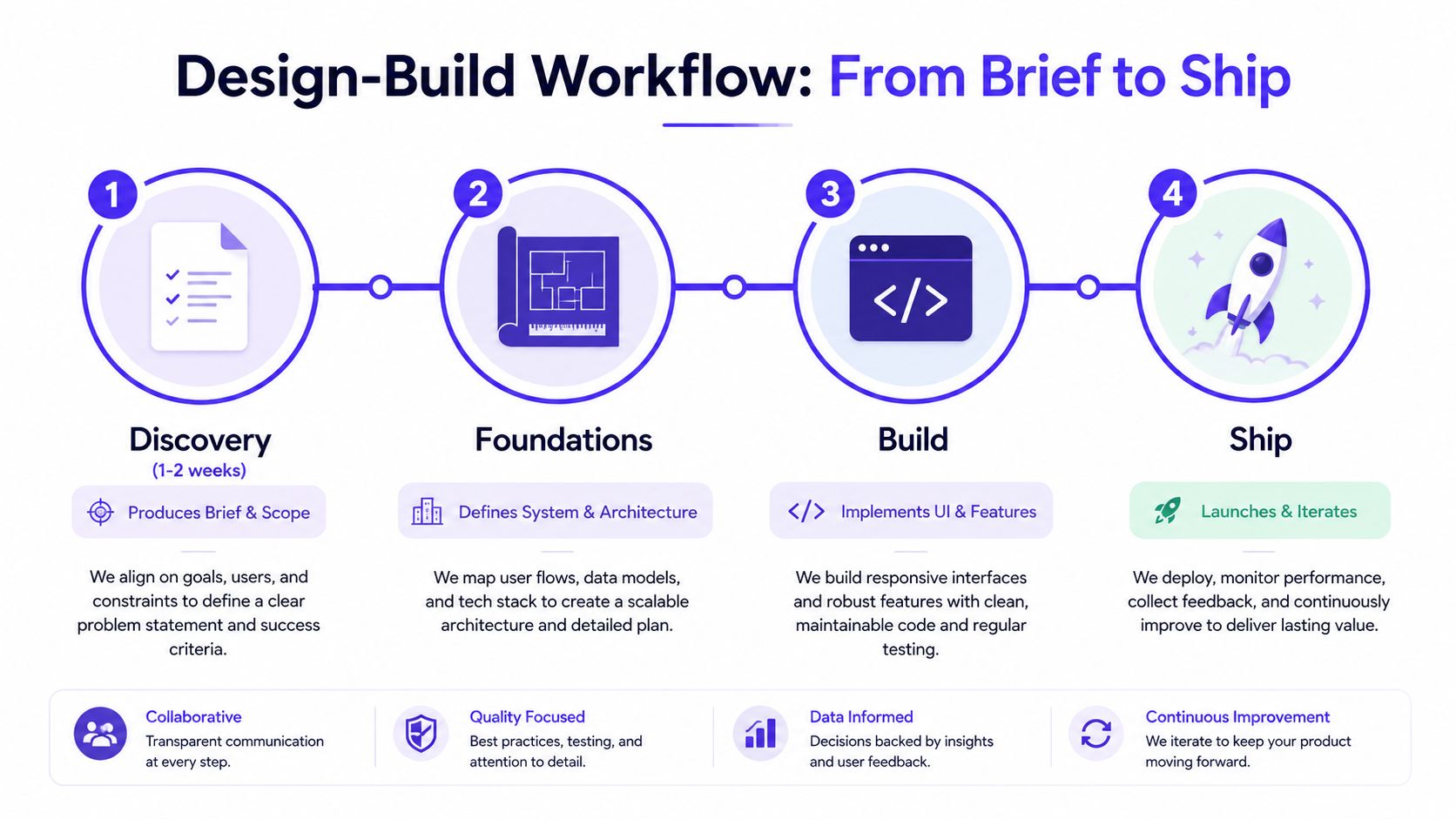
The workflow should feel like a sequence of decisions, not an endless stream of revisions. A typical engagement moves through four phases, each with a clear output and a decision gate.
Discovery creates the boundary
Discovery usually runs for one to two weeks, as documented in the workflow expectations for this type of engagement. The team reviews the product, audience, competitors, existing analytics, technical constraints, and business goal. It produces a brief, competitive teardowns, key user flows, and a signed scope.
The decision gate is scope lock. After that point, new requests can still enter the conversation, but they need an explicit tradeoff. Add a new onboarding path, and something else moves. This protects the build from becoming a collection of urgent opinions.
Foundations remove repeated decisions
The foundations phase establishes the brand system and design tokens, usually in Figma. The team defines typography, color roles, spacing, component behavior, and visual rules that can travel from the website into the product.
The gate is brand sign-off. Founders often damage timelines by asking for major brand changes after product screens and frontend components are already underway. Make the identity decision before the team builds around it.
Build turns decisions into software
Product design and frontend development then move in parallel. Designers finish priority flows while developers establish the component structure and implement approved screens. Weekly demo reviews expose gaps early, especially around responsive behavior, empty states, loading states, validation, and error handling.
The gate is build approval. Approval doesn't mean every possible screen exists. It means the agreed product path works well enough to test, show, and ship.
Launch and handoff finish the arc. The partner ships the public site, hands the product to engineering with usable files and documentation, and leaves a recorded walkthrough. The final gate is a launch checklist, covering content, responsive checks, analytics, accessibility, environment readiness, and ownership after release.
A good partner also publishes a Notion or Linear board. The founder should be able to see decisions, owners, blockers, and upcoming reviews without chasing status updates. For a deeper look at how teams structure the work, see design process steps.
One Partner Versus Three Hires or Three Freelancers
There are three sensible ways to staff product, brand, and frontend work. None is universally correct, but the stage of the company changes the answer.
An in-house setup gives a growing company a product designer, a brand designer, two frontend engineers, and a fractional design lead. That arrangement offers strong institutional knowledge and works well when the roadmap has sustained product velocity. It also creates a management burden before the team has stable processes, and it leaves the founder or product leader responsible for aligning the disciplines.
Three freelancers cost less commitment than hiring, but the founder becomes the project manager. Each person may be excellent in isolation, yet the team still needs someone to resolve conflicting decisions, combine schedules, review quality, and own missed handoffs. Freelancers are a good fit for a narrow logo project, a defined landing page, or a focused product sprint.
A multidisciplinary design and build partner sits between those models. The partner brings the disciplines together, absorbs changes across the scope, and gives the founder one accountable relationship. That makes the model particularly useful from Seed through Series B, when priorities can change every two weeks.
Dimension | In-House Team | Freelancers | Design and Build Partner |
|---|---|---|---|
Cost shape | Ongoing payroll, recruiting, management, tools, and leadership overhead | Variable project fees, plus founder coordination time | Defined project or recurring engagement fee |
Time to first shipped feature | Slower at the start while recruiting and onboarding | Can be quick for narrow work, slower when dependencies overlap | Structured around a shared scope and coordinated delivery |
Accountability | Internal leaders own the outcome | Founder usually owns the seams | One partner owns the connected result |
Best fit | Sustained product velocity and a larger operating team | One-off or tightly bounded assignments | Brand, product, and frontend moving together |
Main risk | High fixed commitment before demand is stable | Misaligned files, schedules, and decisions | Choosing a partner without checking shipped work |
In-house wins once the company has a durable roadmap and enough ongoing work to support the structure. Freelancers suit isolated needs. Between those points, one accountable partner is usually the better operating choice. Founders building SaaS products can also compare the model with a focused SaaS design agency engagement before deciding how much capability to keep internal.
The ROI Case for Funded Startups
The ROI argument starts with the cost of fragmentation. A team redesigns the same pattern because nobody knows whether an existing component is safe to use. Brand work gets duplicated across the site and product. Frontend developers rebuild similar interfaces because design files lack tokens, documentation, or usable components.
A design system turns those repeated decisions into shared infrastructure. A study of IBM Carbon found that developers built a simple form page 47% faster, with median time falling from 4.2 hours to 2 hours, even though the measurement included time spent learning the system. The Carbon design system study is useful because it measures real work rather than assuming that a component library is automatically efficient.
Airbnb offers a broader example. A case study reported that its design system reduced the time required to build a new page by 75%, with average development time per feature falling from 5 days to 2 days. The cited design-system literature connects that improvement to the practical value of reusable patterns across repeated product work.

Turn efficiency into output
Don't present design-system ROI as a vague promise to your board. Track what the team can ship with the same people:
Landing pages: Reuse layout, type, button, form, and navigation patterns instead of rebuilding them.
Onboarding flows: Add product-specific content while preserving known interaction behavior.
Dashboard screens: Extend existing tables, filters, cards, and states rather than creating new visual decisions.
Quality control: Review a shared component once, then apply the correction wherever it appears.
The maturity curve runs from ad-hoc screens to a tokenized library with documented patterns and working frontend components. Early work feels slower because the team is defining the rules. The value increases when those rules begin removing decisions from every subsequent feature.
A separate industry summary reports that mature systems can reduce frontend development time by 35% and QA testing cycles by 25%, while citing an example that removed 4,000 lines of redundant CSS and increased sprint velocity by 22% in the first month. Those figures come from the design-system ROI analysis, and they should be treated as reference points, not promises for every startup.
For a board-ready measurement framework, use how to measure UX design ROI for a startup. Track rework, time from approved design to merged code, reusable component coverage, and the number of experiments shipped. Those measures tell you whether the system is creating capacity or merely adding documentation.
Pricing Models and Selection Criteria
Proposals for design and build services usually take one of three forms. Pick the model that matches how clearly you understand the work, not the model that makes the first invoice look smallest.
Monthly retainer with a defined pod
A retainer works when the roadmap is active and priorities will change. Require a defined pod size, expected availability, meeting cadence, included disciplines, and a process for changing priorities. The contract should make clear whether unused capacity rolls over, whether frontend work is included, and who approves additional scope.
Fixed-scope project fee
Use a fixed fee for a launch, rebrand, marketing site, or clearly bounded product flow. The proposal needs a list of screens, responsive requirements, integrations, review rounds, source files, code ownership, and launch responsibilities. Fixed scope doesn't mean unlimited revisions. It means both sides agree what completion means.
Hybrid or equity-adjacent arrangement
Some longer partnerships combine a reduced cash fee with an equity-adjacent structure. Treat this as a financing decision, not a friendly favor. Define the cash portion, ownership terms, vesting or repayment conditions, termination rights, IP ownership, and what happens if the roadmap changes.
Don't accept invented precision in pricing benchmarks. Engagement cost varies by scope, seniority, technical complexity, and the level of ownership required. A quote without a deliverable map isn't a bargain. It's an unknown.
The one-hour selection test
Score each candidate with yes or no answers. Ask for proof, not reassurance.
Criterion | What to Ask |
|---|---|
Vertical experience | Can they show shipped work for AI SaaS, Web3, or Fintech teams like ours? |
Founder references | Can I speak with a founder who worked with the actual team proposed? |
Design systems | Can they demo a live Figma library and the matching frontend components? |
Frontend quality | Can they show production code, responsive behavior, and handling of states beyond the happy path? |
Workflow visibility | Will we have a Notion, Linear, or equivalent board with owners and decisions? |
Time-zone overlap | Are there enough shared working hours for reviews and shipping cadence? |
Decision ownership | Is one person accountable when brand, product, and code disagree? |
IP ownership | Does the contract clearly transfer the agreed files, assets, and code? |
Handoff plan | Will engineering receive documentation, prototypes, source files, and a walkthrough? |
Change control | Does the proposal explain how new priorities affect timing and fees? |
If a candidate answers “yes” but can't demonstrate the work, score it as “no.” Your startup is buying judgment and execution, not presentation quality.
What Good Output Looks Like in Practice
The most useful examples are compact and specific. They show what changed, which artifacts shipped, and how the team measured the result.
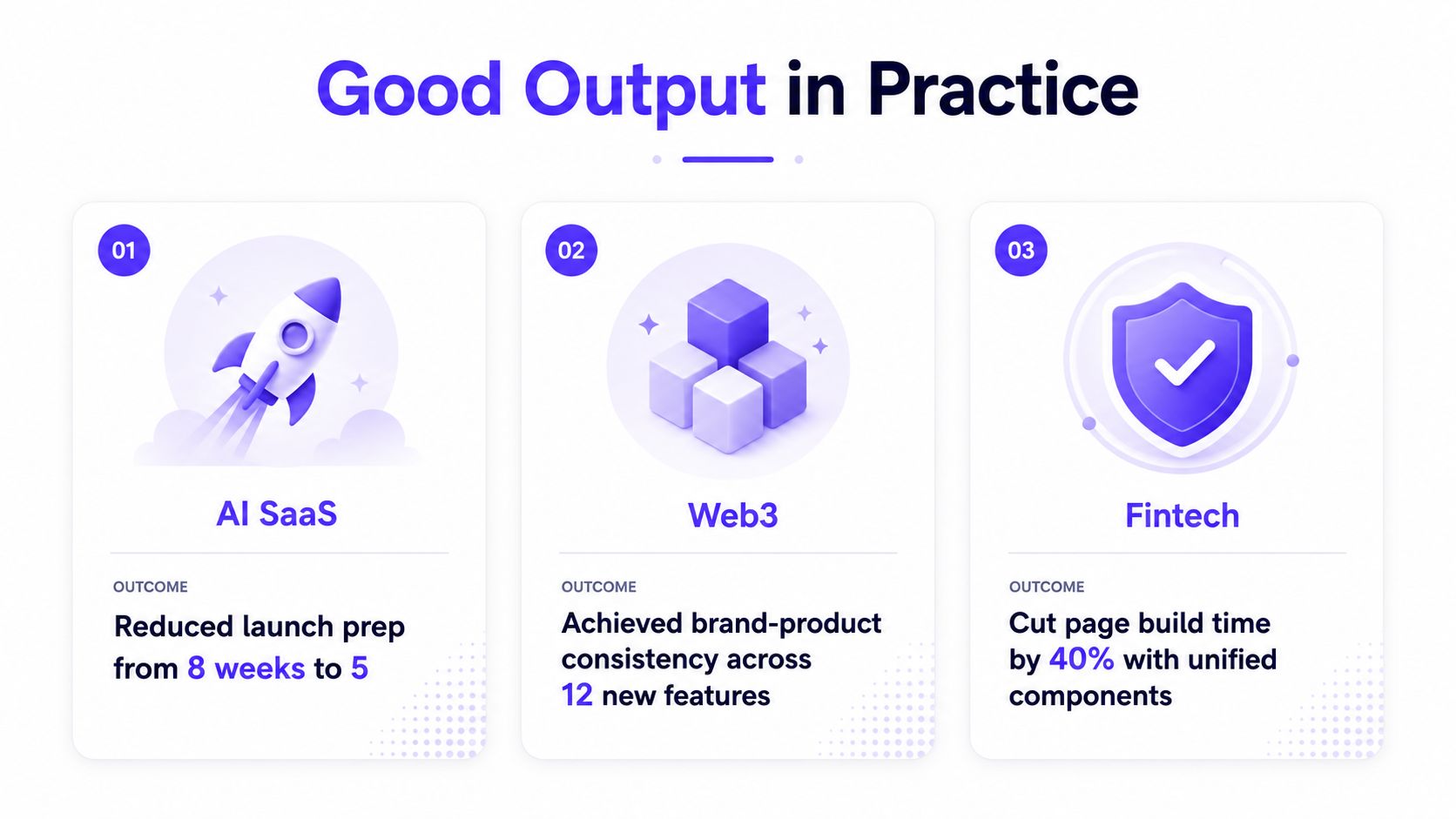
An AI SaaS founder starts with a capable product but a blank Figma file, an inconsistent marketing site, and no shared pattern library. The engagement maps the onboarding path, defines the product and brand foundations, builds a production-ready design system, and ships landing pages that use the same visual language as the application. The outcome isn't just “better design.” The founder leaves with reusable components, documented patterns, and a working page structure that the internal team can extend.
A Web3 wallet team has a different pressure point. The brand voice needs to feel credible, but the product also has to explain wallet connection, signing, transaction review, and failure states clearly before a token launch. One partner can make the messaging and interface behave like one product, so a new feature doesn't look like it came from a different company. The deliverable is a consistent brand system tied directly to the onchain flows, with launch assets and product screens reviewed together.
A Fintech payments startup may already have a marketing site and dashboard, but they were built from separate visual assumptions. Rebuilding both from a shared component library gives the team one language for navigation, forms, tables, alerts, and trust signals. New screens become extensions of an existing system rather than fresh design exercises.
What to request before signing
Ask every studio to show the artifacts behind the outcome:
AI SaaS: Can they show the component library, onboarding prototype, and implemented landing page?
Web3: Can they explain how they designed transaction states, wallet errors, and trust cues?
Fintech: Can they show how the marketing system and dashboard share components without flattening their different needs?
You should also check whether the studio understands the commercial side of the launch. A practical startup sales tool guide can help your team think through the sales workflow that the new site and product experience need to support.
The right output is visible in the files, the browser, and the handoff. If the candidate only presents polished mockups, you haven't seen enough.
When to Hire the Partner and When to Walk Away
Design and build services fit a specific operating moment. You're a Seed to Series B team with a funded roadmap, at least two design-adjacent surfaces to ship, no senior design lead on staff, and a need to move from concept to launch within a quarter. The surfaces might be a product dashboard and marketing site, a brand refresh and onboarding flow, or a wallet experience and launch campaign.
Those conditions make integration valuable because the work has to move together. The brand affects the product. The product affects the site. The frontend exposes decisions that design needs to revisit. One partner can absorb those connections without forcing the founder to coordinate every adjustment.
Walk away when the scope is narrow or the internal capability is already strong:
A single logo: Hire a brand specialist if that's the entire need.
A strong product design lead: Add focused execution support instead of replacing the lead's judgment.
A vague mandate: Don't sign until the partner can define the problem, deliverables, and decision gates.
A stable internal engineering team: Consider a design-only engagement if implementation is already covered.
A short tactical task: Use a freelancer when the work has no meaningful connection to product or brand.
The decision test is simple. If the next six months require brand, product, and frontend to move in lockstep, a design and build partner earns its keep. If they don't, a narrower engagement will save money and reduce unnecessary management.
Shortlist candidates, review shipped work, and run a paid discovery sprint before signing a long contract. You'll learn how the team thinks, how it handles ambiguity, and whether it can turn your product into a coherent experience before committing to a larger relationship.
925 Studios gives AI SaaS, Web3, and Fintech companies one creative partner across product design, brand identity, frontend development, and design systems. If your next roadmap requires those pieces to ship together, visit 925 studios and start with a focused conversation about the product, brand, and frontend work that needs to move first.


Let’s keep in touch.
Discover more about high-performance web design. Follow us on Twitter and Instagram.

