Website Design vs Development: What Founders Need to Ship

Outrank AI

You're probably in the exact spot where this question becomes real. You've got a Figma link from a designer, a staging URL from a developer, a launch date that keeps sliding, and nobody can tell you who owns the gap between “looks right” and “works right.”
That's why most founders search website design vs development in the first place. Not because they want a clean textbook definition. Because they need to decide who to hire, what to pay for, and who's accountable if the site ships late, loads badly on mobile, or looks polished but converts like a brick.
I'm going to give you the blunt version. This is not really a choice between visuals and code. It's a decision about ownership, performance, and accountability. If those are split across separate people without a clear operating model, launches fall apart.
Table of Contents
What the Design vs Development Question Really Means
A founder sends over two links. One is a beautiful mockup. The other is a half-working build. The mockup has the right brand, strong typography, a clean homepage, maybe a sharp dashboard concept. The build has broken spacing on mobile, unclear form states, and interactions that feel slower than they looked in review.
That's the true version of website design vs development.
The founder isn't asking, “What does a designer do?” They're asking a harder question. Who fixes this, and who should've prevented it? That's the question that matters when launch is close and your team is out of patience.
The Web has always required both sides. As the short history of the Web from CERN shows, the internet moved from research infrastructure into a commercial platform fast. Tim Berners-Lee invented the World Wide Web at CERN in 1989, the first web server and browser were running there by the end of 1990, CERN released the software in 1991, and after it made the technology freely available in April 1993, the number of websites grew from about 130 in mid-1993 to more than 12,000 by the end of 1994. By late 1993, the Web had over 500 known servers and about 1% of Internet traffic. By the end of 1994, it had 10,000 servers, including 2,000 commercial servers, and about 10 million users. That growth made one thing obvious. Publishing infrastructure alone wasn't enough. People also needed interfaces they could use.
That's still the job today. Development gives you the system. Design gives people a way through it.
A polished design with weak implementation becomes a frustrating product. A technically sound build with weak design becomes a product nobody wants to use.
If you're deciding what to hire next, stop thinking in job titles first. Think in launch outcomes. Teams typically end up in one of three places:
A polished look, broken in the browser
A fast site that feels confusing
A coherent product, planned as one design-and-build system
That third outcome is what founders want. If you need a clearer picture of what that combined model looks like in practice, design and build services are the right frame to look at, not isolated role descriptions.
What Each Discipline Actually Owns
The lazy explanation is that design makes it pretty and development makes it work. That explanation costs founders money. You need to know who owns which decisions before kickoff, not after the bugs show up, because when ownership is vague, the launch falls flat and nobody can say why.
Here's the actual breakdown.

What design owns before anyone writes code
Design owns the structure of attention. That covers information hierarchy, wireframes, page flow, navigation logic, component behavior, empty states, error states, motion rules, typography, and the visual system that makes a dashboard feel calm instead of noisy. It also owns the intent behind every interaction, which is why design questions sound different from developer questions.
Ask design these before kickoff:
What should users notice first
What happens on hover, focus, error, and success
How should the onboarding flow reduce hesitation
What's the visual rule set for cards, forms, tables, and alerts
If those decisions aren't made early, developers will make them by default. That usually means inconsistency, and inconsistency is what users read as "cheap."
The gray zone is the component library. Designers often think they own the system because they built the screens. Developers often think they own it because they built the components. The boundary isn't the Figma file or the code repo. It's the decision. If no one owns component behavior, spacing logic, and responsive states, the system drifts fast, and every new page makes it worse.
For founders mapping the whole thing, the core parts of a website are worth a review because they make the handoff points obvious.
What development owns after the concept leaves the deck
Development owns the shipped experience. That means frontend architecture, semantic HTML, responsiveness, integrations, CMS implementation, browser behavior, build pipelines, deployment, runtime performance, and accessibility implementation. Mockups stop being promises and become software here.
Mobile is where ownership gets tested. The digital transformation overview from the University of North Texas Open Books documents how quickly the web shifted toward mobile access, and that shift has only deepened since. Treat mobile performance as a shared product decision, not a developer clean-up task. If the design assumes desktop behavior and the build is expected to "make it responsive later," the team is already behind, and the person who gets blamed at launch will be the developer, even though the root problem started in design.
Development questions are different:
Who owns performance budgets
Who validates touch states on real devices
Who handles CMS structure and content rendering
Who's responsible for accessibility behavior, not just visual intent
My recommendation: assign a named owner to each of those four before the first sprint. Unassigned questions don't disappear, they get answered by whoever is under the most deadline pressure, which is how launches miss.
If you want a useful outside read on the handoff problem, these web design to code articles from RapidNative are worth a look because they focus on the messy part founders pay for, translating design files into working software.
Side-by-Side Comparison Founders Actually Use
Founders don't compare roles the way agencies do. They compare risk. They want to know what gets delivered, what breaks under pressure, and who gets the call when launch week goes sideways.
Here's the comparison that matters.
Criterion | Website Design | Website Development |
|---|---|---|
Primary output | Wireframes, UI, visual system, flows, prototypes | Shipped frontend, CMS setup, integrations, responsive implementation |
Decision owner | Hierarchy, interaction intent, content layout, component behavior rules | Architecture, code quality, browser behavior, deployment, performance implementation |
First usable draft | A reviewable concept you can react to | A clickable or live build you can test in the browser |
What breaks when rushed | Confusing flows, weak hierarchy, inconsistent states, pretty but shallow screens | Slow pages, broken layouts, missing states, unstable forms, fragile integrations |
Cost driver | Scope of pages, product complexity, system depth, brand requirements | Build complexity, CMS needs, integrations, QA, responsiveness, performance work |
Who gets blamed when launch misses | Usually nobody clearly, if design stops at files | Usually the developer, even when the root problem started in design |
The first trap is mistaking output for progress
A finished Figma file feels like progress because it's visible. So does a staging URL. Neither proves the product is ready.
Design gives you a decision surface. You can align on brand, hierarchy, and interaction intent. Development gives you a testable product. You can check load behavior, form logic, rendering, accessibility, and responsiveness. Founders get in trouble when they assume one can stand in for the other.
A sharp mockup can still hide expensive problems. A fast build can still hide confusing user flow.
The rush cost is different on each side
When design is rushed, the product usually launches with subtle damage. The path isn't obvious. The signup flow asks for too much at once. Error states are vague. Pricing pages bury the decision. Nothing crashes, but users leak out.
When development is rushed, the damage is louder. Layout shifts. Inputs break. The mobile menu behaves strangely. CMS content blows up the spacing. The page looks right in review and falls apart in use.
That's why founders should stop asking which side is more important. The question to ask is which risk is more expensive for your current launch.
Accountability is the deciding factor
This is the one criterion that usually tells you what model to choose.
If design and development are split, accountability often disappears in the seam. Designers say the build missed the file. Developers say the file didn't solve real states. The founder ends up paying for a third round.
That's one reason teams compare integrated options against disconnected ones, especially when launch windows are tight. If you're weighing a packaged platform against a real partner, this breakdown of AI website builder vs design agency is relevant because it forces the same question, who owns outcomes after the first version goes live?
If nobody owns the gap between concept and shipped behavior, the founder owns it by default.
Where Each Side Quietly Breaks the Product
The expensive failures usually hide until launch day. Traffic arrives, forms go live, and the product starts behaving like a broken promise.

Design can create technical debt before build starts
Founders often hand performance to development and call it a day. That is the wrong split.
A recent Core Web Vitals study summary found that many sites still miss all three thresholds, with mobile sites lagging desktop ones. Interaction responsiveness was a major weak point, which is exactly what happens when design piles on heavy visuals, motion, dense component sets, and third-party scripts without a performance budget.
Google's own Core Web Vitals guidance is blunt about what “good” means. A page passes when Largest Contentful Paint is at most 2.5 seconds, Interaction to Next Paint is at most 200 milliseconds, and Cumulative Layout Shift is at most 0.1, measured at the 75th percentile across mobile and desktop traffic. If the design team ignores those limits, development inherits a problem that was baked in early.
Set route-level performance budgets while you are still in wireframes. Decide what can animate, what can autoplay, what loads above the fold, and what gets deferred.
Development can ship a technically sound product nobody enjoys using
The opposite failure is just as common. The code is clean. The page loads. Users still drop off.
MDN's web performance guidance separates raw speed from how responsive the interface feels. Its practical guidance says idle work should generally finish within about 50 milliseconds, animation frames should target roughly 16.7 milliseconds for 60 frames per second, and user-input responses should land within about 50 to 200 milliseconds. A dashboard can look fine in review and still feel broken if interactions lag, charts block the main thread, or forms update badly.
Device context changes how people finish tasks. The same UNT digital transformation chapter shows that smartphone users made more errors per task than PC users in the study it summarizes, which is a practical warning for product teams. If your flow is being used on a phone, the design and build process has to respect that reality.
The fix is straightforward. Fast code will not rescue a weak flow. Beautiful screens will not rescue blocked interactions.
Matching the Mix to Your Stage and Product
The right answer changes with stage. A pre-seed marketing site is not the same hiring problem as a SaaS dashboard rebuild. A fintech onboarding flow is a different animal again.

Early-stage marketing site
If you're pre-seed or just raised, you usually need one thing. A credible site that explains the product clearly, looks funded, and doesn't collapse on mobile.
That's a design-led build problem with a lightweight frontend layer. You don't need three disconnected hires. You need one partner or one tight pair that can decide brand, messaging hierarchy, page structure, and frontend implementation together.
Keep product strategy and positioning internal. Outsource the interface system and frontend delivery. The risk to watch is overbuilding. Founders burn time chasing motion polish and custom flourishes before they've nailed the story.
SaaS dashboard or design system rebuild
Split ownership gets dangerous here. Your product has real complexity now. Permissions, tables, filters, edge states, chart behavior, empty states, and responsive logic all need a system, not just screens.
The right shape is usually an embedded product designer working closely with one or two frontend engineers, with design system ownership assigned before build starts. That can be internal, external, or hybrid. What matters is that one person owns component decisions and one person owns shipped component fidelity.
A combined partner can work here too. For example, 925 Studios handles product design, brand design, and frontend delivery as one integrated engagement for AI SaaS, Web3, and fintech teams that don't want to build that full layer in-house. That model makes sense when brand, UI, and shipped frontend all need to move together.
Fintech and Web3 onboarding
Founders should stop treating accessibility like a late QA pass.
WebAIM-based reporting found that 94.8% of the top one million homepages failed automated WCAG checks in February 2025. Low-contrast text affected 79.1% of homepages, and missing alternative text affected 55.5%, according to Figma's web design statistics resource. That's why accessibility ownership has to start in design, not get patched in code later.
For fintech onboarding, KYC, wallet setup, account creation, and identity verification, the mix should be accessibility-led design plus frontend ownership of validation and integration. Keep compliance logic internal if it's tied closely to product risk. Outsource the interface and frontend experience if your team doesn't already have senior hands on it.
The product stage decides the mix. The risk profile decides who owns what.
Costs and Timelines Founders Actually Face
Most proposals lie by omission. Not because the vendor is dishonest, but because the biggest costs usually sit between line items, not inside them.
A design-only engagement buys clarity. You get wireframes, visual direction, prototypes, and usually a component system. That's useful when your internal team can build well and just needs direction. The hidden cost is translation. Someone still has to turn decisions into real browser behavior, responsive logic, content handling, and QA.
A development-only engagement buys implementation. That works if the design is mature, complete, and realistic. The hidden cost is rework. If key states aren't designed, developers fill in the blanks, and founders end up reviewing business decisions as bug fixes.
The combined model costs more on paper than a narrow specialist scope and less than the chaos of fragmented ownership. You're not just paying for screens and code. You're paying to remove the gap where most delays, revisions, and launch-week arguments happen.
The timeline founders underestimate
Three separate hires rarely move like one team. Even when each person is good, they need ramp time, review cycles, feedback loops, file cleanup, design QA, implementation interpretation, and decision arbitration.
That's the cost founders miss most. Not just invoices, but coordination drag.
A cleaner way to think about timelines:
Design-only works when your internal frontend team is ready now, with bandwidth, not eventually.
Development-only works when your source files already cover responsive behavior, states, content flexibility, and component logic.
Combined partner works when you need decisions made quickly and shipped without handoff theatre.
The cost of getting it wrong shows up in conversion leakage
Baymard's research found that 17% of US online shoppers abandoned an order because checkout was too long or complicated, while 13% left because the site crashed or showed errors, according to Baymard's UX statistics. That's the clearest argument against the split-hire model. The cost doesn't just appear in project overrun. It shows up when users fall out between friction and failure.
A founder feels that in very concrete ways:
The product story gets weaker because nobody owned the hierarchy end to end.
The launch slips because design QA becomes design redesign.
The site underperforms because the path looked clean in review but broke in use.
You don't pay most heavily for the wrong setup in procurement. You pay for it after launch.
When to Hire Specialists and When to Hire One Partner
Founders don't need ideology here. They need a clean decision.
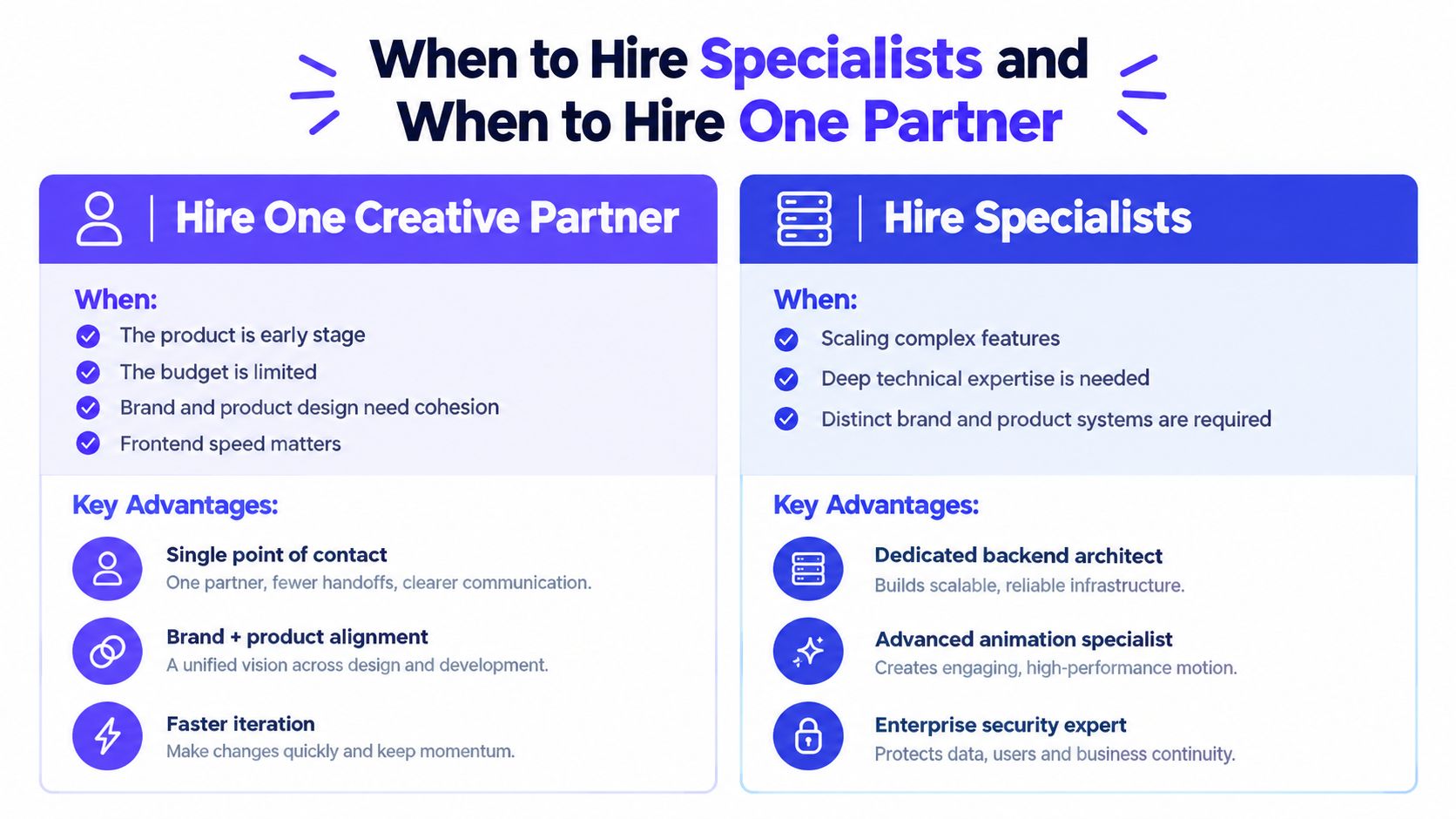
Hire specialists when the problem is specialized. If you're running a mature product org, already have strong brand and frontend coverage, and now need a dedicated design system lead, security specialist, or highly technical backend architect, go narrow. That's what specialists are for.
Hire one partner when the work crosses brand, product design, and frontend delivery, and your real risk is misalignment. That's common in AI SaaS, Web3, and fintech, where the product is complex, the message is evolving, and founders can't afford a six-person handoff chain.
A useful hiring lens is ownership, not discipline. Even broader staffing conversations land on this same issue. These direct hire insights from Nexus IT Group are helpful because they show how hiring shape changes accountability and coordination, even outside design and development.
A founder checklist before signing anything
Run these four questions before you hire:
Who owns the design system once the first round of screens is approved
Who owns performance score when the live site misses the mark
Who is on call the week before launch when responsive issues and content bugs pile up
Who decides what done means for the final shipped experience
If you can answer all four clearly with separate hires, the split model can work.
If you can't, don't force it.
The blunt recommendation
For most early and growth-stage teams, website design vs development is the wrong frame. The right frame is whether you want two handoffs or one accountable partner.
That's why the combined model keeps winning in real startup environments. One creative partner can replace three separate hires, product designer, brand designer, and frontend developer, when the work needs cohesion more than org-chart purity. A specialist model is still the right call for large internal teams with defined systems and narrow gaps. But if speed-to-ship, clarity, and accountability matter most, one integrated partner is usually the smarter buy.
If you need one team that can handle brand, product design, and frontend delivery in the same workflow, that's exactly what 925 studios offers for AI SaaS, Web3, and fintech companies. We help founders ship sites and product experiences without the usual gap between the deck, the design file, and the live build.

Let’s keep in touch.
Discover more about high-performance web design. Follow us on Twitter and Instagram.