
Web3 Design Agency vs In-House Comparison Guide

Yusuf
Founder and lead designer at 925studios

You've got a token launch on the calendar, the product mockups are half-finished, and the founder chat is already asking for a landing page, a dashboard polish pass, and a brand refresh before the next investor update. That's the moment the web3 design agency vs in-house decision stops being theoretical. If you hire too early, you lock in overhead before the product story settles. If you outsource blindly, you can end up with polished screens that don't match the way your team ships.
Option | Best fit | Main trade-off | What founders usually miss |
|---|---|---|---|
Agency | Bursty launches, shifting roadmaps, specialist execution | Less direct control | Governance still needs a clear owner |
In-house | Continuous work, deep product ownership, daily iteration | Fixed burn and slower ramp | Hiring cost isn't just salary |
Hybrid | Teams that need both stability and specialist support | Requires discipline | Handoffs break without rules |
Table of Contents
Introduction to web3 design agency vs in-house
A seed-stage founder usually feels this choice in the middle of a deadline, not in a neat planning meeting. The token page needs to look credible, the product interface needs to stop confusing new users, and the homepage has to hold up in front of investors, partners, and the first real customers. If the team can't ship that standard in time, the launch loses momentum before it even starts.
A Web3 design agency gives you a team that can cover brand, product, and frontend work without forcing you to hire three separate people. An internal hire gives you tighter daily control, but it also adds recruiting, onboarding, tools, and management overhead. For founders comparing options, the question isn't “agency or in-house?” It's who can own the outcome cleanly enough to keep the launch moving.
Practical rule: if the product story is still changing, buy flexibility first. If the work has become repetitive and constant, then internal ownership starts to make sense.
That's why the decision is part design, part operating model. The wrong setup creates avoidable friction, like slow approvals, mismatched visuals, or a founder spending half the week acting as a project manager. For teams building in Web3, this matters even more because launches often move around token timing, community growth, audits, and funding milestones. If you want a useful starting point for how a Web3-focused partner thinks about the market, see 925 Studios' Web3 work.
Overview of agency and in-house models
An agency engagement is built around an external team taking on scoped work, usually through a retainer or project agreement. That team can cover the parts founders struggle to staff separately, such as product design, brand design, and frontend execution. The upside is straightforward, you get senior-level output without adding permanent headcount. The trade-off is just as clear. Someone inside the company still has to own direction, approvals, and priorities.
The question is who controls the workflow. A strong model keeps strategy inside the business while handing specialist execution to a partner. That setup works well in Web3 because launch coordination, founder voice, and product decisions can fall apart when no one owns the full sequence from positioning to proof to distribution. For a broader reference on outsourcing for Web3 and blockchain platforms, that split is the right starting point.
An in-house model looks simpler on paper. You hire one person, then possibly build out from there, and the work sits under direct control. In practice, the company also takes on salary, benefits, tools, recruiting time, and management time. It must keep that person busy enough to justify the role. That is why the decision is really about control shape, not just team size.
Keep strategy close to the business, then decide whether execution needs to live inside the company or with a partner.
For founders comparing options more mechanically, the cleanest lens is workload pattern. Bursty launch work, brand resets, and sprint-based product cleanup fit an external partner well. Daily product iteration and long-term ownership eventually justify internal staff because the work becomes constant, not occasional. If you want a practical comparison of flexible design support and a permanent seat, 925 Studios' comparison of design agency and design subscription models is a useful adjacent read.
Comparing cost and time efficiencies
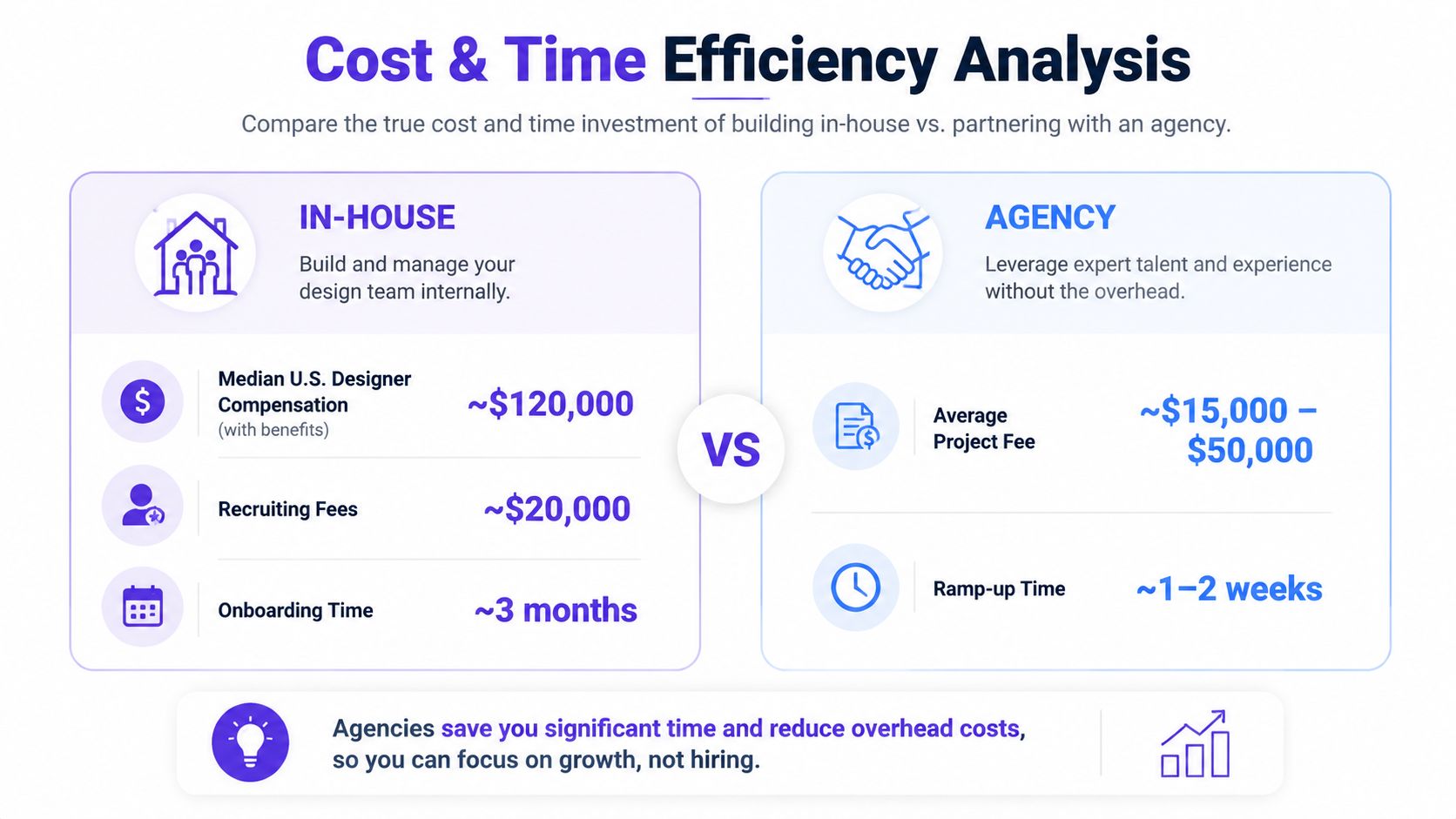
A founder who only compares sticker price will make the wrong call. The question is total cost of ownership, because an in-house designer brings salary, benefits, tools, recruiting time, and management overhead with them. U.S. median annual pay is $95,380 for web developers and digital designers and $98,090 for web and digital interface designers, while private-industry benefits average about 30% of total compensation, which pushes one mid-level in-house designer to roughly $140,000 all-in before recruiting, tools, or management overhead (925 Studios). That is fixed burn, whether the pipeline is full or quiet.
Agency pricing gives founders a different kind of control. Smaller retainers can run $1,000–$5,000 per month, mid-market retainers $5,000–$15,000 per month, and broader web design projects often fall under $10,000 for simpler scopes (Parallel HQ). The advantage is not automatic savings. It is flexibility. You buy capacity only when you need it, instead of paying for a full-time seat through slow weeks and false starts. That is the better fit when design demand rises and falls with launch timing.
Time to first useful output
Speed changes the decision as much as cost. Agencies can start in days, while hiring in-house typically takes 36 days before a single pixel is touched and roughly 90 days before a new hire reaches full productivity (Parallel HQ). That gap is not minor. It decides whether polished launch assets ship on time or whether the market sees rough work first and your team spends the next sprint cleaning it up.
A token announcement with a landing page and onboarding flow makes the trade-off obvious. An external team can start shaping the work after kickoff and scope alignment. An internal hire still has to be sourced, hired, and ramped before the work moves. That delay only makes sense if the roadmap is stable enough to absorb it.
Founder test: if the next three months are launch-heavy, agency support usually protects momentum better than a new hire.
If you are trying to size the budget behind that choice, 925 Studios' product design cost guide for 2026 is a useful planning reference. The broader market also shows how normal outsourced execution has become. Web design services in the U.S. were estimated at $47.4 billion in 2025, growing at a 2.3% CAGR since 2020 (Parallel HQ).
Evaluating quality ownership and governance
The mistake is treating design quality as a pixel-level issue. It sits in the approval chain, the handoff rules, and the person who decides what “done” means. Once founders see that clearly, the agency versus in-house decision becomes about control, accountability, and how work moves through the company.
A practical way to judge both models is to watch a small set of operational metrics. Track total cost of ownership, cost per completed deliverable, average project completion time, ramp-up period, and error rate/defect density. For in-house creative operations, field benchmarks often point to on-time delivery rate ≥ 95%, first-time approval rate ≥ 85%, and revision hours under 10% of total production hours (Zigpoll). Those numbers give founders a real read on whether the internal process is disciplined or just comfortable.
What ownership looks like in practice
An internal team usually has fewer handoffs, which can help brand consistency. It can also create a single point of failure if one designer becomes the only person who understands the product system. Agencies bring broader coverage, which helps when brand, UI, and frontend thinking need to work together, but that broader team still needs clear approval rules or the work drifts.
When the founder, product lead, and marketer all make different calls each week, no design model feels clean. Governance is the issue. A good agency relationship starts by defining who signs off on strategy, who approves visuals, and who owns the final handoff into build. The same discipline matters in-house, because informal approval chains create the same confusion under a different payroll.
How to keep quality from slipping
Use one standard for both models. Brand consistency should not depend on whether the work came from payroll or a retainer. If a change request arrives late, the team should know whether it is a priority shift or a scope problem. That distinction matters because it decides whether design should absorb the change or push back on it.
Clear governance beats extra meetings. Teams move faster when one person owns the decision and everyone else knows the boundary.
The practical takeaway is direct. Internal teams usually win on direct oversight. Agencies usually win on breadth and defined process. In-house design becomes defensible when the company has enough workload to justify stable ownership, enough product complexity to reward deep context, and enough decision discipline to keep approvals from turning into noise. If you need a senior design leader and you want to hire for that seat, apply for Head of Design role.
Managing hiring ramp versus vendor onboarding
A founder sees the same design gap two ways. One path is hiring a person and waiting for that person to learn the product, the brand, and the internal decision rules. The other path is onboarding a vendor that can start from a brief, a kickoff, and a defined scope. Those are different forms of drag, and the difference shows up immediately.

The ramp-up gap founders underestimate
A new hire needs context before output. They need the product narrative, the brand rules, access to past decisions, current priorities, and a manager who can answer questions fast. An agency needs a clear brief, the people who approve work, and a clean first scope. That is why vendor onboarding usually feels faster, but only if the team has already done the thinking.
A hiring funnel adds more friction than founders expect. Job posting, interviews, offer negotiation, notice periods, and onboarding all happen before the new designer can carry real ownership. Vendor onboarding follows a different path. Discovery, scoping, kickoff workshops, and sprint planning happen first, then execution starts. In Web3, that difference matters because launch work often sits on top of token timing, campaign timing, or product release timing. If those dates are fixed, the design process has to fit them.
The more specific the first brief, the less waste on either side. A strong vendor kickoff should name the product surface, the decision owner, the review path, and the files or systems the team needs to touch. A strong new hire handoff should include the same material plus examples of what good looks like inside the company. Without that, both models stall in the same place. People wait for answers that should have been written down.
How to reduce friction either way
Start with the handoff, not the talent search. If you hire internally, give the designer a product narrative, brand rules, active priorities, and the names of the people who can approve work on day one. If you bring in an agency, define the approval chain before kickoff and name who can change scope, who can approve visuals, and who can reject a direction. The work gets slower when founders expect everyone to infer the process.
That discipline matters more in Web3 than many teams admit. Products change quickly, and design requests often come from multiple sides of the business at once. A founder might want a launch page, a product lead might want a UX fix, and a marketer might want campaign assets. If those requests land without a clear order, both an internal hire and an external vendor spend their time sorting priorities instead of producing work.
For teams building internal ownership, the role profile also has to be clear. A senior design lead should not be hired as a vague catch-all. The company should know whether that person is expected to own product direction, manage brand consistency, or coordinate delivery across teams. If you are defining that seat, apply for Head of Design role can help as a reference point for how senior design leadership is framed in the market.
Practical rule: if the work is urgent and the requirements are still moving, outsource the first pass. If the work is recurring and well-defined, hire for the long term.
A video walkthrough can also help teams align around the ramp question before they commit.
Hybrid models for scaling design in Web3
Hybrid teams work best when one part of design stays close to the business and another part flexes with demand. A founder or product lead should keep the product judgment in-house, while outside specialists handle the spikes that come with launches, redesigns, and sudden shifts in scope. That setup fits Web3 teams that are still changing the product but also need steady output on brand and release work.
The workload threshold matters here. In-house design starts to make sense when demand is steady and high enough to justify a full-time seat, while agency support fits short bursts and mixed-skill work better (webdev-design.com). If the need is sporadic, a hire can sit idle between projects. If the same work keeps coming back every week, internal ownership becomes easier to defend because the company is no longer paying for gaps in utilization.
A practical split that works
Keep product calls, roadmap choices, and final design approval inside the company. Bring in external help for launch pages, campaign assets, brand refreshes, and redesign sprints tied to fundraising or major product changes. In Web3, this split keeps one designer from becoming the default owner of everything while still protecting consistency across touchpoints.
The handoff rules matter more than the org chart. The in-house side should set priorities and sign off on the final direction. The external side should own execution speed and delivery discipline. That keeps control where the company needs it and uses outside capacity where it adds the most value.
A hybrid model only works when someone inside the company is willing to make decisions fast.
Founders often treat hybrid as a compromise. It works better as a clean division of labor. The internal team keeps product memory, brand judgment, and context over time. The outside partner fills gaps without forcing the company to carry every specialty on payroll.
Startup case studies and templates
A seed-stage protocol that's about to announce a token can't afford a long hiring cycle. The team usually needs a landing page, investor-facing brand work, and product polish at the same time, and the product story is still moving. In that situation, outsourcing usually wins because the company is buying flexibility while the narrative is still forming. The main risk is over-customizing the launch assets before the core message stabilizes.
A different pattern shows up in teams that already have a clear product and a steady release rhythm. One practical approach is to keep brand direction inside the company and bring in external help for UI sprints when the internal team is stretched. That works well when the founder wants daily ownership over messaging, but still needs extra hands for a redesign or onboarding flow cleanup. The result is less about saving money and more about keeping the work moving without hiring too early.
The third pattern is the one that justifies an internal studio. A Series A fintech team with repeated product updates and ongoing marketing needs can build in-house once the demand is no longer bursty. At that point, the company stops treating design as a project and starts treating it as a core function. That's the point where the workload threshold begins to matter more than the logo on the contract.
Templates that keep the choice honest
Scope checklist: List every deliverable you need in the next quarter, then mark which ones are recurring and which ones are one-off launch work. If the list keeps changing every week, you probably need flexibility more than headcount.
Governance playbook: Name the person who approves strategy, the person who reviews final design, and the person who owns launch timing. If those roles overlap too much, revisions will pile up.
Onboarding timeline: Write out the first two weeks for either a hire or an agency. If you can't describe the first steps clearly, the team isn't ready to scale the work yet.
925 Studios fits into this picture as one creative partner that can cover product design, brand design, and frontend development without forcing a startup to hire those roles separately. That matters most when the team needs one place to validate the product story, shape the brand direction, and get the first version of the onboarding flow out the door.
Decision framework and checklist questions
A founder who is choosing between a web3 design agency vs in-house should make the call from operations, not preference. Start with the work, how often it changes, who approves it, and whether the team can keep it moving without creating bottlenecks. If the answer is mixed, build a split model and define what stays inside the company before the first project starts.
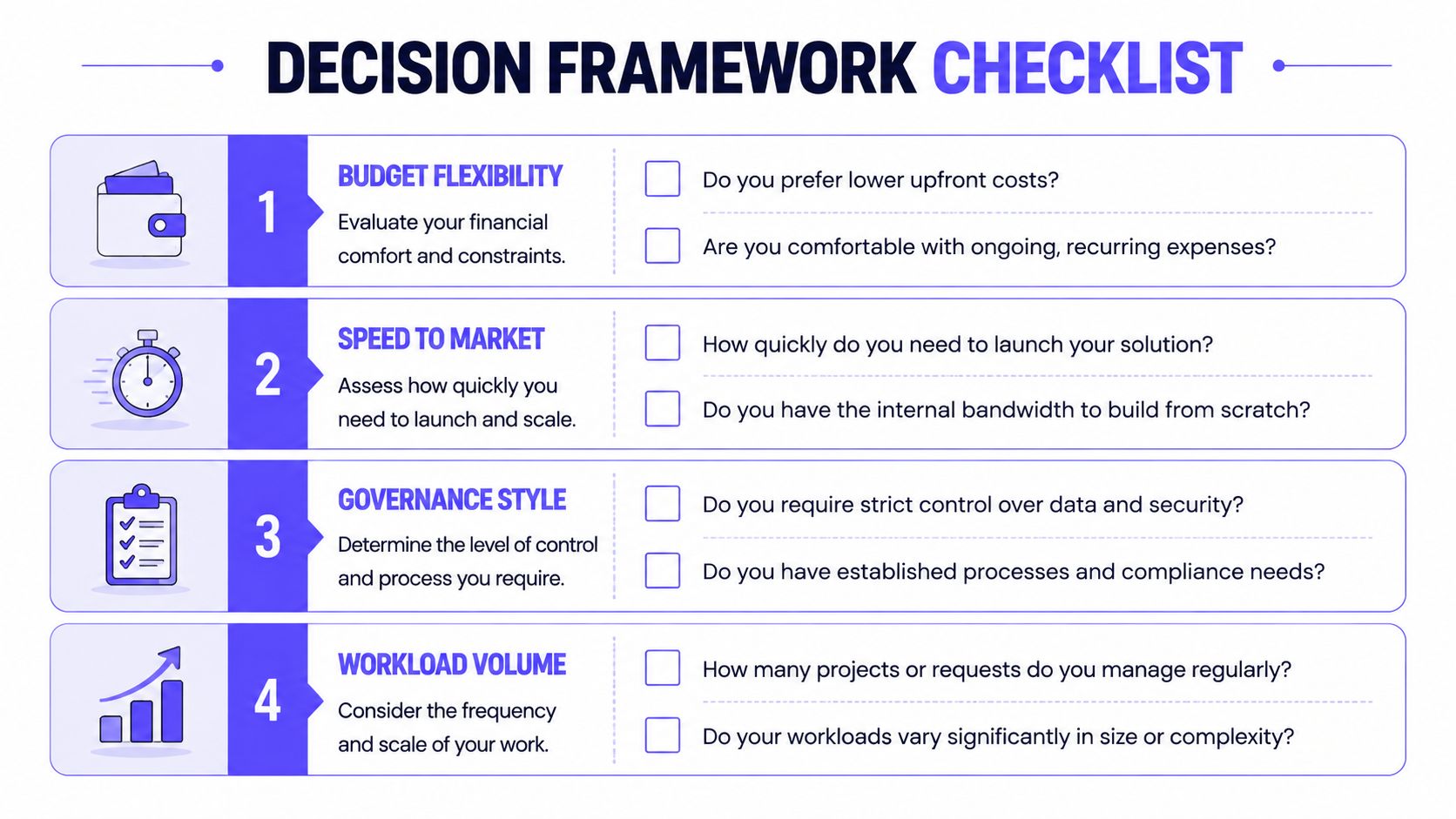
Budget flexibility
Ask these questions before you commit to payroll or a retainer.
Can you carry fixed design spend without starving product work?
Do you need to keep cash available for engineering, audits, or growth?
Would a variable external cost fit the next milestone better?
If the last answer is yes, agency support is usually the cleaner move. If the first answer is yes and the design demand stays steady, internal hiring starts to make more sense.
Speed to market
The question is whether the next release can wait for hiring.
Do you need output before a launch, raise, or token event?
Is the timeline measured in weeks, not quarters?
Would a long onboarding cycle put the release at risk?
If speed is the constraint, agency onboarding protects the schedule better. If the deadline is flexible, hiring has room to catch up.
Governance style
Founders should be honest about how much control they want over the work.
Who makes the final call on positioning and visuals?
Who settles disagreements between product, marketing, and design?
Can the company keep approvals tight without slowing every request?
A team with unclear decision rights will struggle no matter who is doing the design. Fix the approval path first, then decide whether the work belongs inside or outside the company.
Workload volume
This is the factor many teams miss, and it often decides the case.
Is design work constant or bursty?
Does the team need daily iteration, or mainly launch support?
Are you already at the point where one person is overloaded?
Use a simple scenario check. If a team has the same design requests coming in every week, the work keeps touching product, marketing, and updates, and the approvals stay inside one company, in-house becomes easier to justify. If the requests come in waves around launches, campaigns, and special projects, agency support is the better fit because it gives the team capacity without a permanent hire.
The simplest scoring method is direct. If you answered mostly yes to budget flexibility, speed, and bursty workload, choose an agency. If you answered mostly yes to recurring demand, direct control, and daily product ownership, hire in-house. If the answers are mixed, build a hybrid and keep strategy inside the company while using external specialists for spikes.
If you're deciding between agency support, a hybrid setup, or a first in-house hire, 925 Studios helps Web3, AI SaaS, and fintech teams ship product design, brand, and frontend work without building a full internal team first. Reach out if you want a clear plan for what should stay inside the company and what should be handled by a creative partner.


Let’s keep in touch.
Discover more about high-performance web design. Follow us on Twitter and Instagram.

