
Value Proposition Design: Validate Ideas, Win Markets

Yusuf
Founder and lead designer at 925studios

About 80% of new products fail within their first year, and the root cause is usually not bad luck. It's a mismatch between what a company builds and what customers value, a point highlighted in the Strategyzer summary of Alexander Osterwalder's Value Proposition Design.
That's why value proposition design matters. Not as a workshop exercise. Not as a tidy canvas saved in Notion. It matters because founders in AI SaaS, Web3, and Fintech burn time and money every time they ship features based on internal opinion instead of customer evidence.
A lot of teams still operate on hope. They assume users will understand the product, trust the workflow, and care about the differentiators. Then they launch a smart feature set into a market that shrugs. Value proposition design is how you stop doing that. It gives you a way to define who you're serving, what job they need done, what pain blocks them, and what gain is valuable enough to make them switch.
Table of Contents
Your Startup Has an 80 Percent Chance of Failing
Roughly 8 out of 10 new products fail. Founders in AI, Web3, and Fintech should treat that as an operating constraint, not a trivia fact.
Failure usually looks dramatic from the outside and ordinary inside the company. A team ships an AI copilot because the category expects one. A Fintech app adds budgeting tools before proving users trust it with account access. A Web3 product spends months refining token mechanics while the buyer still cannot explain why switching is worth the effort. Money gets spent. Velocity looks high. Demand stays soft.
That pattern is predictable because product failure often starts long before launch. It starts with a weak definition of the customer, a fuzzy problem statement, and a roadmap built from internal opinions instead of buyer evidence. Good teams still fall into this trap because shipping feels productive, while customer discovery feels slower and less certain.
Practical rule: If your product story starts with the feature, the model, or the protocol, you are probably solving the wrong problem at the wrong level.
I see this constantly in technical categories. Founders can explain the stack in detail and still struggle to answer the commercial question buyers use to make decisions. Why should I change my workflow, take on risk, and pay for this now? If the answer is vague, the product is not ready, no matter how strong the engineering is.
Value proposition design matters here because it forces a tougher standard. It asks whether the product connects to a specific job, removes expensive friction, and produces an outcome the customer can recognize quickly. That is the kind of design strategy work that reduces product risk before you build too much.
The trade-off is simple. Teams can spend a few weeks getting sharper on customer evidence now, or spend six months building features that create polite demo feedback and weak conversion. One path bruises founder ego early. The other burns cash later.
This discipline gets even more important when the market is noisy. AI founders can confuse novelty with value. Web3 founders can overestimate ideology and underestimate usability. Fintech founders can focus so hard on compliance and infrastructure that they miss the moment where the user decides whether the product is worth trusting at all.
A tighter customer definition fixes more than messaging. It improves roadmap decisions, onboarding, pricing, sales calls, and retention because the team is finally working from the same reality. If your segment is still too broad, leveraging your ideal customer profile helps narrow the buyer, the urgency, and the context where the problem is painful enough to act.
The hard truth is that founders do not lose by building too little. They usually lose by building too much of the wrong thing.
That is why the first win is not a polished product. It is clear evidence that a specific customer wants the outcome badly enough to change behavior. Once that is true, design, product, and engineering can compound in the right direction. A partner like 925 Studios can then help turn that validated value proposition into a polished product people understand, trust, and adopt.
What Is Value Proposition Design Really
Value proposition design is a method for building the right key for the right lock.
The lock is the customer's situation. Their job. Their friction. Their risk. Their desired outcome. The key is your product, experience, and message. If the cuts don't match, the key looks impressive and still won't turn.
That's why value proposition design is not about writing a clever headline. It's a way to reduce risk before you spend months building the wrong thing.
It's not “build it and they will come”
The default founder move is simple. Spot an opportunity, build a feature set, push it live, then hope demand appears. That approach feels fast, but it hides a lot of expensive assumptions.
A better approach starts with customer evidence. You identify what people are trying to achieve, where current options fail them, and what would make switching feel worth it. Then you shape the product and the message around that reality.
For teams still trying to sharpen who they're really selling to, leveraging your ideal customer profile is useful because it forces tighter thinking around buyer type, urgency, and fit. That's the front end of the same discipline.
The work is simple to describe, harder to do
At a practical level, value proposition design asks four blunt questions:
Who is the customer really: Not the broad market, the specific segment with the most urgent pain.
What are they trying to get done: The functional task, but also the pressure around it.
Why do current options fall short: The shortcomings themselves house the pain, and initiate switching behavior.
What can your product uniquely improve: Not every feature matters. Only the ones that remove friction or create a meaningful gain.
Many teams fail at this because they stay abstract. They write “save time,” “improve trust,” or “simplify workflow.” Buyers don't switch for vague promises. They switch when the product clearly helps them move from a bad current state to a better future state.
A good value proposition sounds like customer language, not internal strategy language.
The other mistake is treating this as a one-time exercise. It isn't. Markets shift, customer expectations move, and competitors change the baseline. That's one reason design strategy work has to stay tied to execution, research, and messaging. A useful primer on that connection is what design strategy means in practice.
The Core Frameworks Demystified
The frameworks around value proposition design sound more academic than they are. In practice, they're just tools for answering different parts of the same problem.
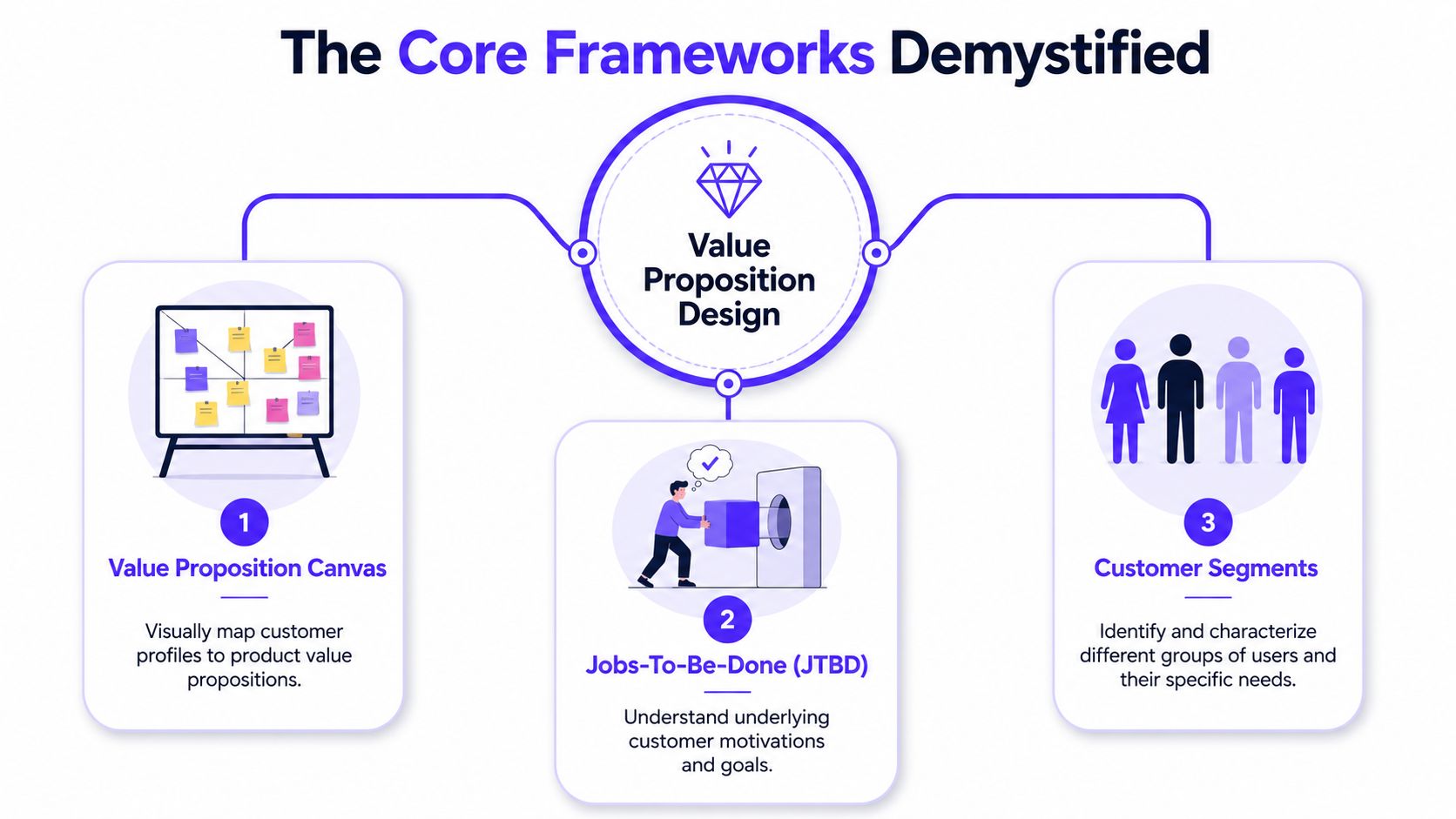
The canvas is your blueprint
The Value Proposition Canvas gives you a simple map. On one side is the customer profile, jobs, pains, and gains. On the other is your value map, product, pain relievers, and gain creators.
This is useful because it forces a discipline many teams neglect. Every feature has to earn its place. If it doesn't reduce a real pain or create a gain the buyer wants, it's probably roadmap clutter.
For a Fintech founder, that might mean asking whether a new analytics widget helps a finance lead complete a decision faster, or whether it just adds visual noise. For a Web3 product, it might mean deciding whether cross-chain complexity needs to be surfaced, hidden, or guided.
JTBD tells you why buyers switch
Jobs-To-Be-Done, or JTBD, goes one layer deeper. It focuses on the progress the customer is trying to make.
That's a big shift. Customers don't buy software because it has features. They choose a tool because they need to accomplish something under real constraints. They're trying to close books with less manual checking, move assets with fewer trust concerns, or get model outputs into a workflow without creating review chaos.
The JTBD method is not loose brainstorming. The THRV explanation of value proposition design describes a five-step iterative process that includes understanding customer goals, analyzing the competitive environment, identifying value opportunities, designing solution concepts, and articulating value using customer language.
Segments tell you where pain is strongest
Customer segmentation keeps you from treating every prospect like the same buyer.
That matters because pain intensity varies. An AI feature that feels essential to a product ops lead may feel irrelevant to a CTO. A custody workflow that matters to a serious crypto team may be meaningless to a casual retail user. The same product can be “nice to have” for one segment and urgent for another.
Here's how the three frameworks help side by side:
Framework | What it helps you do | Best use |
|---|---|---|
Value Proposition Canvas | Map customer needs against product value | Spot feature bloat and weak claims |
JTBD | Understand why people choose, switch, or reject solutions | Shape better product direction and messaging |
Customer Segmentation | Isolate the audience with the sharpest pain | Improve targeting, onboarding, and prioritization |
If your team can't say which segment feels the pain most sharply, you're still too broad.
Together, these frameworks do one important thing. They move the conversation from “What should we build next?” to “What problem is worth solving, for whom, and why us?”
Applying Value Prop Design Step by Step
Most founders don't need another framework diagram. They need a working process.
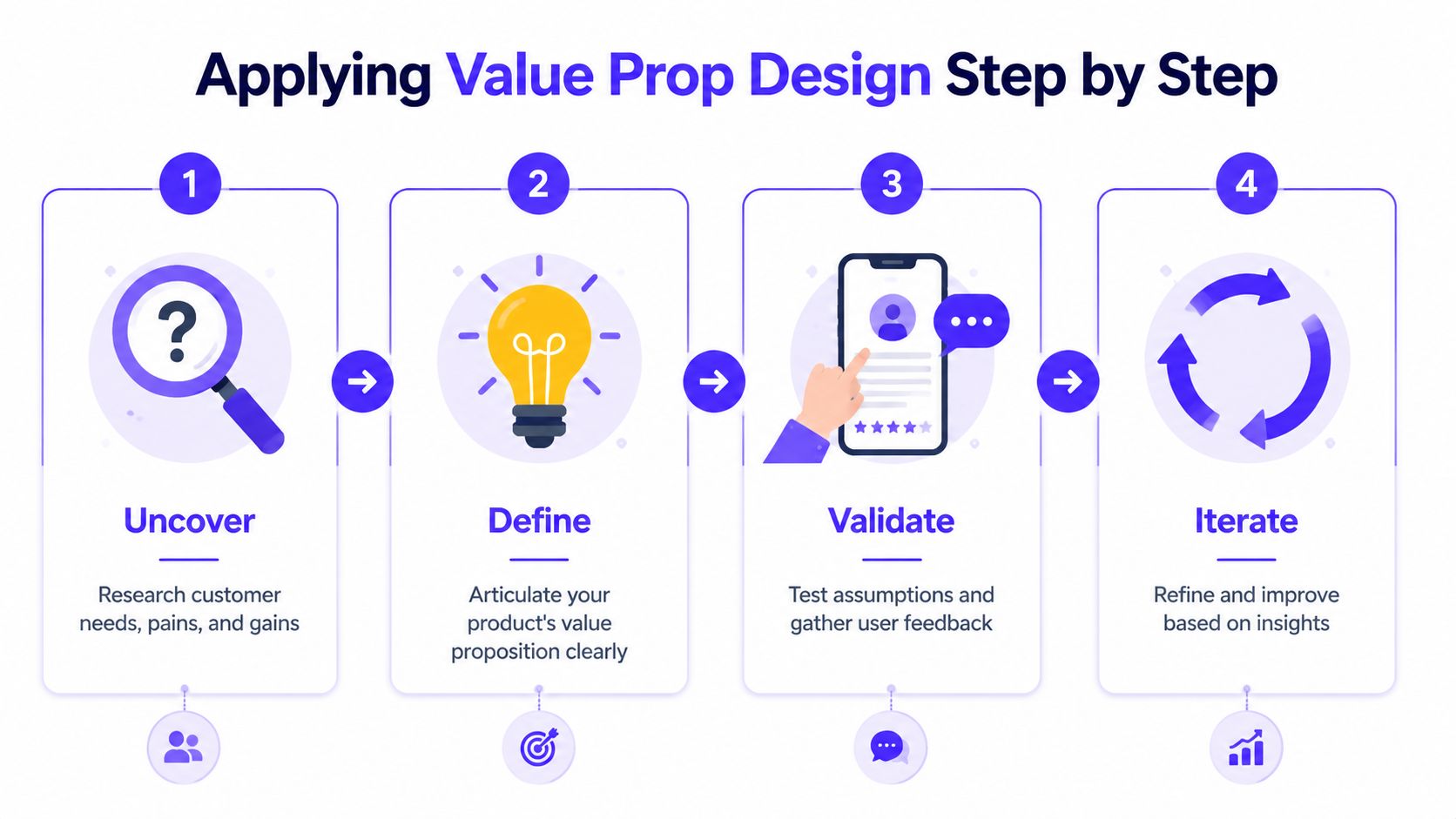
Step 1 uncover the real job
Start with customer evidence, not feature ideas. Talk to people who already feel the problem. Watch how they work. Listen for what they were trying to achieve before they mention your product category.
In AI SaaS, a data scientist might say they need a model ops tool. That sounds like the job, but it usually isn't. The deeper job may be getting reliable outputs into production without turning every handoff into a manual review process.
In Web3, a user may say they want better swap tooling. The core job may be moving assets confidently without second-guessing fees, wallet flows, or bridge risk. In Fintech, a finance team might ask for reporting. What they need is cleaner visibility before a board meeting or audit discussion.
Useful interviews focus on moments of struggle:
Ask about the trigger: What happened that pushed them to look for a solution?
Ask about current workarounds: Spreadsheets, internal scripts, Slack messages, and manual review chains reveal hidden pain.
Ask what made the problem costly: Cost can mean money, time, trust, delay, or internal friction.
Step 2 define the promise
Once the job is clear, write a value proposition that a buyer can understand in one pass.
Many teams get lazy at this point. They write category language. “AI-powered workflow automation.” “Next-generation financial infrastructure.” “Secure decentralized coordination.” None of that tells a buyer why they should care.
A stronger value proposition connects product value directly to the customer's situation. For example:
AI SaaS example: Help ops teams review model outputs in a workflow that reduces manual handoffs.
Web3 example: Make cross-chain actions feel understandable and trustworthy for users who don't want to decode every transaction.
Fintech example: Give finance teams a cleaner path from raw transaction data to decision-ready reporting.
Keep the language blunt. If your sales lead, product lead, and founder all describe the value differently, you haven't finished the work.
A quick explainer can help teams align before they start shipping:
Step 3 validate with something users can react to
Don't validate with a strategy deck. Put a concrete artifact in front of people.
That can be a clickable prototype in Figma, a narrow product slice, a revised onboarding flow, or a landing page that frames the promise clearly. The format matters less than its realism. Users need enough fidelity to reveal confusion, trust gaps, and missing value.
What works in practice:
Test one promise at a time: If you're testing trust, don't also test pricing and navigation in the same session.
Use realistic scenarios: Ask a DeFi user to complete a cross-chain task. Ask a finance lead to locate the exact insight they'd need for a review meeting.
Watch for hesitation: Confusion, drop-off, and side questions usually tell you more than direct praise.
Validation gets sharper when users react to a believable experience, not a founder's explanation.
Step 4 iterate on a schedule
Value proposition design only works if it stays current. The Interaction Design Foundation overview of the Value Proposition Canvas notes that teams should update the canvas at least once every six months so it stays aligned with changing customer needs and market conditions.
That update matters because products drift. Features pile up. Competitors reshape buyer expectations. An onboarding flow that worked six months ago may now hide the one differentiator that matters.
A simple operating rhythm helps:
After interviews: update pains, gains, and language.
After launches: review what users adopted.
After losses: check whether the promise was weak, unclear, or irrelevant.
Every six months: refresh the full canvas, even if the product feels stable.
From Canvas to Code With an Embedded Design Partner
A validated canvas is useful. It is not enough.
Founders often do the hard strategic thinking, confirm there's real demand, then lose momentum in execution. The product still needs interface decisions, brand clarity, frontend quality, and enough polish that users can trust what they're seeing.

A canvas doesn't ship product
The gap between strategy and shipped product is where a lot of good ideas stall.
A founder may know the user's pain exactly. But if onboarding is messy, if the UI makes important actions feel risky, or if the marketing site sounds disconnected from the product experience, the value proposition breaks down before the customer sees its value.
That's why execution has to stay cross-functional. Product decisions affect interface choices. Interface choices affect engineering scope. Engineering constraints affect what can be tested credibly.
A useful signal comes from hiring expectations. In a discussion about senior product design case studies, the point was clear: designers need to show cross-functional collaboration with development leads so it's obvious they can work inside real engineering constraints and ship code-ready solutions.
Execution changes the quality of feedback
The quality of what you ship affects the quality of what you learn.
A rough prototype can help early. But when you need users to trust a Fintech flow, understand a complex SaaS dashboard, or complete a Web3 transaction without backing out, surface quality matters. Copy, states, hierarchy, interaction logic, and frontend behavior all shape whether feedback reflects the concept or just the roughness of the build.
That's also why systems thinking matters. When design and development move separately, the product starts to feel inconsistent fast. Components drift. Messaging changes screen to screen. Small trust breaks pile up. Teams dealing with that problem usually need a tighter handoff model and a stronger foundation like embedded design systems.
Good value proposition design does not end with a workshop. It becomes real when the message, interface, and product behavior all tell the same story.
Measuring What Matters and Common Mistakes to Avoid
Teams waste a lot of money here.
They run interviews, ship prototypes, collect demo requests, and still cannot answer the only question that matters. Did the value proposition cause the right user to take the next meaningful step?
Attention is weak evidence. For AI, Web3, and Fintech founders, stronger evidence usually looks like activation, first-task completion, repeat usage, referral behavior, and willingness to keep going without a sales rep translating the product for them. If those signals are missing, the offer is still blurry, the workflow still feels risky, or the problem is not painful enough to change behavior.
Make pains and gains measurable
Vague pain statements create vague products.
A team says users are "confused during onboarding," then builds extra tooltips, another explainer screen, and a longer email sequence. None of that helps if the issue is that a compliance lead stalls at identity verification, or a crypto user hesitates before signing a wallet transaction because the consequence is unclear. Specificity changes what gets designed, what gets built, and what gets cut.
A better standard looks like this:
Weak pain statement: Users get confused during onboarding.
Stronger pain statement: Users pause at the permissions step because they cannot tell what access they are granting or what happens next.
Weak gain statement: Buyers want faster reporting.
Stronger gain statement: Finance leads want to turn raw transaction data into a review-ready summary in one session, without exporting to spreadsheets.
That level of detail gives product, design, and engineering something testable. It also helps founders avoid the classic mistake of measuring interest at the page level while missing failure inside the product. Teams trying to connect value proposition work to funnel behavior should study how friction shows up across the journey, not just on the landing page. This guide on how to improve conversion rates is useful for that reason.
Mistakes that wreck validation
The expensive mistakes are rarely dramatic. They show up as months of polite user feedback, roadmap momentum, and weak retention.
Mistake | What it looks like in practice | Better move |
|---|---|---|
Falling in love with the solution | Protecting a feature set before confirming the job is urgent | Write the customer job separately from the feature idea, then test the job first |
Asking leading questions | "Would you use this?" or "Does this seem helpful?" | Ask what they do today, what it costs them, and what they already tried |
Treating all feedback equally | Counting praise from non-buyers the same as objections from real decision-makers | Weight feedback by segment quality, urgency, and buying authority |
Measuring noise | Reporting traffic, clicks, or signups without activation and retention context | Track whether qualified users complete the core action and return |
Explaining away friction | Dismissing hesitation as user error during tests | Log the exact moment trust drops, then fix the copy, flow, or interaction |
Validation works when it exposes where the proposition breaks under genuine scrutiny.
That means setting pass or fail criteria before the test starts. For an AI product, that might be whether users trust the output enough to use it in a real workflow. For a Fintech product, it might be whether they complete a sensitive flow without needing reassurance from support. For a Web3 product, it might be whether they understand the transaction well enough to finish it without backing out.
Founders who keep this discipline usually make better roadmap calls. They can see whether the issue is segment, message, trust, or product behavior, and they stop funding features that only patch around a weak core offer. A useful way to keep that pressure on the team is to review a standing set of product market fit questions for roadmap decisions before new work gets approved.
This is also where an embedded partner earns their keep. A polished test experience does not guarantee demand, but it does remove avoidable noise. When 925 Studios helps founders turn a value proposition into a product slice people can use, the goal is simple. Get clearer signals faster, so the next investment decision is based on behavior, not optimism.
A Founder's Value Proposition Design Checklist
You don't need a giant strategy sprint to start. You need a tighter operating habit.
Use this checklist to pressure test whether your value proposition design work is grounded in reality or still built on assumptions.
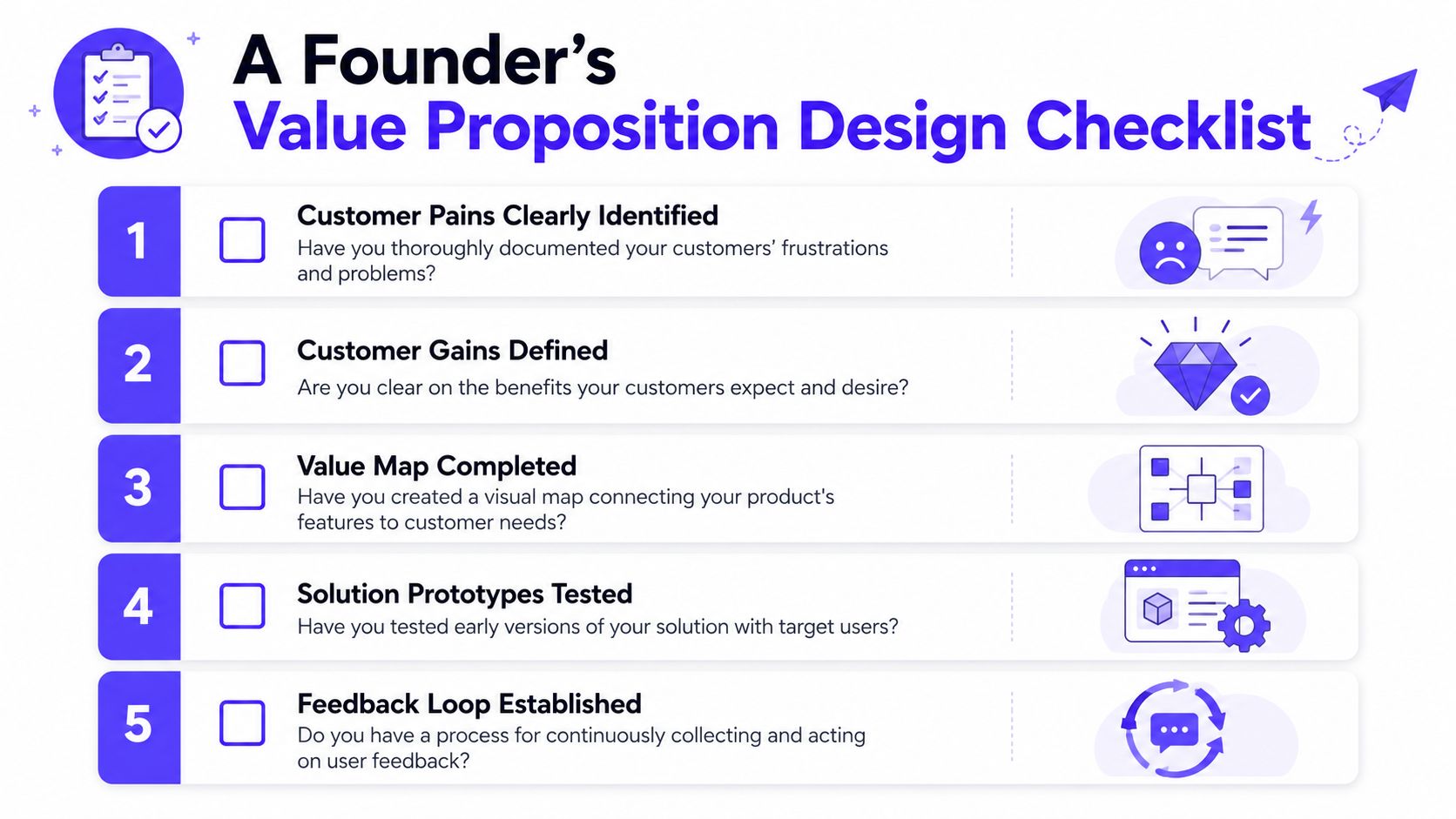
The working checklist
Name the segment precisely: Don't say “startups” or “consumers.” Name the buyer and the context where pain is strongest.
Write the customer job in plain English: If a non-technical founder can't understand it, the wording is too abstract.
List the top pains with observable detail: Focus on friction users can describe, demonstrate, or point to in a workflow.
Define the gains that would make switching worth it: Be specific about the improved outcome, not just the feature.
Build one testable artifact: A prototype, flow, or narrow product slice is enough if it gives users something real to react to.
Run customer conversations regularly: Keep notes on triggers, objections, workarounds, and language patterns.
Refresh the canvas on an operating cadence: If the product or market changed, the value proposition probably needs an update too.
Check launch readiness against execution reality: A practical resource for that final pass is the Saaspa.ge launch checklist, especially when strategy is done and the team needs to tighten delivery details.
The founders who do this well aren't more creative. They're more disciplined. They stop treating value proposition design like branding homework and use it as a filter for what gets built, what gets cut, and what gets shipped.
925 Studios helps AI SaaS, Web3, and Fintech teams turn validated ideas into polished product, brand, and frontend execution. If you need one creative partner that replaces three hires, a product designer, a brand designer, and a frontend developer, see how 925 studios works.

Let’s keep in touch.
Discover more about high-performance web design. Follow us on Twitter and Instagram.

