SaaS Product Development Services Explained for Founders

Outrank AI

You've raised funding, the product idea is clear enough to sell, and the launch date is already becoming a promise to investors. Then three SaaS development firms explain their services, and none of them mean the same thing. One talks about UX and frontend work. Another starts with cloud architecture. The third promises “digital transformation” without explaining who handles billing, security, onboarding, or post-launch fixes.
That confusion is expensive. SaaS product development services cover far more than design and code, and the right buying decision depends on your product stage, operating model, budget, and need for permanent ownership. This guide explains what belongs in the scope, what the main engagement models deliver, what costs to expect in 2026, and how to separate a capable delivery partner from a polished sales process.
Table of Contents
Why Founders Struggle to Buy SaaS Product Development Services
A funded founder usually doesn't struggle to find vendors. They struggle to compare them.
One provider may offer a product strategist, UX designer, and frontend developer. Another may offer backend engineering, cloud infrastructure, and DevOps. A third may package everything into a fixed project price while excluding security reviews, billing logic, monitoring, and future updates.
The result is a proposal that looks affordable until the product has real customers. At that point, the founder discovers that the initial build supports the demo but not the business. Customers need different plans, account permissions need tightening, onboarding needs improvement, and every release requires more manual work than expected.
Practical rule: If a proposal only describes screens, features, and a launch date, it isn't a complete SaaS scope.
The market context makes this distinction more important. One forecast projects worldwide SaaS revenue at US$488.53 billion in 2026, rising to US$855.63 billion by 2031, with an 11.86% CAGR. Another forecast estimates US$406.04 billion in 2024 and projects US$1.229 trillion by 2030, at a 19.5% CAGR. The United States alone is forecast to generate US$254.94 billion in SaaS revenue in 2026. These are projections, but they show why product quality, release discipline, and differentiation matter in a crowded category. The SaaS market forecasts and regional figures provide the broader context.
By the end of this article, you should be able to ask four practical questions:
What is included? Strategy, design, architecture, security, billing, launch, and maintenance should be visible in the scope.
What will it cost? Use team-structure benchmarks to challenge both suspiciously cheap and inflated proposals.
How should you buy it? Choose between a defined project, an embedded team, or an ongoing creative partnership.
Who should deliver it? Judge the partner by shipped work, operating discipline, and the people assigned to your product.
What SaaS Product Development Services Actually Include
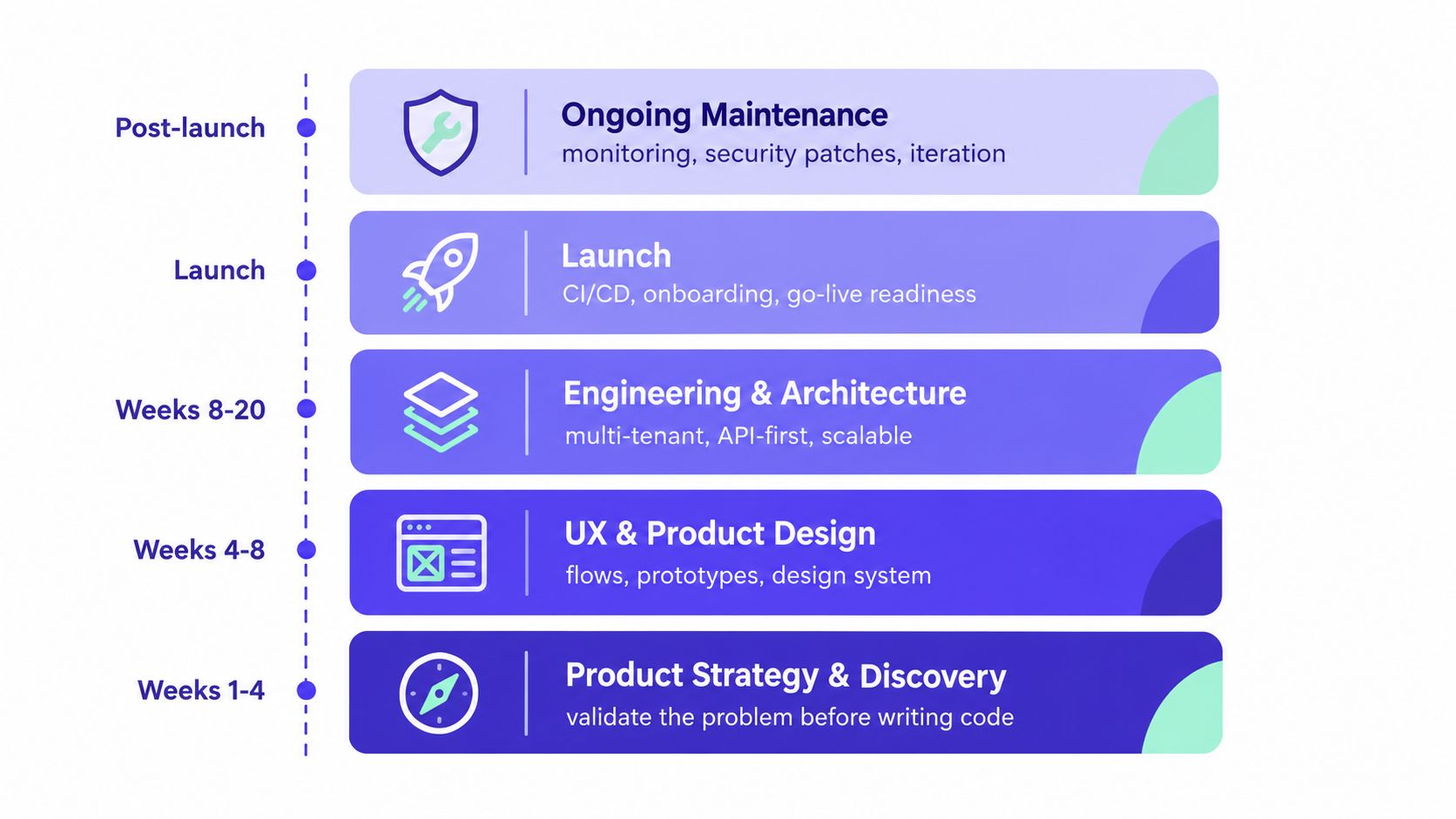
SaaS development starts before the first interface is designed and continues after the product goes live. A complete engagement usually spans strategy, product design, engineering, launch operations, and continuous improvement.
Strategy and discovery
The first job is to define the problem, buyer, workflow, and smallest useful product. This isn't a workshop that produces a presentation and disappears. It should clarify what the product must help users do, what information the interface needs to expose, and which assumptions need testing before engineering commits to them.
For an AI SaaS product, discovery might reveal that the hard problem isn't the model integration. It may be trust, review workflows, usage visibility, or explaining why the system produced a result. For a fintech product, the key issue might be permissions and auditability rather than the dashboard's visual polish.
UX and product design
Design turns the product strategy into journeys, screens, prototypes, and interaction rules. The work should cover onboarding, empty states, errors, permissions, account settings, billing screens, and the main product workflow, not just the happy path shown in a sales demo.
A design system belongs here too. It defines reusable components, states, spacing, typography, and interaction patterns so the product doesn't become a collection of unrelated screens. It also gives frontend developers a clearer implementation target.
Engineering and architecture
Engineering includes frontend and backend implementation, but those are only visible parts of the technical scope. SaaS product development also includes architecture, infrastructure, billing, security, deployment, monitoring, integrations, and continuous updates, as outlined in this overview of SaaS product development services.
Consider a fintech dashboard. The interface may show balances, transactions, alerts, and account activity. The product still needs reliable subscription rules, role-based access, tenant isolation, secure data handling, audit trails, integrations, and monitoring. If billing says a customer has one plan while the application grants access to another, the visual design won't save the business.
Multi-tenancy deserves explicit treatment. One application may serve multiple customers, but each customer's data and permissions must remain isolated across queries, APIs, background jobs, files, reports, and administrative tools. The engagement should document that model instead of leaving it as an assumption.
Launch and operation
Launch work includes testing, deployment automation, onboarding readiness, analytics, error tracking, and support handover. A product isn't ready because the main workflow works on a developer's machine. It needs a controlled route into production and a way to identify failures after customers start using it.
For a broader explanation of the business and technical scope, founders can also review this guide to product development consulting.
Maintenance and iteration
SaaS products keep changing. Customers request improvements, browsers change, dependencies require patches, and usage patterns expose weak parts of the experience. Ongoing work may include security updates, performance improvements, new integrations, UX refinement, design-system maintenance, and frontend delivery for new features.
Treat maintenance as part of the product plan, not as an unpleasant surprise after launch.
Engagement Models and Typical Deliverables
The best engagement model depends on how clearly you understand the scope and how often you expect priorities to change. A defined MVP and an evolving product roadmap need different commercial structures.
Fixed-scope project work
A fixed-scope project works when the main workflows, requirements, and acceptance criteria are understood. You typically receive discovery outputs, product specifications, UX flows, interface designs, a defined frontend build, testing, and a handoff package.
The benefit is commercial clarity. You know what the team has agreed to deliver and when the engagement ends. The limitation is equally clear. If customer feedback changes the roadmap, every new requirement may become a change request, a negotiation, or a deferred item.
This model suits a product team validating a narrow workflow, redesigning a defined area, or launching a marketing site with a known page structure.
Dedicated or embedded teams
A dedicated team works inside your operating rhythm. You may receive a product designer, frontend developer, product engineer, and delivery lead who join planning, review feedback, and adjust priorities as the product develops.
Deliverables can include product specifications, UX and UI design, frontend implementation, design-system expansion, marketing pages, and iterative improvements. The team doesn't stop at a handoff because the engagement is designed around continued shipping.
This model suits founders who already have backend or infrastructure ownership but need senior product design and frontend capacity. It also suits products where the interface changes as users test new workflows.
Subscription-style creative partnerships
A subscription or ongoing creative partnership usually provides recurring access to a defined set of design and frontend capabilities. The work might include a product redesign in one cycle, a marketing site in the next, and new dashboard flows or design-system components after that.
The deliverable isn't only a list of screens. It is a dependable creative capacity that can move between product, brand, and frontend needs without forcing the founder to hire separate specialists for each request. The tradeoff is that priorities must be managed carefully. Without a clear queue and review process, recurring access can become a collection of disconnected tasks.
The design system compounds
A design system is often the most valuable deliverable because it reduces repeated decisions across product, website, and frontend work. Figma reports a 34% increase in design efficiency for teams using mature design systems, while benchmarks cited by Mind the Product say design systems can reduce development cycles by up to 50% and lower rework. These figures are cited in Mind the Product's discussion of design systems.
The practical test is simple. Ask whether the partner will deliver reusable components, usage guidance, states, and implementation-ready patterns, or just a set of polished screens. The former keeps paying dividends. The latter becomes stale as soon as the product evolves.
Founders who want a deeper breakdown of commercial structures can compare product design agency engagement models.
What SaaS Development Costs in 2026
Start with team structure, not a single headline project price. The figures below are annual estimates from a 2026 SaaS development cost benchmark, so use them to sanity-check a proposal rather than treat them as a universal quote. The underlying SaaS development cost breakdown explains why the ranges vary.
SaaS Development Cost by Team Structure
Team Structure | Typical Annual Cost | Best For |
|---|---|---|
In-house developers | $120,000 to $150,000 per developer | Founders who need permanent ownership and internal product context |
Local agencies | $160,000 to $200,000 | Companies that want a nearby external team and formal project delivery |
Freelancers | $45,000 to $70,000 | Narrow assignments with strong internal product management |
Outsourced contract agencies | $75,000 to $130,000 | Startups that need broader capability without assembling every role internally |
Those numbers describe broad team arrangements, not the complete cost of a product. Specialized roles create their own budget line. One 2026 hiring breakdown estimates junior developers at $60,000 to $90,000, mid-level developers at $90,000 to $130,000, and senior developers at $130,000 to $180,000. It places UI/UX designers with two to three years of experience at $65,000 to $90,000, and senior product designers at $100,000 to $140,000. The role-by-role estimates appear in this SaaS hiring budget guide.
What changes the quote
Seniority changes the economics. A senior person may cost more, but they can make architectural, product, and interaction decisions without constant supervision. A low-cost team can become expensive if the founder has to supply the missing product management and quality control.
Design and frontend may be separate cost centers. One estimate places UI/UX design at $8,000 to $30,000 and frontend development at $25,000 to $100,000. The same source estimates in-house US staffing for those capabilities at $800,000 to $1.2 million annually in salaries alone. Founders can use this SaaS UI/UX design cost guide to examine that split.
Scope determines whether the number is credible. Ask if the proposal includes architecture, tenancy, security, billing, integrations, monitoring, testing, deployment, and post-launch support. A quote that only covers interface design and frontend implementation is not comparable to an end-to-end SaaS engagement.
The number of hires matters. If you need product design, brand design, frontend development, and someone to coordinate the work, compare the proposal against the combined cost and ramp time of those roles. Don't compare a partner's fee with one employee's salary when the partner is replacing multiple capabilities.
Use the table as a filter. An unusually low price usually means something is excluded. A high price can be justified when the team brings senior judgment, real product ownership, and a scope that includes the operational work most proposals hide.
Outsourcing vs Hiring In-House
Outsourcing wins when recruiting would delay the product and you need specialist capability immediately. Hiring in-house wins when the product has enough durable complexity to justify permanent ownership and the company can support the management overhead.
One recent benchmark claims an outsourced team can deliver an MVP in four to six months, while an in-house team may take nine to twelve months, partly because recruiting can add three to six months before engineering starts. Those are estimates, not guarantees, and the source presents them as a comparison of outsourcing and internal hiring timelines in its SaaS development company guide.
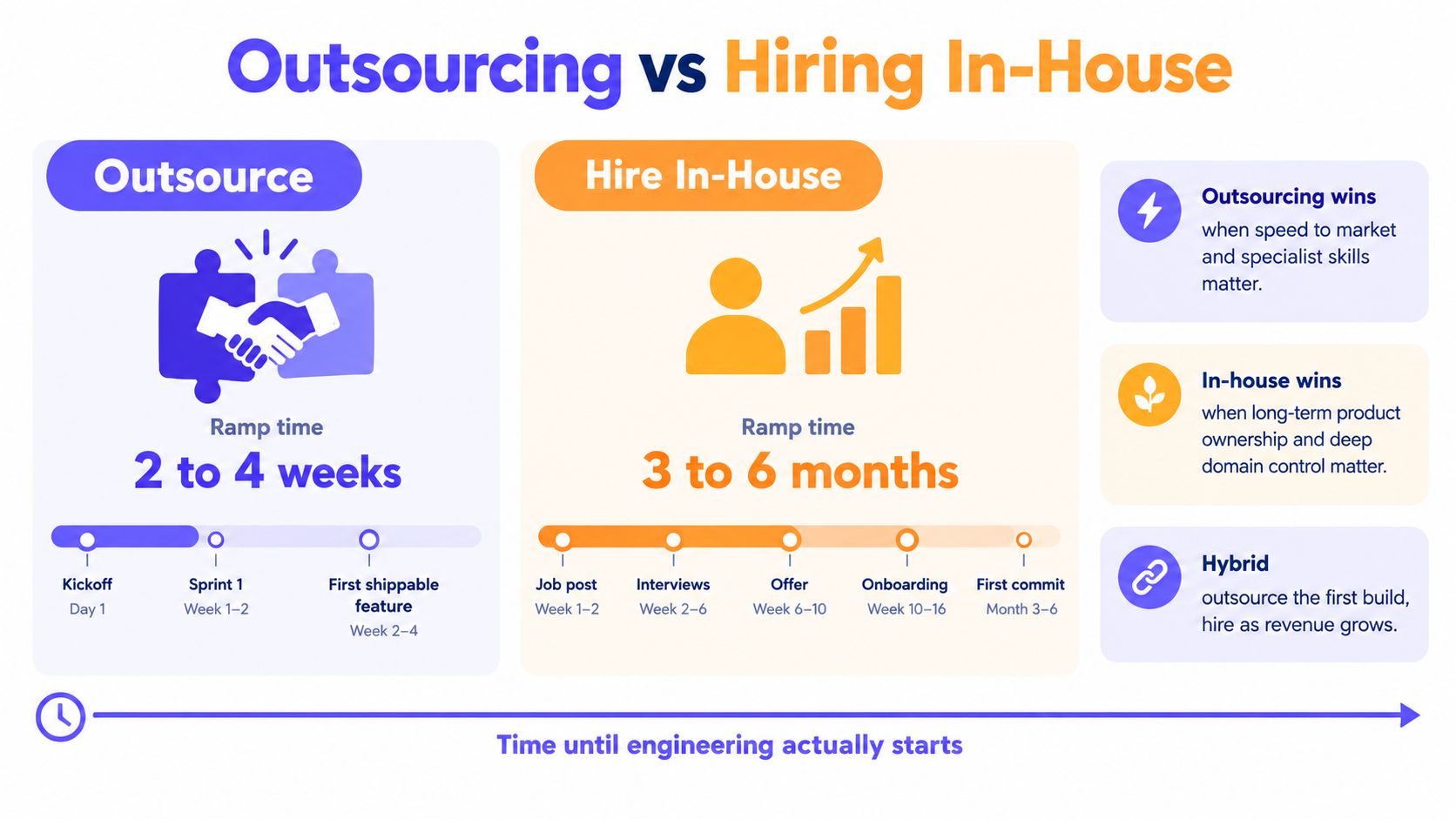
The time difference matters because a founder pays for more than salaries during recruitment. Product decisions wait. Design feedback becomes stale. Investor and customer commitments get harder to manage. A partner can bring an existing working rhythm, while an internal team must be sourced, evaluated, hired, onboarded, and aligned.
But speed alone is a weak buying criterion. AI-native products need more than a model call and a dashboard. Usage-based pricing adds billing and entitlement decisions. Enterprise buyers expect stronger security, access control, auditability, and integrations. A partner that ships a fast interface but can't handle those requirements moves the risk into the next phase.
When internal ownership is the better choice
Hire in-house when the product contains proprietary domain knowledge that changes daily, when product decisions need constant internal access, or when the roadmap supports permanent specialists. Internal teams also make sense when the company expects ongoing engineering work across the product rather than a defined launch or design transformation.
The strongest setup is often hybrid. An external partner can establish the product direction, design system, brand foundation, and frontend patterns, while an internal team gradually takes ownership of backend systems and long-term operations.
Decision rule: Outsource when you need concentrated capability now. Hire when the capability will remain central to the company after the initial build.
For an early startup, use a partner to validate and ship the first product. For a growing company, combine external specialists with internal ownership. For a mature business, keep critical product knowledge inside while using partners for focused redesigns, new surfaces, or capacity gaps.
How to Evaluate a SaaS Development Partner
A capable partner should survive detailed questions about work, people, process, and operations. Don't let a portfolio of attractive screens substitute for evidence that the team can ship and maintain a real product.
Start with comparable shipped work
Ask to see live SaaS dashboards, admin panels, billing flows, onboarding journeys, and marketing sites. A fintech interface has different constraints from a consumer app. A Web3 product may need to make wallets, transactions, and account states understandable. An AI SaaS product must communicate system output and user control clearly.
Ask what the partner contributed. A logo on a case study doesn't tell you whether the team owned the product strategy, redesigned the interface, built the frontend, or only supplied visual direction.
Ask who will do the work
The person who sells the engagement may not be the person who designs or builds it. Request the proposed team by name and role. Ask who attends working sessions, who reviews designs, who writes frontend code, and who has authority to make tradeoffs.
Then ask what happens when the scope changes. Strong teams can explain how they prioritize work, document decisions, review pull requests, test interfaces, and handle disagreement between product, design, and engineering.
Use delivery metrics that expose quality
Don't accept raw story-point velocity as the main proof of performance. Velocity measures story points completed per sprint and can help estimate release scope, but it doesn't tell you whether the team ships safely or spends time waiting in reviews and deployment queues.
A stronger operating view uses the four DORA metrics:
Deployment frequency: How often the team releases changes.
Lead time for changes: How long a change takes from code commit to production.
Change failure rate: How often releases cause problems or require remediation.
Mean time to recovery: How quickly the team restores service after an incident.
These metrics capture both speed and release quality. A technical guide to DORA metrics and development velocity explains why teams should evaluate delivery flow instead of relying on raw output. Use them to ask better questions: Where does work wait? How long do reviews and tests take? What happens after a failed release?
Confirm the handoff and support model
Before signing, get clear answers about repository access, design-file ownership, documentation, deployment access, monitoring, support response, and future updates. The commercial model should also state the scope, milestone billing, intellectual property ownership, and what happens when the engagement ends.
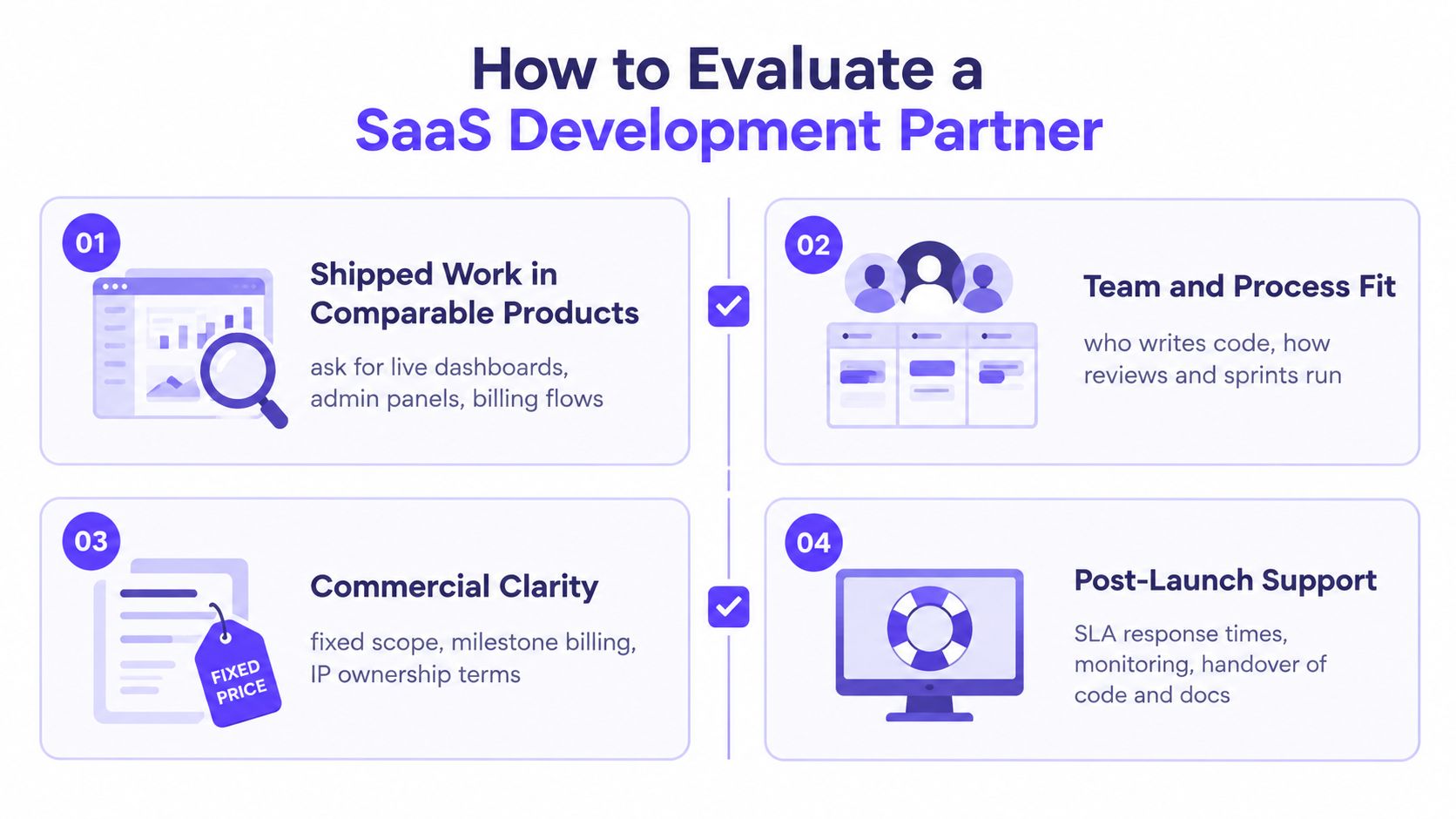
A first call should leave you with evidence, not enthusiasm. Ask to inspect the work, meet the delivery team, understand the measurement system, and read the post-launch terms before you compare prices.
When One Partner Beats Three Hires
A funded AI SaaS, Web3, or fintech startup often needs three capabilities at once: a product designer to make the application usable, a brand designer to make the company credible, and a frontend developer to turn the work into a functioning interface.
Hiring those roles separately creates more than three salaries. It creates coordination between product decisions, brand decisions, design files, and implementation. A product team may approve a dashboard pattern that the marketing team doesn't use. The frontend developer may rebuild components that the product designer already defined. The founder becomes the person resolving every mismatch.
One embedded creative partner can remove that coordination tax when the work is tightly connected. The same team can shape a full product redesign, define a design system, create a marketing site, develop the frontend, and carry the visual language into the brand identity.
That matters for complex products. AI workflows need clear states and understandable outputs. Fintech dashboards need hierarchy, trust, and careful handling of dense information. Web3 products need to turn unfamiliar technical actions into interfaces that users can use without guesswork. The output should be a shipped product, not a set of disconnected design artifacts.
A specialist such as a SaaS design agency can be a practical fit when the main gap sits between product strategy, design, brand, and frontend execution.
This model isn't right for every company. If your primary need is heavy backend engineering, infrastructure operations, data engineering, or complex compliance implementation, you need a partner with those capabilities or an internal engineering team that owns them. A creative partner can complement that team, but shouldn't be presented as a replacement for deep backend ownership.
Choosing Your Path Forward
Scope the whole product before comparing providers. Architecture, tenancy, security, billing, integrations, monitoring, launch readiness, and maintenance belong in the conversation alongside UX and frontend work.
Then match the commercial model to the way your company operates. Choose a fixed project when the requirements are stable. Choose an embedded team when feedback will reshape the roadmap. Choose an ongoing creative partnership when product, brand, website, and frontend needs will continue arriving together.
Budget against real team structures, not a single attractive quote. Use shipped work and delivery metrics to judge capability, and ask who will do the work after the contract is signed.
The founder at the start of this article doesn't need another list of agencies. They need to decide what the company requires now: a project vendor, a permanent team, or one embedded partner that connects strategy, design, brand, and shipped frontend work.
925 studios offers product design, brand identity, design systems, marketing site design and development, and frontend delivery for AI SaaS, Web3, and fintech teams. If you need one creative partner to connect product strategy with polished shipped interfaces, visit 925 studios and start with a clear conversation about your current product gap.

Let’s keep in touch.
Discover more about high-performance web design. Follow us on Twitter and Instagram.

