
Product vs Project Manager: The Right Hire for Your Startup in 2026

Yusuf
Founder and lead designer at 925studios

Here’s the simple truth on the Product Manager vs. Project Manager debate: a Product Manager decides what to build and why, playing the long game for market success. A Project Manager takes that plan and executes it, owning the how and when within a set scope, timeline, and budget.
For a founder, it’s like this: one person sets the destination, and the other navigates a specific leg of the journey.
Table of Contents
The Core Difference Between Product and Project Managers
Getting this distinction right is critical, especially for early-stage startups where every hire counts. Hiring the wrong role at the wrong time bleeds cash and kills momentum. A Product Manager owns the product’s vision and its ultimate success in the market. Their entire job is to make sure the team is building something customers will actually pay for.
In contrast, a Project Manager’s world is one of execution. They take a specific, defined initiative, like launching a new marketing site or integrating an API, and see it through to completion, on time and within budget.
A Product Manager’s focus is strategic and ongoing, tied to the product’s lifecycle. A Project Manager’s focus is tactical and finite, tied to a project’s start and end dates.
This visual breaks down the core functions and where each role lives.
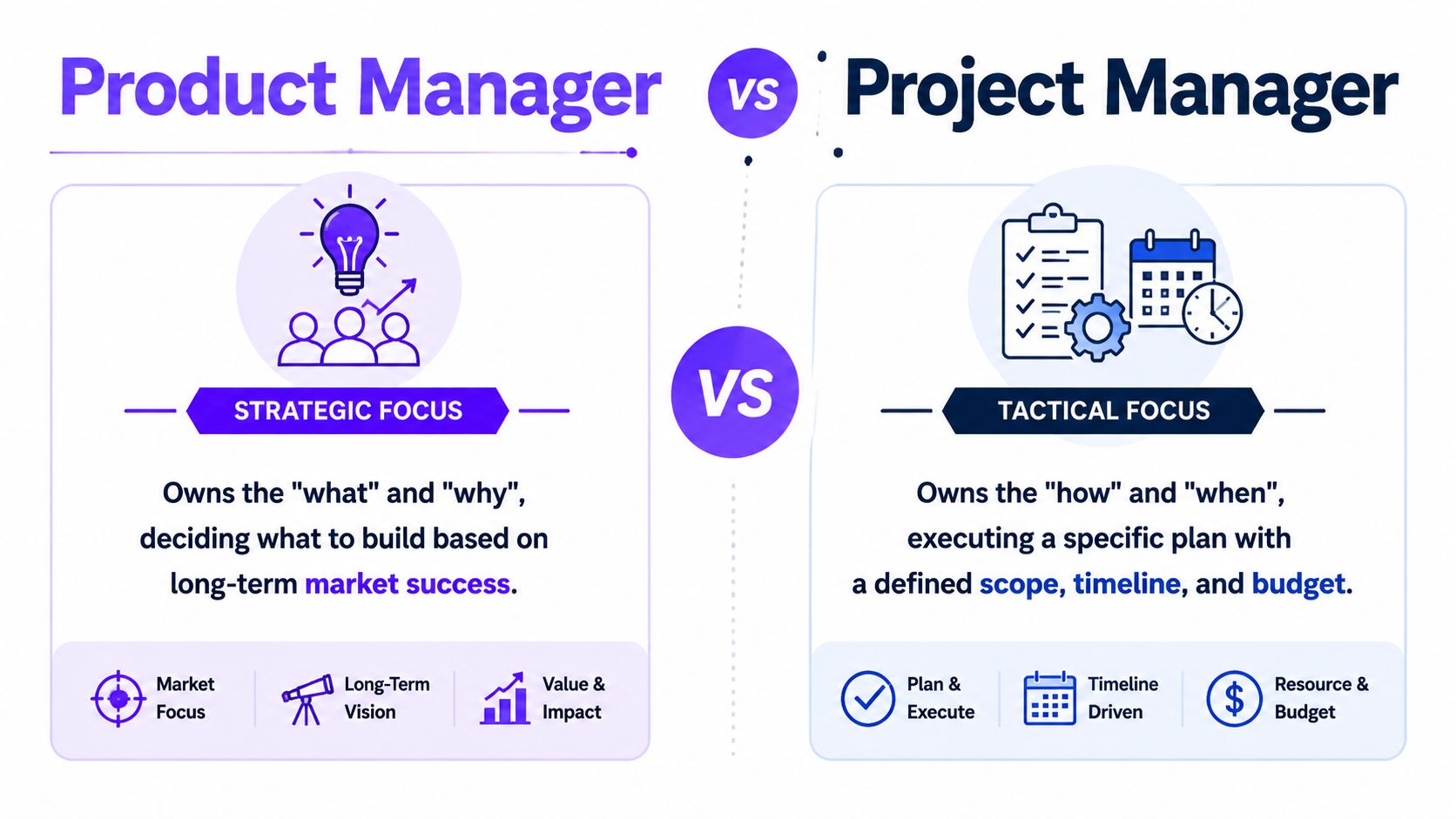
The infographic shows how one role is obsessed with defining value, while the other is obsessed with delivering that value efficiently.
Product Manager vs. Project Manager at a Glance
This table cuts through the noise, comparing the core questions and focus areas for each role. If you’re a founder deciding on your next hire, this framework clarifies which set of responsibilities your company needs most right now.
Dimension | Product Manager | Project Manager |
|---|---|---|
Main Question | "Are we building the right thing?" | "Are we building the thing right?" |
Core Focus | The 'what' and 'why' | The 'how' and 'when' |
Time Horizon | Ongoing product lifecycle | Finite project timeline |
Success Metric | Market adoption, revenue, user value | On time, on budget, within scope |
To get a feel for the structured, process-driven world of project management, it's worth exploring the methodologies outlined in WeekBlast's PMBOK resources. Their work is defined by process and constraints, whereas a Product Manager’s work is defined by discovery and outcomes.
How Each Role Translates Vision into Reality
The real difference between a Product Manager and a Project Manager becomes clear when you watch how they spend their days. While both are essential for shipping a product, they operate at different altitudes, turning abstract goals into tangible results through completely distinct activities.
A Product Manager’s day is built around discovery and strategy. They are obsessed with answering one question: "What should we build next, and why?" Finding that answer means spending their time on high-level work that defines where the product is headed.
Their world revolves around:
User Interviews: Talking directly to customers to get to the root of their pain points.
Market Research: Sizing up competitors and spotting market shifts to find new opportunities.
Roadmap Planning: Plotting the product's evolution over the next few quarters and even years.
Ultimately, their job is to maximize the value the product delivers to both the customer and the business. They don't just dream up features. They build a rock-solid business case for them, grounded in data and real user needs.
From Problem to Plan
Imagine a Product Manager at an AI SaaS company. Through a series of customer interviews, they notice users are consistently struggling to interpret their data. That's a crucial insight. Their next move is to translate this problem into a potential solution, defining a new AI-powered analytics feature.
This is where a Product Requirements Document (PRD) becomes their most important tool. A well-written PRD is how a Product Manager bridges the gap between a strategic idea and the concrete steps needed to build it, as this helpful SaaS product requirements guide details. The Product Manager crafts the user stories and acceptance criteria that will guide the entire design and engineering effort.

From Plan to Execution
Once the "what" and "why" are set, the Project Manager steps in to own the "how" and "when." They take that defined feature and break it down into a detailed execution plan. Their reality is a world of logistics, coordination, and relentless risk management.
A Project Manager's day is all about tactical execution:
Building and managing detailed project timelines and critical milestones.
Allocating resources and keeping a close eye on the budget to prevent overruns.
Tracking progress daily and ruthlessly clearing any blockers that stand in the team's way.
Keeping all stakeholders in the loop with clear status updates.
The Product Manager ensures the right feature is being built to solve a real user problem. The Project Manager ensures that feature gets built and delivered on time and within budget.
Think of a fintech startup launching a new payment integration. The Product Manager defines the feature based on user demand and complex compliance needs. Then, the Project Manager takes over, coordinating the work between engineers, QA testers, and legal teams to hit the launch date without a single misstep.
In the startup world, especially in tech, the debate between Product Managers and Project Managers is settling. While both roles are vital, there's a clear trend: the market is betting heavily on the strategic value of the Product Manager. This is a fundamental shift in where companies believe value is created.
The reason is straightforward. Companies today win or lose on the strength of their product, not just the efficiency of their delivery. For fast-moving sectors like AI SaaS, Web3, and Fintech, the product is the growth engine. In these arenas, having the right product vision is infinitely more critical than just shipping features on schedule.
A Project Manager helps you build the thing right. A Product Manager ensures you're building the right thing in the first place. For a founder, that distinction is everything.
The Shift to Product-Led Strategy
This pivot toward product-led thinking places the Product Manager at the very core of the business. Their job is to define a product so compelling it can practically sell itself, which directly shapes long-term company value. A Project Manager, while absolutely essential for keeping a complex build on track, is focused on executing a scope that has already been defined.
This strategic premium is reflected in hard market data. The U.S. Bureau of Labor Statistics and Lightcast project the Product Manager role will grow by 11.6% over the next decade, a rate far outpacing the average job. This growth is a direct response to the urgent need for clear product vision in tech.
Asana's 2026 reporting puts a number on this value gap, showing Product Managers earning a median salary of $147,000 compared to a Project Manager's $105,000. That $42,000 difference isn't arbitrary, it’s the market’s valuation of strategic, value-creating work over purely executional tasks. You can see more details in their full report on product and project roles.
For any funded startup, the lesson is clear. Your first critical hire needs to be the person who defines the product's value. Getting your product strategy right from day one is simply non-negotiable. Many early-stage companies find that hiring one skilled Product Manager, or working with a creative partner like 925 Studios to handle strategy, is a far more effective use of capital than staffing separate product and project roles from the start.
When to Hire a Product Manager vs. a Project Manager
Deciding between a Product Manager and a Project Manager is one of those early, make-or-break hires for a founder. Get it right, and you focus your team on what actually matters. Get it wrong, and you burn cash while progress grinds to a halt.
The choice boils down to a single question: are you still figuring out what to build, or do you have a clear plan and just need help executing it? The answer depends entirely on your startup’s stage. Early on, the game is all about finding a painful problem and validating a solution people will pay for. Later, the challenge shifts to managing complexity and shipping on a proven strategy.
Hire a Product Manager When You Are Defining the Product
You need a Product Manager first if your biggest risk is a strategic one. This is almost always the case for startups at the Seed or Series A stage, still hunting for product-market fit. Their entire job is to own the "what" and the "why," turning market chaos into a clear product vision.
Hire a Product Manager if you're:
Searching for product-market fit: You've got an idea but aren't sure which features will win over your first 1,000 users.
Developing your long-term strategy: You need to build a product roadmap that connects business goals to customer needs for the next 12 to 24 months.
Pivoting or expanding your product: You have to validate a new direction based on hard customer feedback and market analysis, not just gut feelings.
Imagine you have a brilliant technical concept for a new DeFi platform. You know the tech is sound, but you have no idea which specific features will pull users away from established players. That’s a classic Product Manager problem. They’ll be the one doing user research, analyzing competitors, and defining the core value prop that guides your team to build something people actually want.
Hire a Project Manager When You Are Scaling Execution
Bring in a Project Manager only when your product is more mature and your operational complexity is starting to bite. Once you have a validated product and a clear roadmap, your bottleneck shifts from strategy to execution. A Project Manager owns the "how" and the "when," making sure complex initiatives land on time.
Hire a Project Manager if you're:
Managing multiple complex workstreams: Your team is juggling several big projects at once, and you need someone to track all the dependencies.
Launching in new markets: You’re a Series B company expanding into three new countries, each with its own logistical and regulatory hurdles.
Executing large-scale integrations: You're building a major integration with an enterprise partner that demands tight coordination across multiple teams.
A Product Manager is essential when your biggest risk is building the wrong product. A Project Manager becomes necessary when your biggest risk is failing to deliver a well-defined product on time.
As you map out your team, looking into roles like a product development consultant can offer a wider perspective on your hiring choices. This view can strengthen your strategy for startup execution by showing different ways to bring in strategic expertise. For most founders, the conclusion is clear: lock down your product vision first. The founding team can often manage execution until a dedicated project manager is truly needed.
How Each Role Collaborates with Design and Engineering
The real difference between a Product Manager and a Project Manager isn't found in a job description. It’s revealed in the day-to-day collaboration with designers and engineers. Having a great strategy or a tight plan means nothing if the people building the product aren't working together effectively.
A Product Manager’s job is to be a partner in creation. They don’t hand down a list of requirements. Instead, they work closely with designers and developers to explore problems, test hypotheses, and build solutions together.
This dynamic forms a continuous, collaborative loop, often called a product trio:
The Product Manager brings the why. They own the business goals and customer problems, constantly asking, “What problem are we solving, and why does it matter to our users and our bottom line?”
The Product Designer brings the how (for the user). They own the user experience, asking, “What’s the most intuitive way for someone to navigate this and solve their problem?”
The Engineer brings the how (for the tech). They own technical feasibility, asking, “What’s the most stable, scalable, and sensible way to build this?”
This isn't a relay race, it's a huddle. The three of them are locked in a strategic process of proposing, prototyping, and refining ideas until they land on the best possible outcome. This collaboration directly impacts the final shipped product's quality and market fit.
The Project Manager as a Communication Hub
A Project Manager, on the other hand, operates in a more linear and logistical world. Once the product trio has aligned on a solution, the Project Manager steps in to quarterback its execution. Their focus isn't on the creative "what," but on the operational "how" and "when."
Their interactions are all about creating clarity and predictability. They work with design and engineering leads to break down the work, get time estimates, map out dependencies, and slot everything into sprints or a project timeline. They become the central hub for communication, making sure everyone knows what the deadlines are, who is responsible for what, and what is blocking progress.
A Product Manager works with the team to define the path forward. A Project Manager works for the team to clear the path ahead.

Think of it this way: the Product Manager lives "upstream" in the discovery phase, while the Project Manager lives "downstream" in the delivery phase. At 925 Studios, we embed with your team to bridge this gap, handling the product strategy, UI/UX design, and frontend development needed to turn a vision into a shipped product, all within one unified team. This eliminates the need for a separate project manager to coordinate handoffs, because there are none.
For a deeper look at building great user experiences within this framework, check out our complete guide to SaaS UX design for founders.
Why the Hybrid Role Often Fails in Startups
Every early-stage founder is tempted to save a headcount by creating a hybrid "Product and Project Manager" role. It seems efficient on paper, but in practice, it almost always backfires. The reason is simple: the two jobs demand completely opposite mindsets.
Product management is the art of embracing uncertainty. A great Product Manager thrives in the unknown, constantly exploring new ideas, talking to users, and pivoting based on what the market is telling them. Their job is to find the right questions, not just execute someone else’s answers.
Project management, in contrast, is about systematically destroying uncertainty. A great Project Manager takes a defined plan and drives it to completion with precision. They are masters of scope, timelines, and budgets, turning the chaos of a build process into something predictable.
A single person trying to do both is set up for failure. They are constantly pulled in opposite directions, forced to choose between chasing a new customer insight or sticking to a rigid delivery schedule.

The result is a person who does a mediocre job of both. The critical strategic work of product discovery gets rushed, and the tactical work of project delivery starts to slip.
A Fintech Cautionary Tale
We saw this happen firsthand with a promising fintech startup. Their hybrid hire was brilliant but completely overwhelmed. While trying to validate features for a new investment product, they were also bogged down managing the day-to-day sprint.
The product roadmap became a confusing mix of half-validated ideas and urgent but unimportant tasks. Launch dates were repeatedly missed, not because the team was slow, but because the direction was never clear. They were trying to navigate a maze while drawing the map at the same time. This directly hurt the product's market reception and the company's brand perception.
The lesson for founders is clear: focus your first hire on product vision. Execution and delivery can be managed by the engineering team or a dedicated creative partner like 925 Studios. Don’t compromise on the one role that defines what you're building and why it will win.
Frequently Asked Questions About Product and Project Roles
These are the most common questions founders ask when trying to structure their early-stage teams. Here are direct answers to clear up the confusion between Product Manager vs. Project Manager roles.
Can Our Head of Engineering Also Act as the Product Manager?
This is a classic early-stage shortcut, but it's not a long-term solution. Your Head of Engineering is focused on the technical architecture and build quality, the "how we build it." A Product Manager owns the customer value and business outcomes, the "what we build and why."
When one person tries to do both, the customer and market research is almost always the first thing to get dropped. That research is what separates a product that lasts from one that just launches. You need a dedicated voice in the room whose only job is to champion the user.
We Use Agile and Scrum, Do We Still Need a Project Manager?
In most cases, no. Agile frameworks like Scrum already have roles that handle project management functions. The Scrum Master keeps the process running smoothly and removes blockers, while the Product Owner (who is often your Product Manager) owns and prioritizes the backlog.
For most startups, a strong Product Manager and a self-organizing engineering team make a dedicated Project Manager unnecessary. You only need one once you start juggling multiple, complex, cross-departmental initiatives.
This setup keeps your team lean and focused on one thing: shipping product.
Who Manages the Project if We Only Hire a Product Manager?
In a small, agile team, project management becomes a shared responsibility. The Product Manager sets the priorities, the tech lead helps break down the work into technical tasks, and the whole team tracks progress together in daily stand-ups. This lightweight approach works perfectly well until your operational complexity explodes.
This is also where a creative partner can fill the gap. They manage their own design and development workflow, taking that entire burden off your team. The right partner handles both the product strategy and the execution, delivering polished work without you having to manage the process.
Your product's success depends on senior-level product design, brand design, and frontend development. At 925 Studios, we provide one creative partner to handle all three, so you can ship a polished product without building an in-house team. Learn how we help founders build better products.


Let’s keep in touch.
Discover more about high-performance web design. Follow us on Twitter and Instagram.

