
MVP in Startups: A 2026 Guide to Validation

Yusuf
Founder and lead designer at 925studios

You're sitting on a deck that got polite nods, maybe a couple of “this looks promising” messages, and now someone wants to know what you're building next. The pressure isn't to invent more ideas. It's to decide what proves the company should exist.
That's the mvp in startups decision. Not “what can we strip out,” but “what do we have to prove before we spend money, time, and credibility?” Eric Ries' definition still holds up because it keeps founders honest, an MVP is the version of a new product that lets a team collect the maximum amount of validated learning with the least effort (minimum viable product). If you're building AI SaaS, Web3, or fintech, that framing matters more than ever, because a thin product that doesn't earn trust just becomes a cheap way to fail.
Table of Contents
The Founder Moment That Forces the MVP Decision
You don't make the MVP call in a strategy meeting. You make it when the room goes quiet after the demo and someone asks what happens next. Maybe you've got seed money in the bank, maybe you've only got enough runway for one careful shot, but the question is the same, what gets built in the next eight to twelve weeks?
That's where founders usually get sloppy. They confuse a beta, a v1, and a real MVP. A beta is often a product with a nicer coat of paint. A v1 is often a road map wearing a launch label. A true MVP is a test of the most expensive assumption in the business.
Practical rule: If the next release can't tell you whether the core problem, solution, or buyer interest is real, it's not an MVP, it's a bigger gamble.
That's why the strongest startups treat the first build like a learning instrument, not a mini product line. The goal isn't to impress everyone. The goal is to find out what's false as cheaply as possible. In the lean startup view, that means designing for validated learning, not feature count (Lean Startup MVP definition).
If you need a useful companion to that thinking, how Rite NRG accelerates MVPs is a solid example of how teams can move from idea to usable evidence without bloating scope. The lesson is not “build faster.” It's “build with sharper questions.”
A founder should be able to answer one sentence before writing a spec: what risk is this MVP designed to falsify? If that answer is fuzzy, you're not ready to build. If it's clear, the rest of the decisions get a lot easier. For a sharper way to frame that test, I'd start with value proposition design, because the MVP only works when the offer is specific enough to evaluate.
What an MVP Actually Is in a Startup Context
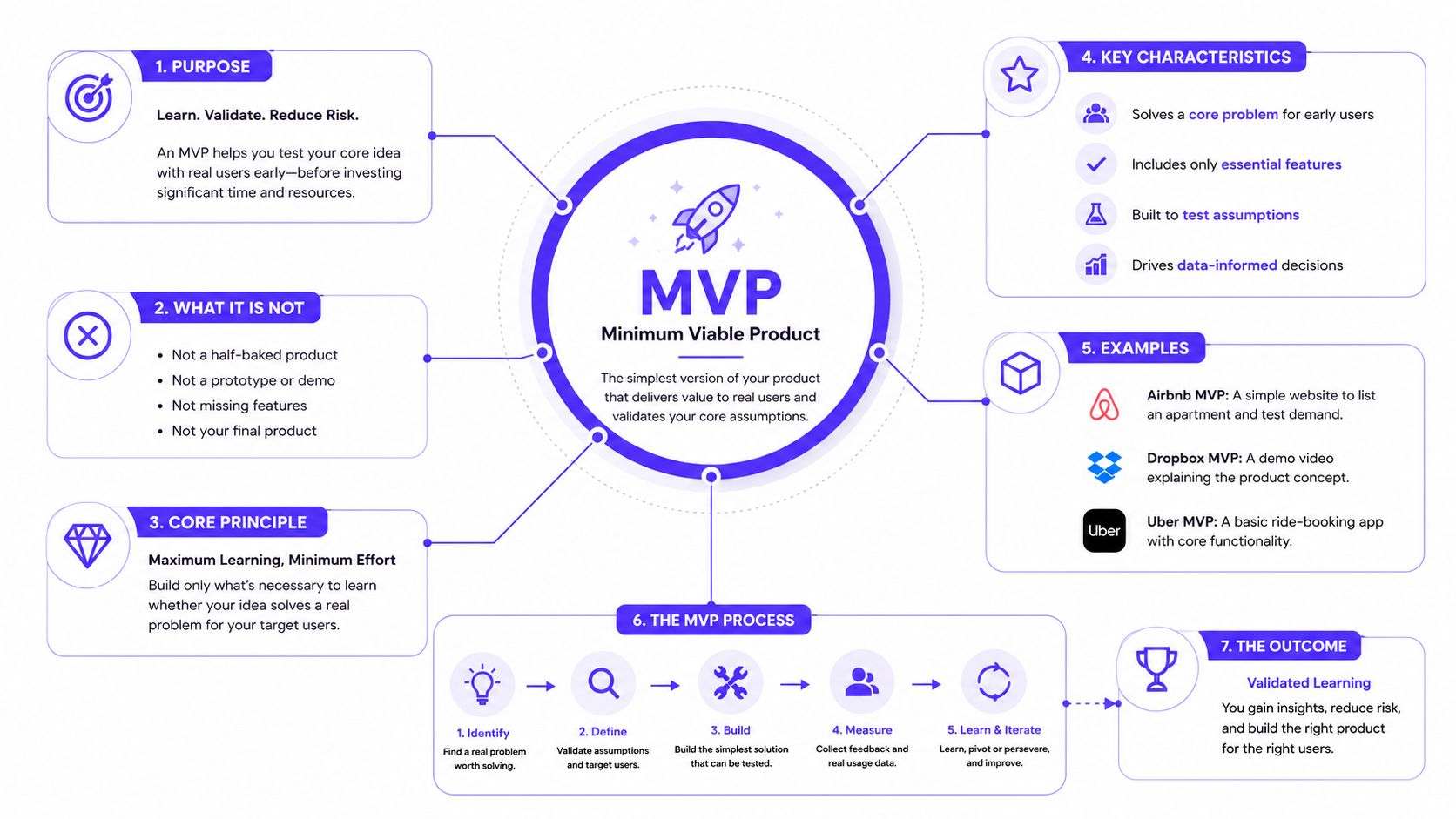
Eric Ries' definition is still the cleanest one available, because it forces the right trade-off. An MVP is the version of a new product that lets a team collect the maximum amount of validated learning about customers with the least effort (minimum viable product). In plain English, that means you're building the smallest thing that can produce real evidence, not the smallest thing you can brag about shipping.
That distinction matters. A prototype can show a flow. A demo can sell a vision. A v1 product can ship a lot of code. None of those automatically prove that customers want it, use it, or will pay for it. An MVP does one job, it exposes whether the core assumption survives contact with real users.
A working definition founders can use
Think of the MVP as the smallest release that can answer three questions:
Do users understand the offer?
Can they reach value quickly?
Does the buyer see enough trust or business value to continue?
That's why field guidance keeps pushing founders toward tight scope, direct customer contact, and short build windows. One MVP launch framework recommends reaching 50 to 200 ideal users directly, keeping the feature set to 5 or fewer core capabilities, and finishing development in 8 weeks or less (MVP success rate data). That's not about speed for its own sake. It's about keeping the product close to the question it's supposed to answer.
A useful MVP spec is one where two people won't argue about whether it works.
That's the value of testable acceptance criteria. Horizon Labs recommends writing them before development starts, including error states, performance, and security criteria, and rewriting any criterion that two people could disagree on (technical acceptance criteria template). Ambiguity kills learning. If “done” is fuzzy, the validation is fuzzy too.
The clean takeaway is simple. An MVP is not a smaller product by default. It's a narrower proof. If you can't name the proof, you don't yet have the scope.
The Four MVP Types Founders Build
Founders usually reach for one of four formats, and the right one depends on what you need to learn, not on what sounds impressive in a pitch.
The four archetypes side by side
MVP Type | What It Tests | Time to Ship | Best For |
|---|---|---|---|
Landing page | Demand, messaging, positioning | Very fast | Pre-product market testing |
Concierge MVP | Willingness to pay, workflow, service logic | Fast | Early B2B validation |
High-fidelity prototype | UX, onboarding, trust, navigation | Fast to moderate | Buyer-facing products with credibility needs |
Minimal SaaS build | Real usage, retention, behavior change | Slower, but still constrained | Seed-stage products with working prototypes |
A landing page MVP is for demand and message clarity. It tells you whether anyone cares enough to click, book, or raise a hand. A concierge MVP tests whether the problem is painful enough that people will go through a manual process first, which is useful when you want to validate the workflow before automating it. A high-fidelity prototype is the right move when the product has to look credible to earn a meeting, especially in fintech and Web3, where trust is part of the product. A minimal SaaS build tests the thing most founders need to know, whether the product changes behavior and keeps people coming back.
The mistake is picking the cheapest format by default. Choosing the cheapest format is only smart when it yields the right answer. For AI SaaS, Web3, and fintech, credibility often matters more than raw speed. A rough build that looks unserious can distort your signal before you ever learn anything useful.
That is why a lot of founders are better off with a more polished starting point. One recent guide argues for high-fidelity prototypes, a 5 to 10 user pilot, and activation-rate tracking, with 40 to 60 percent framed as a strong B2B SaaS signal and under 20 percent as weak onboarding or unclear value (2026 startup guide). Treat that as a directional signal, not gospel. The deeper point is that trust can be part of the test.
If you want practical build tactics after choosing your format, find actionable MVP strategies from SubmitMySaas is useful because it stays close to execution instead of theory. The right MVP type is the one that makes your riskiest assumption visible fastest.
How to Decide What Goes In and What Stays Out
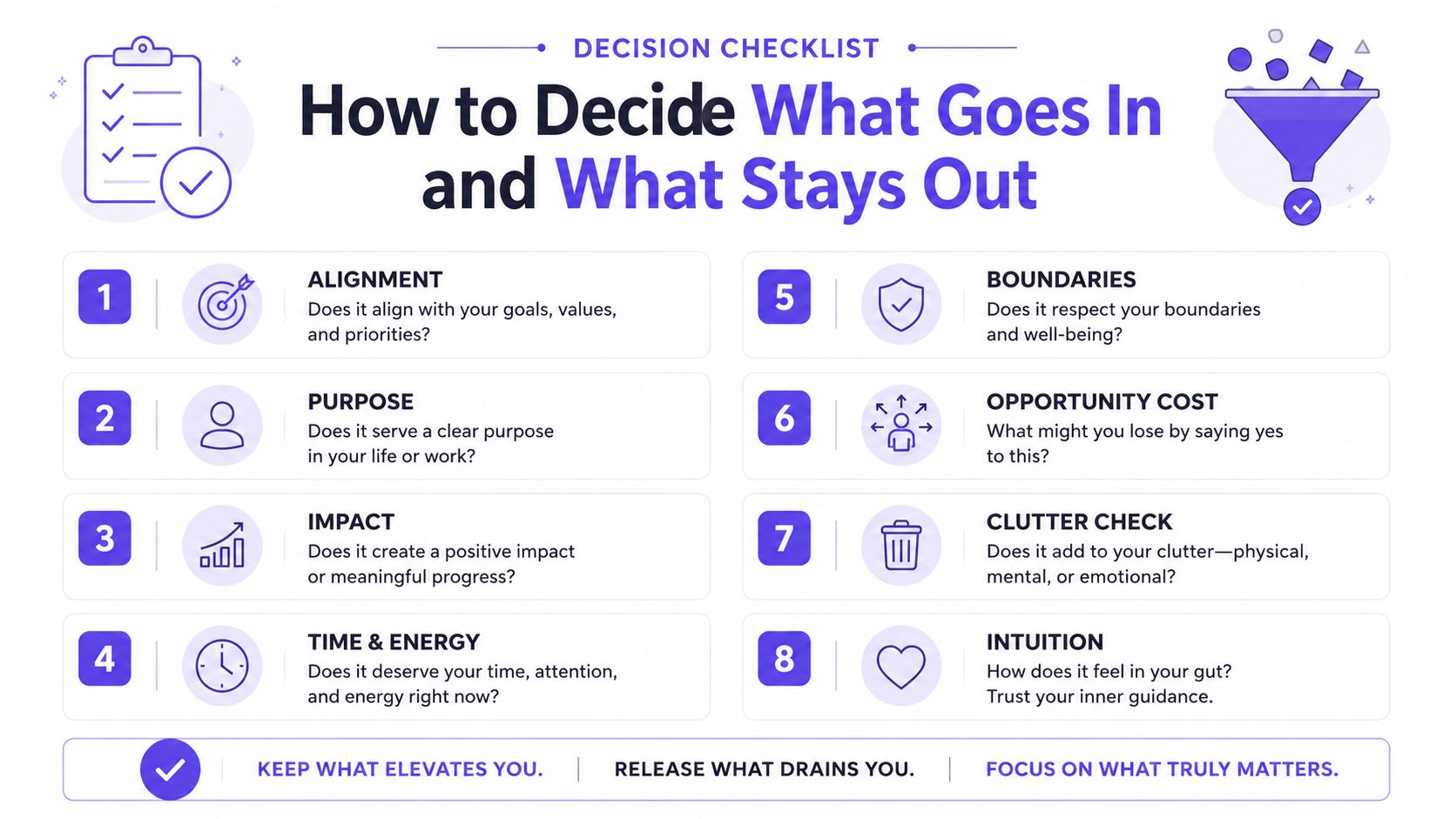
Start with one core assumption. If the product works, what must be true for it to matter? If buyers need to trust it before they adopt it, every feature should earn that trust. If users need to reach value fast, every screen should make that path shorter. Scope gets easier once the question gets narrower.
Use three filters, not a wish list
Ask every proposed feature three things:
Does it test the core assumption?
Does it block activation?
Does it signal trust or credibility to the buyer?
If the answer is no to all three, cut it. If the answer is yes to one, keep it only if it matters to the specific MVP test you are running. That keeps you from building a roadmap dressed up as a release.
A minimal UI can save design time, but in AI SaaS, Web3, and fintech, a bare interface can also hurt conversion. Buyers in those categories often read polish as a proxy for competence, especially when they are handing over money, data, or access. Microsoft's startup guidance is blunt about the enterprise side of this. Moving from MVP to larger deals is about enterprise readiness for startups, because enterprise customers expect reliability, security, and operational maturity from day one.
The buyer-vs-user split is critical. Atlassian calls out the gap directly, the user may want ease of use while a different stakeholder controls the budget or approval process, so the MVP has to test both activation and purchase validation in one release (minimum viable product). Most MVP guides flatten those roles into one person. That is bad advice in B2B. The user does not always buy, and the buyer does not always use.
Use this test: if a feature improves experience but does not help the user activate, build buyer trust, or answer a real assumption, it stays out.
For a practical scoping benchmark, Uniridge recommends starting with a single core assumption, a written list of features not being built, explicit pivot triggers, and instrumentation from day one, then beta testing with 10 to 50 users by weeks 7 to 8 (how to build an MVP). That is the right shape of discipline. A strong MVP includes a written out-of-scope list, because restraint is part of the design. You should also check the product-market fit questions you expect the MVP to answer before you add anything that is only there to make the build feel complete.
Metrics That Tell You the MVP Is Working
Signup numbers are the easiest metric to celebrate and the easiest to misunderstand. They show interest. They do not prove the product solves a real problem. CRV is right to push founders toward retention and willingness to pay, because product-market fit shows up in repeat use and payment intent, not curiosity alone (CRV MVP methodology).
What belongs on the dashboard
At minimum, the dashboard should answer three questions:
Are people coming back weekly?
Are they getting to value?
Would they pay, renew, or keep going?
Weekly retention belongs near the top because it is the clearest sign the product solves an ongoing problem. Gross churn matters alongside it, because a leaky product can hide behind fresh signups for a while. Activation rate is the earliest useful signal, because it shows whether people reach the moment the product is supposed to create value.
The strongest signals are behavioral. Opinions are noisy. Event data from tools like Mixpanel or Amplitude shows what users did, and Sentry shows where the product broke while they were trying to do it. Siift makes the same point from a founder's angle, measure behavior rather than opinions, then end the test with a binary decision, pivot, persevere, or stop (smart validation).
Signup numbers indicate interest, but they don't confirm the product is useful. The activation benchmark from the Presta guide is useful as a reading aid, 40 to 60 percent suggests strong B2B SaaS onboarding, while under 20 percent points to weak onboarding or a broken value proposition (2026 startup guide). Use that as a red flag, not a trophy metric. If activation is low, the product is either confusing, untrusted, or solving the wrong job.
For a tighter view on which early questions matter most, product-market fit questions gives founders a useful prompt set. The honest MVP dashboard is small, and it should force action, not debate.
Timeline, Team, and Working with a Creative Partner
A seed-stage MVP shouldn't drift for months. The cleanest plan is two weeks of discovery, four to six weeks of build, and two weeks of beta with a small pilot group, then a binary call at the end of week eight. That's long enough to learn something real and short enough to stop you from polishing the wrong thing.
The bigger decision is team shape. Most funded startups do not need to hire a product designer, a brand designer, and a frontend developer just to prove an idea. They need one senior partner who can handle all three layers without creating handoff drag. That's the working model behind 925 Studios, one creative partner covering product design, brand design, and frontend delivery for AI SaaS, Web3, and fintech teams.
That matters because MVP work fails at the seams. A founder hires separate people, the brand person shapes the promise, the designer shapes the experience, the developer ships the surface, and nobody owns the whole decision. The result is usually a product that looks assembled instead of intentional. When you're testing credibility, that's a problem.
A more honest budget range for a validated MVP with real polish is $30,000 to $75,000 (2026 startup guide). That's not cheap, but it's often cheaper than building twice. The money isn't just for screens and code. It's for reducing the risk that your first impression feels too rough for the buyer you want.
Good MVP teams optimize for learning speed, not headcount optics.
Railsware's post-MVP framework also makes the team shape point well, product managers, product designers, and a small group of developers can cover the MVP stage without bloating the org (what comes after an MVP). If you've already got a capable internal team, keep it. If you don't, don't pretend hiring three juniors is the same as buying one strong delivery partner.
The decision isn't in-house versus agency in the abstract. It's whether you can get to a trustworthy release with the least organizational drag. If the answer is no, one embedded partner is the cleaner move.
Pitfalls Specific to AI SaaS, Web3, and Fintech
An AI SaaS MVP fails fast when it looks like a thin wrapper around a model. That may work for a demo. It does not work for a buyer who expects a clear workflow, acceptable latency, and a predictable answer when the system gets something wrong. If the interface feels like a novelty layer, the sale gets harder.
Web3 teams make the opposite mistake. They explain the chain, the wallet, and the signing flow instead of hiding the plumbing behind a normal product experience. The user should care about the benefit, not the mechanics. If the product forces them to think about infrastructure, it feels like homework.
Fintech is the trust category. A scrappy build can make the whole company look risky, even when the core idea is sound. Microsoft's enterprise guidance makes the point clearly, buyers want reliability, security, and operational maturity before they expand usage (enterprise readiness for startups). In fintech, that is the product, not a nice extra.
The contrarian view in 2026 is that many funded startups underbuild credibility, not features. A rough MVP may backfire if the buyer is a Head of Product, a compliance lead, or anyone who reads the interface as a proxy for risk. A high-fidelity prototype tested with a small pilot can tell you more than a scrappy release that nobody trusts enough to use. For Web3 teams that need to tighten support expectations and user trust, find better community management strategies is worth reading because product credibility and community credibility travel together.
AI product teams should also read AI UX research. The best interface is the one that makes the model's output understandable, not just impressive. Domain-specific MVPs fail when they copy generic startup advice instead of designing for the actual buying environment.
Your 90-Day MVP Execution Checklist
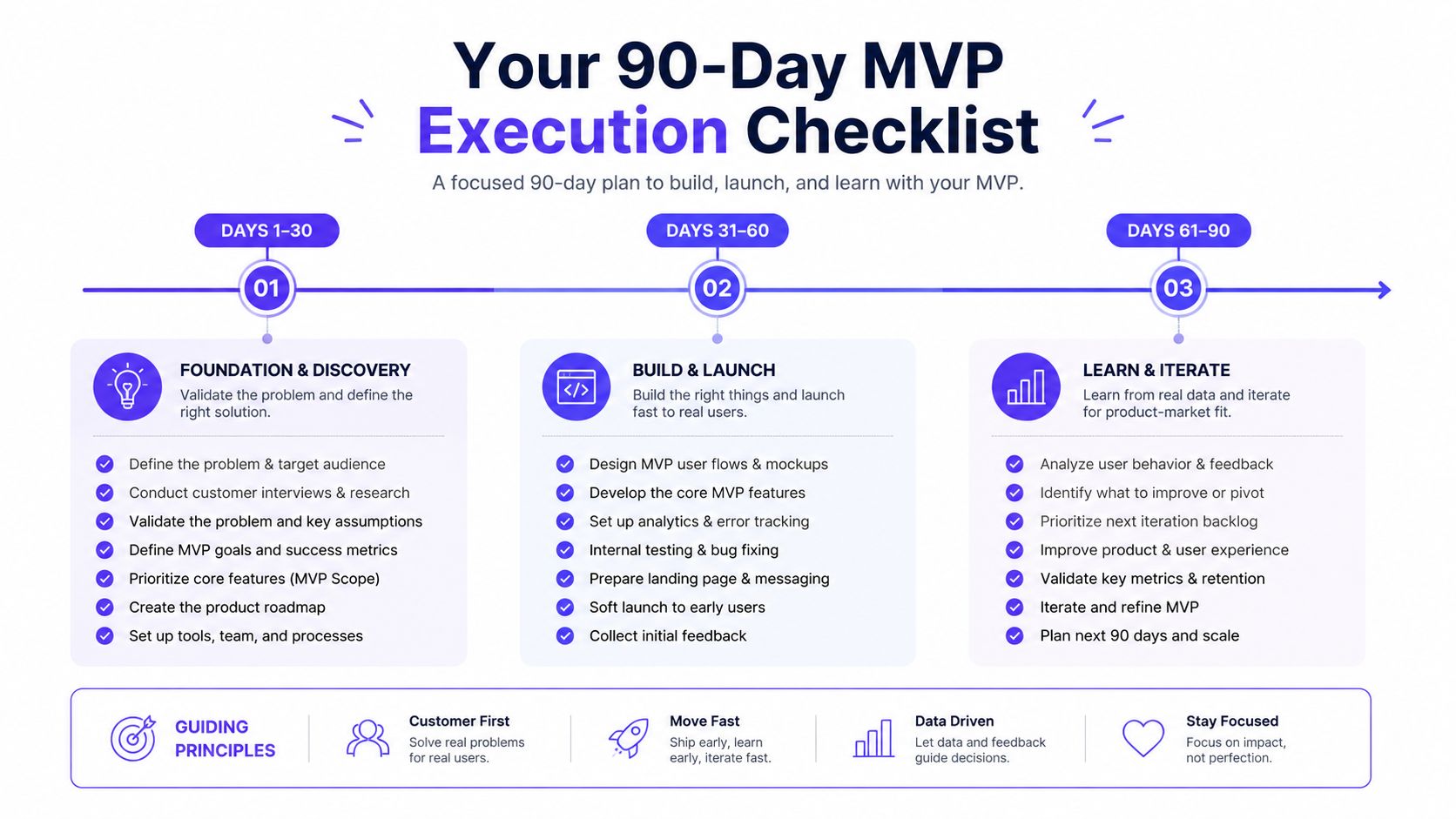
Weeks 1 and 2, do the hard thinking. Run 10 or more customer interviews, choose one core assumption, write the feature list you're not building, and define the activation event before any design starts. If you can't write the decision rule now, you'll invent one later to protect the work.
Weeks 3 through 8, build with weekly acceptance criteria reviews and instrumentation from day one. Keep the scope small, keep the UI honest, and review behavior data instead of debating vibes.
Weeks 9 through 12, open beta to 20 to 50 pilot users, watch activation, retention, and willingness to pay, and make the binary call. Under 20 percent activation, weak retention by week four, or zero payment signal means the MVP failed its job.
Before you hire anyone or write a line of code, answer this: what is the single assumption this MVP exists to falsify, and how will we know within eight weeks if it's wrong? If you want a partner that can take that answer and turn it into shipped product, brand, and interface without fragmenting the work, start a conversation with 925 Studios.


Let’s keep in touch.
Discover more about high-performance web design. Follow us on Twitter and Instagram.

