Creative Agency for Startups: A Founder's Guide

Outrank AI

You've raised funding, your product works, and the next launch is already on the calendar. But your brand still looks like an early prototype, the onboarding flow needs another redesign, and the frontend team is turning polished Figma screens into something nobody wants to use. Hiring a product designer, brand designer, and frontend developer could solve the problem, but it also creates three searches, three onboarding processes, and three people who must agree on what the product should feel like.
That's why the right creative agency for startups isn't just a logo vendor. It's an embedded partner that connects brand identity, product experience, and shipped frontend work. For AI SaaS, Web3, and fintech companies, that connection can matter more than visual polish alone.
Table of Contents
What a Creative Agency for Startups Actually Does
A founder usually reaches out after a specific breakdown. The pitch deck feels inconsistent, the website explains the product poorly, and the app has grown screen by screen without a shared system. A startup-focused creative agency starts by finding the connection between those problems instead of treating each one as a separate design request.
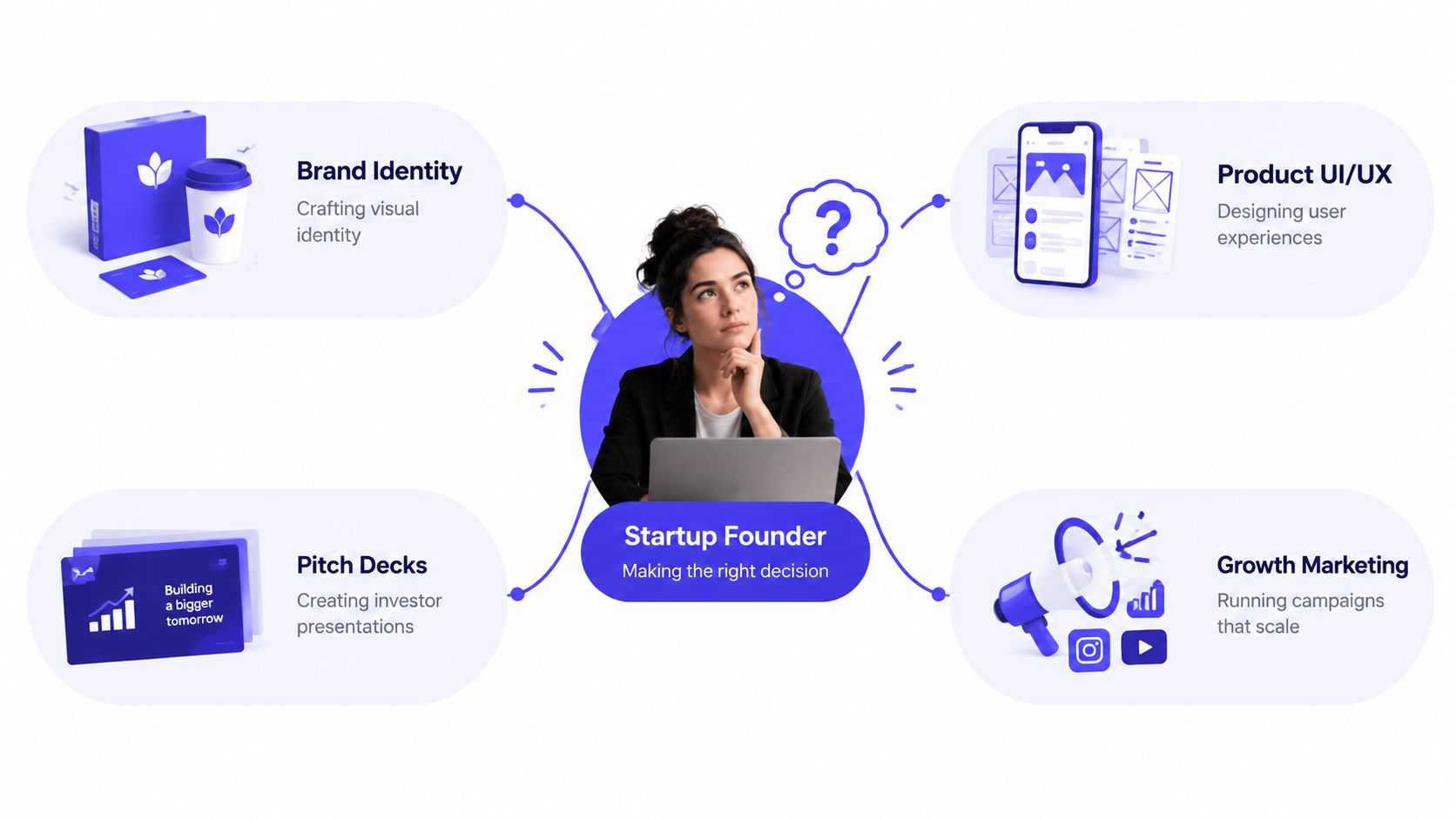
The work may begin with brand strategy, positioning, messaging, and visual identity, then move into the product itself. Designers define the interface language, map onboarding flows, build reusable components in Figma, and document the rules engineers need to implement them. The same team can shape an investor deck, landing page, launch campaign, and product tour so a prospect sees one company rather than several disconnected versions.
That product involvement separates a startup creative partner from a traditional advertising agency. An ad agency may focus on campaigns and media. A freelancer may deliver a landing page or a set of screens. A startup partner needs to understand the product roadmap, technical constraints, customer objections, and the stage of the business.
The weekly operating rhythm
In practice, the relationship should feel closer to an extension of your team than a vendor waiting for a monthly brief. A typical cadence includes:
Async Slack updates: Decisions, questions, and progress stay visible without filling every day with meetings.
Weekly working sessions: Founders, product leaders, engineers, and designers resolve priorities together.
Shared Figma files: The source of truth includes flows, components, content states, and implementation notes.
Launch support: The team adapts the system for product releases, GTM creative, sales collateral, and rebrands.
A good agency also knows when not to over-design. An early AI SaaS product may need a clear onboarding flow before it needs a complete brand book. A fintech team may need trust-building interface patterns and plain-language explanations before it needs motion graphics. A Web3 startup may need to make wallet actions and security choices understandable before it adds visual spectacle.
Founders raising capital can also use resources such as find investors for creative agency when they're mapping the broader funding and agency terrain. For a closer look at the product side of this model, compare it with a SaaS design agency that works inside the product rather than only around it.
Why Design and Brand Matter for Funded Startups
Design affects whether people understand, trust, and use a product. That matters before a prospect has learned your architecture, tested your model, or spoken with your sales team. The website, pitch deck, dashboard, and onboarding flow form an early argument about whether your company is credible enough to explore.
McKinsey's Design Value Index tracked 300 publicly listed companies over five years. Its top-quartile design performers achieved 32% higher revenue growth and 56% higher total returns to shareholders than peers, while outperforming the S&P Index by 219% over 10 years. Those figures come from McKinsey's design value research summary, and they don't prove that a logo creates revenue. They do show that design-led execution can correlate with outcomes at company-finance level, not just marketing level.
For a funded startup, the mechanism is practical. A clearer AI SaaS homepage can help a buyer understand the workflow before booking a call. A better fintech interface can reduce uncertainty around money movement, permissions, and compliance. A Web3 product with understandable wallet and transaction states can make developers more willing to try it.
Trust has a measurable technical layer
Brand matters, but performance determines whether people experience the brand at all. Google research found that a 0.1-second improvement in load time can materially improve each step of the user journey, including an 8.4% conversion lift in retail contexts. The findings are documented in Google's Milliseconds Make Millions report.
Portent reported that pages loading in 1 second achieved roughly three times the conversion rate of pages loading in 5 seconds. Its analysis also showed conversion rates falling from about 3.05% at 1 second to 0.67% at 4 seconds in the studied context, as detailed in Portent's site-speed analysis. That's why a creative partner must understand image compression, blocking assets, responsive states, and frontend implementation.
Metric | Design-Mature Startup | Design-Deferred Startup |
|---|---|---|
First impression | Clear value proposition and credible visual system | Buyers spend effort decoding the company |
Product experience | Reusable patterns guide users through complex tasks | Each feature feels designed in isolation |
Sales enablement | Website, deck, and demo support the same story | Marketing materials contradict the product |
Technical delivery | Components are designed for implementation | Engineers recreate screens through guesswork |
Growth efficiency | Creative work supports conversion and retention | More traffic exposes more experience problems |
You can also explore practical resources on scaling brands on Meta and TikTok, but paid distribution won't repair unclear positioning or a slow, confusing product. Traffic amplifies the experience you already have.
When to Hire an Agency Instead of Building In-House
The right question isn't whether agencies or employees are superior. It's whether your current stage justifies permanent capacity. A startup needs different design coverage before product validation than it does during a broad enterprise push.
Pre-seed and seed
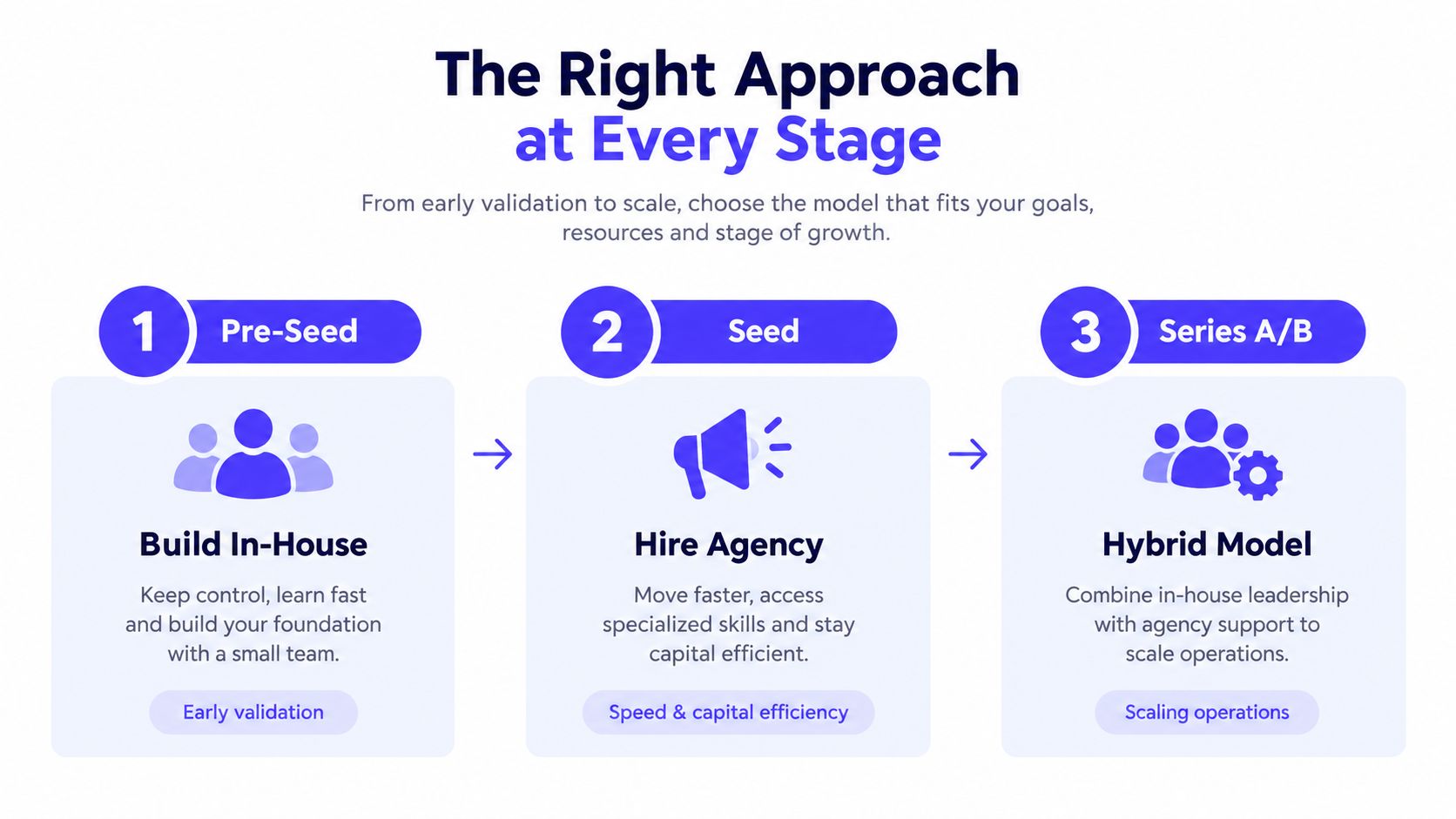
At pre-seed, founders should usually keep design close to the product and avoid building a large creative function. You need enough quality to validate the idea, communicate the product, and support fundraising. A founder, engineer, or product-minded generalist can often handle early decisions while a specialist helps with the highest-risk flows.
Seed is where an embedded agency becomes useful. Priorities change quickly, and the team may need brand identity, product UI, a launch site, and investor materials in the same operating window. Hiring three separate specialists creates coordination work before the company has a design leader to manage it. A partner that covers strategy through frontend can keep the system coherent while the team learns what the market wants.
Series A
Series A is usually the hybrid stage. Keep product ownership inside the company, often with one strong in-house product designer or design lead, and use an agency for capacity, brand work, design systems, or a major website and launch. The internal person protects product context. The external team handles concentrated delivery without forcing the company to hire every capability at once.
Series B
By Series B, many startups should consider building an internal brand lead and product design team. The company has more recurring work, more stakeholders, and more institutional knowledge to retain. An agency still makes sense for a rebrand, a new product surface, a major launch, or a period when the internal team is overloaded.
Hire earlier when one of these triggers appears:
A new fundraise: The company must turn a technical product into a convincing market story.
A product pivot: Existing screens and messaging no longer match the new customer or workflow.
An enterprise GTM push: Buyers need stronger trust signals, clearer permissions, and more mature sales materials.
A competitive launch: The product needs a coherent identity and a release experience across web, app, and campaigns.
For broader channel decisions, founders can review e-commerce growth strategies, then apply the same discipline to product and brand capacity. Don't hire permanently because the company feels successful. Hire when recurring demand requires ownership you can no longer borrow.
One Partner vs Three Hires and the Real Cost Comparison
Treat this decision as a runway calculation, not a debate about taste. The three roles startups commonly try to cover are a brand designer, a product designer, and a frontend developer who can turn approved designs into working interfaces.
A single product designer in a major U.S. market can cost about $155,000 to $205,000 per year once salary, benefits, tooling, recruiting, and onboarding are included. Recruiting and first-year onboarding can add $22,000 to $38,000, according to the 2026 product designer hiring cost analysis. That is before a separate brand designer or frontend developer joins the payroll.
Frontend developer compensation also varies widely. In 2026, U.S. base salaries range from about $75,000 to $190,000, with many senior offers between $130,000 and $185,000, according to KORE1's frontend developer salary guide. The U.S. Bureau of Labor Statistics reports a $92,650 median annual wage for web developers in May 2025, which gives founders a neutral reference point for the market cost of web product work.
What the monthly comparison reveals
Freelancers can look cheaper at first because they're often priced by task or hour. Product design rates commonly range from $25 to $200 per hour, with basic wireframing and UI work often between $25 and $80 per hour, as shown in Arc's designer pricing guide. The trade-off is management. Someone still has to define the brief, reconcile feedback, maintain the system, and coordinate the handoff.
Line item | In-house, 3 hires | Embedded agency partner |
|---|---|---|
Product design | One permanent salary, benefits, tools, recruiting, and onboarding | Included within the agreed team or retainer |
Brand design | A second hire with separate priorities and management | Shared with product work through one system |
Frontend implementation | A third hire, with salary and engineering coordination | Included when the partner owns design-to-build delivery |
Project management | Usually absorbed by a founder or product lead | Bundled into the engagement |
Capacity | Fixed, even when priorities change | Can scale with the roadmap and launch cycle |
Institutional memory | Stronger after successful onboarding | Must be protected through documentation and rituals |
An embedded partner doesn't automatically cost less than employees. It buys flexibility and bundled capability. The company avoids separate recruiting, ramping, and coordination while it still needs several disciplines.
In-house does offer real advantages. Employees build deeper product context, respond through faster Slack loops, and retain knowledge between projects. If the work is constant and the startup can support design leadership, internal hiring becomes more attractive. If runway is tight and the needs are uneven, one partner can be the more responsible choice.
How to Evaluate and Interview a Startup Creative Agency
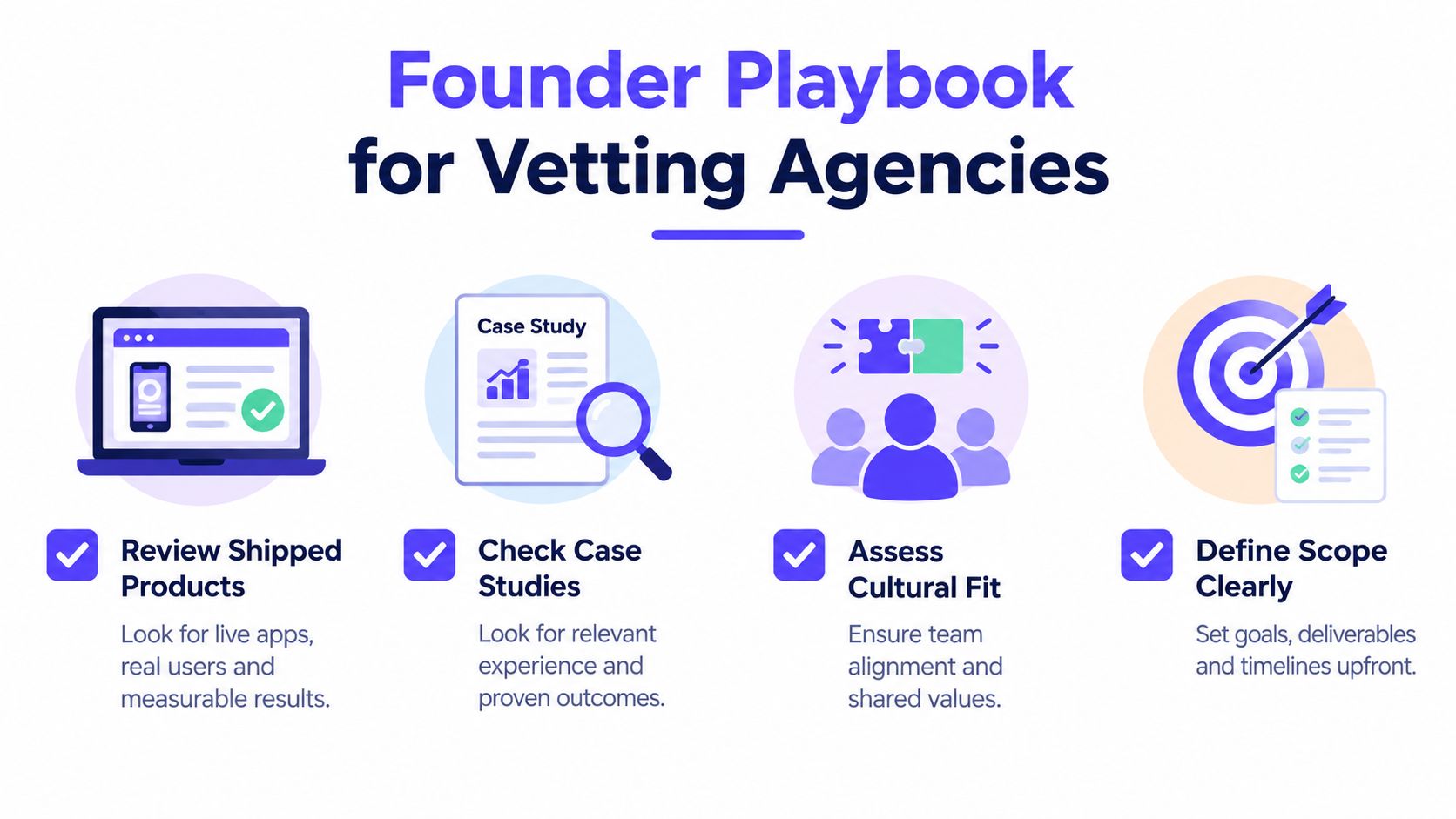
Start with the portfolio, but don't stop at the polished homepage. A strong portfolio should show live or shipped products, not only attractive screens. Look for dashboards, onboarding flows, websites, design systems, and implementation details that resemble the constraints your team faces.
Ask what happened after the presentation. Did engineers build the work? Did the agency work inside an existing codebase? Did the team handle empty states, permissions, errors, accessibility, and responsive behavior? If every example is a perfect hero shot, you're looking at art direction, not necessarily product capability.
Ask questions that expose the process
Use the interview to test how the agency thinks under pressure:
Who writes the brief? If the agency only waits for instructions, it may struggle with ambiguous startup work.
What happens in week one? You should hear about product review, user or stakeholder context, technical constraints, and an early working output.
Who will do the work? Confirm that the senior people in the pitch remain involved after signing.
How does scope change? Ask for the approval path, cost impact, and decision owner before work begins.
How does handoff work? Look for component libraries, annotations, prototypes, implementation reviews, and direct engineer collaboration.
Ask for the communication details too. Confirm time-zone overlap, async response expectations, meeting cadence, IP ownership, file ownership, and how disagreements get resolved. A mature partner won't promise to accept every opinion. They'll explain how they test a direction, make a recommendation, and document the decision.
The pitch itself is diagnostic. An agency that agrees with every vague request may be trying to close the deal rather than protect the outcome. You want a team that asks why the feature matters, which user is affected, what constraint is fixed, and how success will be judged.
Use a controlled onboarding
A 30-60-90 day review gives both sides a useful exit ramp. At 30 days, review communication, context gathering, and the quality of early work. At 60 days, assess whether the team is shipping usable systems rather than isolated assets. At 90 days, decide whether the agency has earned a broader role.
Founders who need a deeper checklist can use this guide on how to hire a design agency for a startup. The goal isn't to find a partner that never disagrees. It's to find one that makes disagreement productive.
Engagement Models and Pricing for Startup Creative Work
The contract shape should match the uncertainty of the work. Founders often choose a model because it sounds familiar, then discover that the pricing structure encourages the wrong behavior.
Four models founders actually use
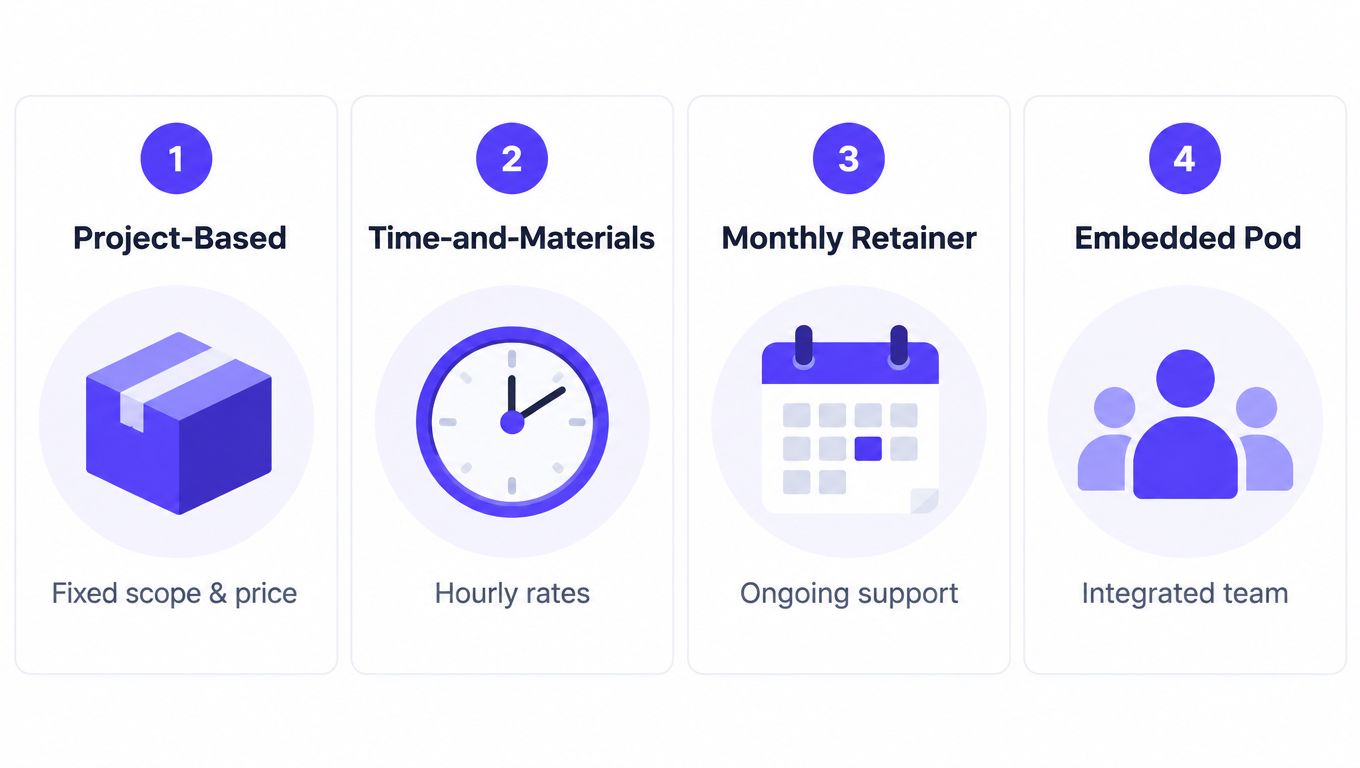
Project-based work has a defined scope, deliverables, and price. It fits a brand identity, pitch deck, launch site, or tightly bounded redesign. The benefit is budget clarity. The risk is that every meaningful change becomes a negotiation or change order.
Time and materials charges for hours or agreed capacity. It suits exploratory product design where user feedback, technical discovery, or product direction may change the work. You gain flexibility, but you need a strong product owner who can prioritize and stop low-value exploration.
Monthly retainers provide recurring access for a flat fee, a defined number of hours, or an FTE-equivalent allocation. They fit teams with ongoing design needs across product, marketing, and sales. Define response times, meeting limits, included disciplines, rollover rules, and what happens when demand exceeds capacity.
Embedded pods combine product design, brand, frontend, and project coordination around a shared roadmap. This is the most useful structure when the startup is shipping continuously and needs one team to move from strategy to interface to implementation. It also requires the clearest decision rights, because the partner is operating close to the company.
Negotiate the risk, not just the rate
Startup branding projects commonly fall between $15,000 and $50,000 at early stage, while broader engagements can reach $50,000 or more. Premium strategy-led agencies may charge $150,000 or more, according to this analysis of startup branding agency costs. Those ranges reflect how much work sits beyond a logo, including strategy, identity systems, website design, and launch assets.
Another industry summary places typical startup brand projects around $15,000 to $90,000 or more, with timelines from roughly 2 to 12 weeks, as discussed in this startup branding agency guide. Treat these as market ranges, not a quote for your project.
Reasonable negotiation levers include a paid pilot, milestone billing, a narrower first phase, a case-study rate, or equity when both sides clearly understand the risk. Don't ask for equity to disguise an underfunded project. Ask for a pilot when you need evidence of fit, then expand only after the team proves its operating rhythm. For a detailed view of product design engagement structures, review product design agency engagement models.
Red Flags and Common Mistakes When Hiring a Creative Agency
A creative agency relationship rarely fails because the team can't choose a color. It fails because nobody defined ownership, feedback, scope, or delivery. Surface those risks before the contract, not after the first missed launch.
The warning signs are operational
A vague scope creates endless interpretation. “Refresh the brand and improve the product” isn't a deliverable. Ask for named outputs, review points, decision owners, and explicit exclusions.
A fixed fee with no change process looks safe until the product changes. Startup priorities will move. Add a documented change-order process, a capped discovery phase, or a kill clause that lets either side stop after a defined milestone.
A portfolio full of Dribbble shots tells you little about shipping. Request live products, engineering references, responsive states, and examples of work that survived technical constraints.
No named point of contact creates fragmented communication. You should know who owns the relationship, who makes design decisions, and who handles implementation questions.
Slow async communication is a serious concern for a small team. If the agency takes too long to answer simple questions during sales, the delivery relationship probably won't improve after signing.
Fix the relationship before replacing it
An existing engagement can often be rescued. Create a weekly demo cadence where the agency shows working flows, not only presentation slides. Build a shared Figma library with agreed naming, components, and status labels. If Slack threads become too abstract, switch complex feedback to short Loom walkthroughs with a written decision afterward.
Practical rule: Every meeting should end with an owner, a decision, and the next visible output.
Watch for the bait and switch too. The senior strategist may sell the engagement while junior designers do all the work. Put the actual team in the room before signing, and make staffing changes subject to approval.
Finally, don't ask an agency to design more than your engineers can build. A beautiful system that sits untouched in Figma is not progress. Prioritize the flows tied to the next launch, document the rest, and keep the work connected to a product decision.
Choosing the Right Creative Partner for Your Startup
Start with three questions. What stage are you in? What design gap is blocking progress? Can your budget support an embedded partner without putting the runway at risk? Those answers should narrow the search before you compare visual styles.
A pre-seed company may need focused product validation and a usable launch surface. A seed AI SaaS team may need one partner across positioning, onboarding, dashboard design, and frontend implementation. A fintech company entering enterprise sales may need a more disciplined trust system across its website, product, and sales materials. A Web3 startup may need to make technical actions understandable before it invests in a louder identity.
Shortlist for relevance, not reputation
Review agencies against the work you need:
Portfolio relevance: Have they shipped products with similar complexity?
Industry fluency: Can they discuss AI workflows, fintech trust, or Web3 user behavior without hiding behind jargon?
Product depth: Do they understand flows, states, systems, and implementation?
Brand continuity: Can the identity survive inside the app, not only on the homepage?
Working chemistry: Do they ask sharper questions and make decisions clearly?
Capacity fit: Will the team support your roadmap, or only complete a one-off deliverable?
Then share a short brief with the business problem, audience, current product, technical constraints, launch context, and decision deadline. Ask shortlisted partners to respond with what they'd clarify, what they'd prioritize, and what they'd leave out. Their omissions often reveal more than their mood boards.
A paid pilot sprint is the safest next step. Make it narrow enough to judge the working relationship and substantial enough to expose real collaboration, such as redesigning one onboarding path, building a product component set, or connecting a landing page to a live frontend. Review the output, communication, and handoff before committing to a larger engagement.
For teams that want one embedded creative partner instead of separately hiring a product designer, brand designer, and frontend developer, 925 Studios offers product design, brand identity, websites, design systems, and frontend implementation for AI SaaS, Web3, and fintech companies.
If your startup has outgrown its visual identity or is losing momentum between product, brand, and frontend work, share your current roadmap and the next launch with 925 studios. The team can help scope a focused pilot or an embedded engagement that connects strategy to shipped interfaces.

Let’s keep in touch.
Discover more about high-performance web design. Follow us on Twitter and Instagram.