
7 Best Web Design Companies for Startups

Outrank AI

The popular advice is to choose the agency with the most impressive portfolio. That's the wrong test for a startup. A polished homepage doesn't tell you whether a team can simplify a technical product, connect design to conversion, build a maintainable frontend, or work inside the constraints of an AI SaaS, Web3, or fintech launch.
The best web design companies solve different problems. Some are strongest at product UX, some at brand and storytelling, some at Webflow operations, and others at complex enterprise delivery. Compare product design, brand, frontend execution, technical web capabilities, engagement model, relevant evidence, pricing transparency, and startup-stage fit before you compare awards.
This list evaluates 925 Studios, MetaLab, Clay, Ramotion, Work & Co, Webstacks, and Refokus through that lens. Public pricing and exact timelines aren't available for every firm, so the recommendations distinguish verified public signals from questions you'll need to ask in a sales call. If you're still defining your requirements, this guide to the top website builder for non coders can help you separate a simple marketing site from a product-led web build.
The best partner is the one matched to your product risk and delivery stage, not the most famous name.
Table of Contents
1. 925 Studios
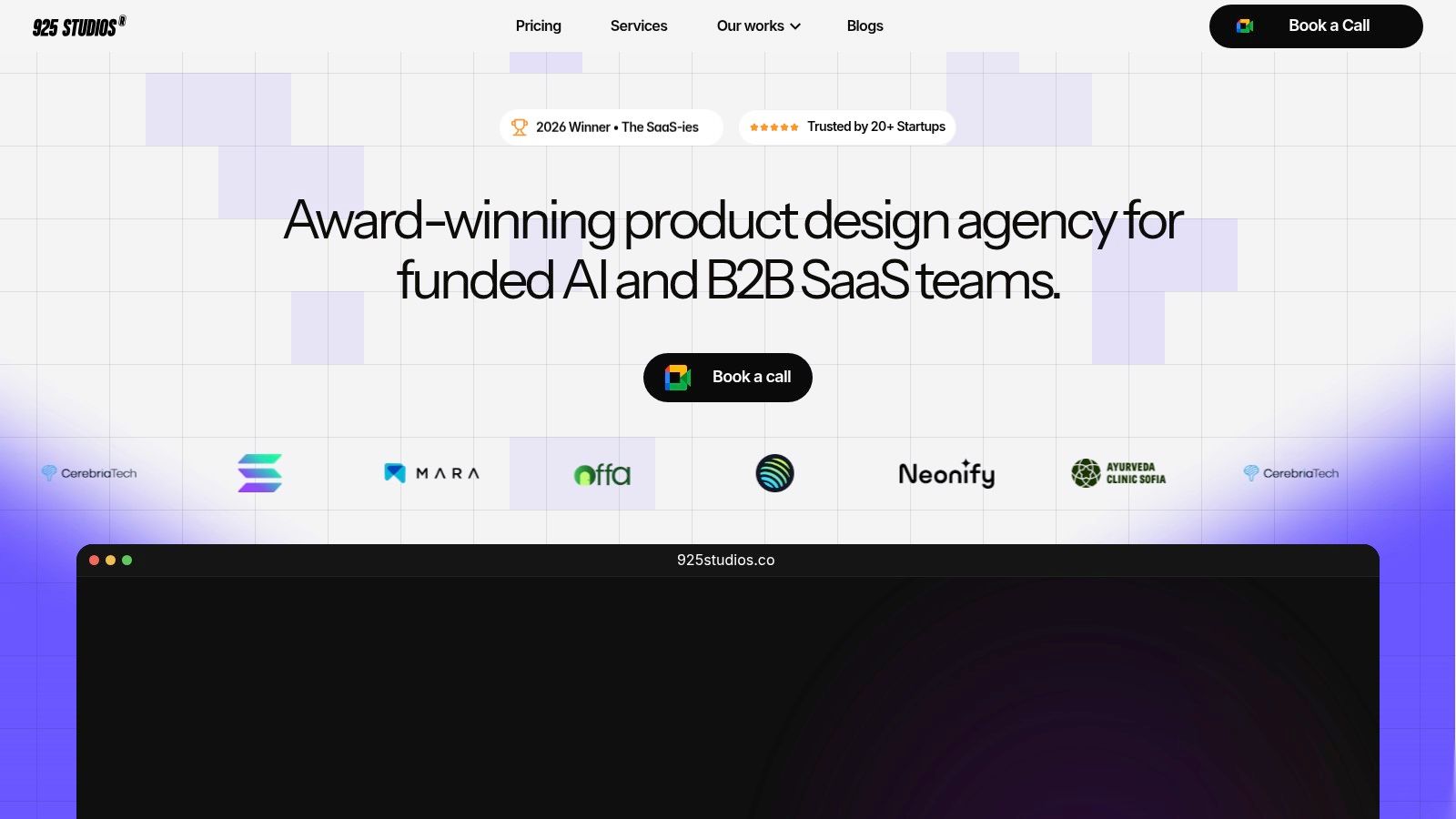
925 Studios suits funded startups that need a website and product work from the same team. The studio covers product design, brand identity, frontend development, and website delivery, reducing the coordination burden of hiring separate specialists for each part of the launch.
That setup fits AI SaaS, Web3, and fintech companies with complex products and small internal teams. Its scope can include SaaS dashboards, marketing sites, design systems, and full product redesigns. Founders keep strategy, interface decisions, and shipped pages in one working relationship instead of passing a brand brief, product brief, and Figma file between vendors.
The firm also frames its work around clarity, conversion, performance, and maintainability. Its stated approach includes applied AI in the workflow, modular systems for later pages and features, and lightweight, SEO-friendly implementation. These priorities matter when the website must generate demo requests while the product team continues changing positioning, navigation, onboarding, and core functionality.
Engagement model and delivery fit
925 Studios offers two engagement paths. A retainer provides a dedicated team, ongoing design requests, founder involvement, and communication through Slack, Google Meet, Discord, and Loom. Fixed-scope projects use milestones, giving teams with a defined launch objective a more contained route to delivery.
The public offer also includes a risk-free seven-day trial. Exact pricing and timelines are not listed publicly. Request a scope-based proposal that separates discovery, brand work, product design, frontend development, content support, and post-launch changes.
Strengths and trade-offs
Choose 925 Studios when:
You need one partner: One coordinated team can cover product design, brand design, and frontend development.
Your product is technically complex: AI SaaS dashboards, fintech workflows, Web3 products, and conversion-focused marketing sites need more than a visual refresh.
You need a scalable system: Shared components and design rules help the team add pages and product features without repeating every decision.
You're funded and moving toward growth: The model fits Seed through Series B teams and scaling startups that need senior coverage without building a full internal design function.
The trade-off is scope and cost. A hobby project, basic brochure site, or early pre-seed experiment may not need this level of coverage. Public information describes engagement types and inclusions, but a consultation is still required to confirm budget and schedule.
Practical rule: Hire 925 Studios when the next milestone requires both a better product experience and a shipped public-facing website.
2. MetaLab
MetaLab is a strong choice when your startup needs high-polish product and brand work that can stand beside established technology companies. The firm works across product design, branding, websites, and frontend engineering, giving it a broad scope for teams that need their interface and marketing experience to feel like one product.
Its public body of work includes recognizable product and platform work, including work associated with the YouTube player and refinements connected with Threads. Those examples signal experience with products that need intuitive interaction, disciplined systems, and a high standard for everyday usability, not just a launch campaign.
MetaLab is particularly useful when the problem is category storytelling. A startup may have a technically strong product but struggle to explain why it matters, how it differs, or where a user should begin. A team with experience across product and marketing surfaces can align the homepage, navigation, onboarding, and product language around the same value proposition.
Where MetaLab makes sense
The firm suits funded startups, product-led growth companies, and larger organizations that want a partner capable of working across several surfaces. It can be a good fit when the project includes a brand evolution, a marketing website, and product interface work rather than a standalone landing page.
The main risk is procurement friction. Pricing is custom, and demand can make scheduling competitive. A smaller startup should ask whether the proposed team will include the senior practitioners shown in the portfolio or whether day-to-day work will move to a less experienced delivery group.
For a closer comparison of scope and positioning, review these MetaLab alternatives for 2026 before making a shortlist.
Trade-offs for founders
Best fit: Teams that value broad product and brand polish, strong storytelling, and a mature design process.
Less suitable: Founders who need a small fixed-scope website, published pricing, or an immediate start.
Ask directly: Who owns frontend implementation, how much engineering is included, and what happens after the initial launch?
MetaLab is a credible choice when the cost of an unclear product story is high. It's less compelling when the only requirement is to replace an outdated brochure site.
3. Clay
Clay is the clearest choice for a fintech or SaaS company that needs premium branding, content, product UX, and web production in one engagement. The US-based agency combines branding, websites, product experience, development, and an in-house content studio covering copy, illustration, 2D, 3D, and video.
That depth matters for technical companies selling trust. A fintech website has to explain risk, security, workflow, and value without making the visitor feel lost. Clay's combination of identity, content, motion, and interface design can help a company turn a dense product into a more understandable story across the homepage, feature pages, product screens, and sales materials.
The agency has worked with recognizable technology and financial brands, including Grayscale, Marqeta, Tipalti, Discover, and Marqeta-related fintech work described in its public positioning. Its multi-office US presence and remote delivery model can support distributed startup teams, although location won't replace the need for a clear working cadence.
A strong content and brand option
Clay is valuable when the website needs more than interface design. An in-house content capability can reduce the handoff between strategy, messaging, visual direction, and implementation. That's useful for a startup whose product is changing quickly or whose existing copy doesn't explain the buyer problem clearly.
Senior design-director oversight is another positive signal for companies that want strategic guidance rather than production-only support. The downside is that this level of specialization is generally aimed at funded startups and enterprise organizations, not scrappy MVP budgets. Clay doesn't publish pricing, and SEO is generally integrated into web engagements rather than sold as a standalone service.
See these Clay agency alternatives for brand design in 2026 if you're comparing a content-heavy brand engagement with a smaller embedded product team.
Founder decision
Choose Clay: When fintech-grade trust, visual identity, content depth, and high-end UX all matter.
Avoid it for: A narrow landing-page refresh with minimal strategy or content needs.
Confirm before signing: The exact content deliverables, number of concepts, development responsibility, and SEO handoff.
Clay is a strong partner for a company that needs to look credible to customers, investors, and enterprise buyers at the same time.
4. Ramotion
Ramotion is the practical option for B2B SaaS founders who want a combined brand, website, and product UX engagement with clearer public process signals. The agency offers startup packages and documents services across brand identity, design systems, product UI and UX, marketing websites, CRO, SEO, Webflow, and Jamstack options.
That combination helps reduce procurement uncertainty. A founder can start with a defined package or scope instead of assembling a large custom brief before knowing whether the agency is a fit. City-specific squads in San Francisco, New York, and Los Angeles may also help teams that prefer closer timezone alignment or regular live collaboration.
Ramotion works well when the business needs a stronger identity and a better product explanation, not merely new page layouts. A SaaS company might use the engagement to clarify its positioning, create a repeatable visual system, redesign core product flows, and build a marketing site that supports acquisition.
Transparent signals, broader scope
The agency's published process and startup-package approach are its biggest advantages. Buyers can evaluate the expected work before a long sales cycle and ask sharper questions about milestones, deliverables, and ownership. Its technology-brand and SaaS experience also makes it a reasonable candidate for teams selling to technical buyers.
There's a trade-off. Highly custom builds and animation can expand both scope and timeline. If you only need a few pages updated, a full brand, product, and web package may be more than the project requires. Review these Ramotion alternatives for product design in 2026 if you're deciding between a packaged agency and a more embedded studio model.
Best fit: B2B SaaS teams that want published process signals, brand support, and a structured combined engagement.
Watch closely: Custom animation, content production, and revision assumptions.
Ask for: A split proposal showing the cost and timeline for brand, product, website, development, and ongoing optimization.
Ramotion is the sensible shortlist candidate when pricing transparency matters more than choosing the most prestigious name.
5. Work & Co
A famous portfolio is not a startup hiring strategy. Work & Co earns consideration when the problem is coordination, technical breadth, and reliable execution across a digital ecosystem. Now part of Accenture Song, the firm covers strategy, research, product design, design systems, brand, full-stack development, commerce, CRO, and SEO or content strategy.
That scope matters when a website must connect to a larger product transformation. Work & Co can bring product, marketing, experimentation, and implementation into one engagement instead of splitting responsibility among separate vendors. It is also suited to AI-forward work, with capabilities in generative AI and multimodal UX. Those skills can help an AI product explain unfamiliar interactions clearly.
Use the client list as an execution signal, not a fit guarantee. Its public clients include Apple, Google, IKEA, Nike, and Airbnb. These references suggest experience with large audiences, multiple teams, and demanding operating environments. They do not show that the firm will adapt its process to a small startup or a short launch window.
Choose Work & Co when the project is mission-critical, technically broad, or tied to a major product change. Governance, quality assurance, experimentation, and cross-team coordination become valuable when the site supports several functions at once.
The trade-off is capacity and process. Enterprise-oriented pricing and timelines can exceed a pre-seed or early Seed budget. Procurement may also require more stakeholders, documentation, and coordination than a smaller studio engagement. A narrow launch site or validation sprint will rarely justify that overhead.
Best fit: Growth companies and enterprise teams with product, marketing, engineering, and compliance stakeholders.
Poor fit: Founders who need a small independent team, a quick test, or a limited marketing-site build.
Confirm before signing: the actual delivery team, decision-making structure, discovery requirements, engineering allocation, milestones, and approval process.
Work & Co is a practical choice when complexity threatens the outcome. Its portfolio should support that decision, not make it for you.
6. Webstacks
Webstacks fits B2B SaaS companies that treat the website as an operating product, not a one-time marketing asset. Its work centers on composable web systems, conversion optimization, site operations, ongoing iteration, and training for marketing teams.
The technical scope covers Webflow, Sanity, Next.js, Vercel, and Netlify, plus migrations and component systems. Webstacks also connects websites with Salesforce, HubSpot, and other revenue operations tools. That setup suits teams that need to publish pages, update campaigns, manage forms, and connect website activity to pipeline without routing every change through engineering.
Public SaaS examples associated with Calendly, Snowflake, and ServiceTitan point to experience with product-led growth, enterprise sales, and large content libraries. Treat those references as evidence of relevant execution, not as proof of fit for your company.
Decide based on the operating model
Webstacks makes sense when the site will keep changing after launch. Regular testing, new pages, technical SEO work, CRM integrations, and ongoing improvements justify an operating partner. A small brochure site or one campaign landing page does not.
The trade-off is architectural responsibility. A composable setup requires clear decisions about content ownership, hosting, integrations, content models, engineering support, and agency exit terms. A modern stack still creates maintenance work. Before signing, ask who owns the code and accounts, where the code lives, how marketers publish safely, and who handles failures after launch.
Choose Webstacks: When SaaS growth, CRM integration, editor independence, and continuous site operations are central to the plan.
Choose another partner: When the requirement is a small static site, a single landing page, or a project your team will rarely update.
Ask for: A post-launch operating plan, CMS training, analytics setup, integration map, maintenance responsibilities, and ownership terms.
For Seed teams, confirm that the engagement will not introduce more architecture than the roadmap needs. Growth teams with dedicated marketing and revenue operations staff can gain more from the platform and ongoing iteration. Webstacks is a practical choice for teams prepared to ship continuously and maintain the system, rather than a vendor for a site that will be forgotten after launch.
7. Refokus
Choose Refokus when the website must carry the brand, explain a complex product, and give the marketing team control after launch. Its specialty is expressive Webflow work, including custom interactions, motion, design systems, and large SaaS websites with many pages.
The agency's early Webflow Enterprise Partner positioning matters for teams treating Webflow as a serious content platform. Refokus combines brand identity, strategy, creative development, and post-launch enablement, so the result can support ongoing marketing work rather than depend on developers for every update.
Its Awwwards, FWA, and CSSDA recognition indicates strong visual craft. That evidence supports a design-led brief, but it does not prove conversion performance. Ask to see relevant outcomes, such as improved sign-ups, clearer product journeys, or stronger engagement, before treating awards as a hiring reason.
Hire for a distinctive Webflow system
Refokus fits a B2B SaaS or technology company that needs a memorable first impression. Custom interactions can clarify a technical product, show how a workflow operates, and make an unfamiliar category easier to understand. The team's creative strength is most useful when the site is a major acquisition asset, not a simple information page.
The main decision is platform fit. A Webflow-first build creates friction for companies committed to another CMS, dependent on a heavily customized application stack, or keeping most content and functionality outside Webflow. Motion and custom craft can also expand scope. Require a performance budget and mobile behavior requirements before approving the concept.
Use this screening list:
Best fit: A startup prioritizing a flagship Webflow site, strong creative direction, and marketing-team control after launch.
Less suitable: A company locked into another CMS or seeking the lowest-cost implementation.
Confirm: CMS ownership, migration scope, SEO controls, accessibility work, performance testing, and post-handoff support.
For Seed teams, confirm that the visual ambition matches the roadmap and budget. Growth teams with dedicated marketing staff can gain more from the platform and ongoing content control. Refokus should be a first call when the website itself must differentiate the company and support acquisition.
Top 7 Web Design Companies Comparison
Agency | Implementation complexity | Resource requirements | Expected outcomes | Ideal use cases | Key advantages |
|---|---|---|---|---|---|
925 Studios | Medium, modular, production-ready builds | Dedicated embedded team (retainer or fixed-scope), senior-focused; best for funded startups | Measurable conversion & performance gains; production-ready sites/apps | Seed–Series B AI SaaS, Web3, fintech teams needing speed + design + frontend | One-stop team replacing multiple hires, modular systems, applied AI, fast turnaround |
MetaLab | High, polished marketing & product experiences | Senior multi-disciplinary teams; custom pricing and scheduling | High-fidelity, brand-forward interfaces and scalable design systems | Seed to global brands launching marketing sites or product refinements | Strong name-brand portfolio, cross-industry storytelling, execution at scale |
Clay | High, brand, motion/3D and development integrated | In-house content, dev and senior oversight; enterprise budgets typical | Premium UX, identity and motion-rich sites with polished copy/visuals | Fintech & SaaS leaders wanting integrated identity + UX + content | In-house content studio, award-recognized UX, senior design directors |
Ramotion | Medium–High, end-to-end with potential for custom animation | Transparent starter packages or custom scopes; US city squads | Clear scoped brand + site + UX with CRO/SEO options | B2B SaaS teams wanting combined brand/product/web with defined process | Published processes, starter pricing, proven SaaS engagements |
Work & Co | Very high, enterprise-scale systems from research to engineering | Large cross-functional teams, enterprise procurement, higher budgets | Robust mission-critical platforms and complex digital ecosystems | Enterprise programs, category leaders with governance/QA needs | Deep strategy→engineering capabilities, GenAI/multimodal expertise, industry recognition |
Webstacks | Medium, composable web & iterative site ops | Specialized stack expertise (Webflow, Sanity, Next.js); ongoing iteration commitment | Fast-to-ship, editor-friendly SaaS sites optimized for SEO and RevOps | B2B SaaS treating website as a product with continuous iteration | Composable architecture expertise, strong RevOps/CRM integrations, site-ops model |
Refokus | Medium–High, Webflow enterprise builds with advanced motion | Webflow-first teams, custom pricing; craft/motion increases budget | Expressive, conversion-aware flagship sites with technical rigor | Teams needing high-craft Webflow enterprise sites with interactions | Webflow Enterprise Partner, award-winning motion/interaction design, enterprise-scale builds |
Choose by Startup Stage, Then Vet the Team
The right agency depends on the next business milestone. A pre-seed founder validating a problem shouldn't buy an enterprise transformation. A growth-stage fintech team with compliance, product, brand, and acquisition pressure shouldn't treat a website as a collection of attractive pages.
For funded Seed through Series B teams, 925 Studios is the strongest fit when you need product design, brand identity, and frontend coverage from one partner. Its embedded model is especially useful for AI SaaS, Web3, and fintech companies that need a product redesign, a conversion-focused marketing site, or a shared design system without hiring three separate specialists.
Choose Ramotion when transparent startup packages and a documented process matter most. Choose Webstacks when continuous SaaS site operations, CRM integrations, composable architecture, and marketing-team autonomy are central to the plan. Choose Clay when fintech-grade branding, content depth, and high-end product storytelling carry more weight than a lean MVP budget.
Choose Refokus when the priority is a flagship Webflow experience with distinctive interaction design. Choose MetaLab when you need broad product and brand polish across a refined product and marketing surface. Choose Work & Co when the program is truly enterprise-scale and its heavier coordination model is justified by technical complexity, governance, and multiple delivery teams.
Before signing, run the same practical test with every finalist:
Request two relevant examples: Ask for work involving your product type, buyer, platform, or technical constraints, not just the agency's most famous projects.
Ask who will do the work: Confirm the names, roles, seniority, and availability of the people assigned to strategy, design, content, and development.
Confirm deliverables and revision limits: Get page lists, feature scope, number of concepts, revision rounds, testing responsibilities, and acceptance criteria in writing.
Test the working process: Start with a defined milestone, such as a homepage and one core product flow, before committing to a broad transformation.
Clarify CMS and code ownership: Confirm access to design files, source code, hosting, domains, analytics, content, integrations, and component libraries.
Request pricing by scope: Separate discovery, brand, product design, content, development, QA, launch, and ongoing support so you can compare proposals fairly.
Confirm post-launch support: Ask who fixes defects, trains your team, monitors performance, and handles new pages or product changes.
Tie success to a shipped outcome: Define what must be live, usable, measurable, and owned by your team at the end of the engagement.
Use the same discipline when writing an AI search agency RFP. Specify the business outcome, technical environment, ownership terms, and evidence you expect before agencies respond.
Compare the next delivery milestone, not just portfolios or awards. The agency that can clearly explain what will ship, who will ship it, and how your team will use it afterward is usually the safer hire.
925 Studios gives AI SaaS, Web3, and fintech teams one creative partner for product design, brand identity, website development, and frontend delivery. If you need senior coverage without hiring three separate specialists, visit 925 studios and discuss the product milestone you need to ship next.

Let’s keep in touch.
Discover more about high-performance web design. Follow us on Twitter and Instagram.

