10 DesignJoy Alternatives for AI SaaS, Web3, and Fintech

Outrank AI

A product can have solid engineering and still lose trust in the first thirty seconds because its screens look like every other tool in the category. That problem rarely starts with bad code. It starts when a hypothetical founder spends months trying to hire a product designer, a brand designer, and a frontend developer, then ships rough screens because none of those roles is in place.
That hiring gap explains why subscription studios and embedded creative partners have become practical options for funded teams. The wider design-services market was estimated at approximately $150 billion in 2024 and is projected to reach about $280 billion by 2033, with an estimated 7.2% compound annual growth rate from 2025 through 2033. The estimate includes in-house teams, freelancers, and agencies, so outsourced design is part of an established professional-services market, not a niche buying pattern. See the global design-services market estimate for the underlying scope and caveat that these are directional research figures.
This list of DesignJoy alternatives is organized by hiring gap, not by a generic ranking. Each option is judged by what it means for an AI SaaS, Web3, or fintech team with a product to ship: the roles it covers, how requests enter the system, how many projects can run at once, and where the provider stops being useful. Before you compare providers, you can also review this LATAM's Upwork alternative for another way to source creative and technical talent.
Table of Contents
1. Superside
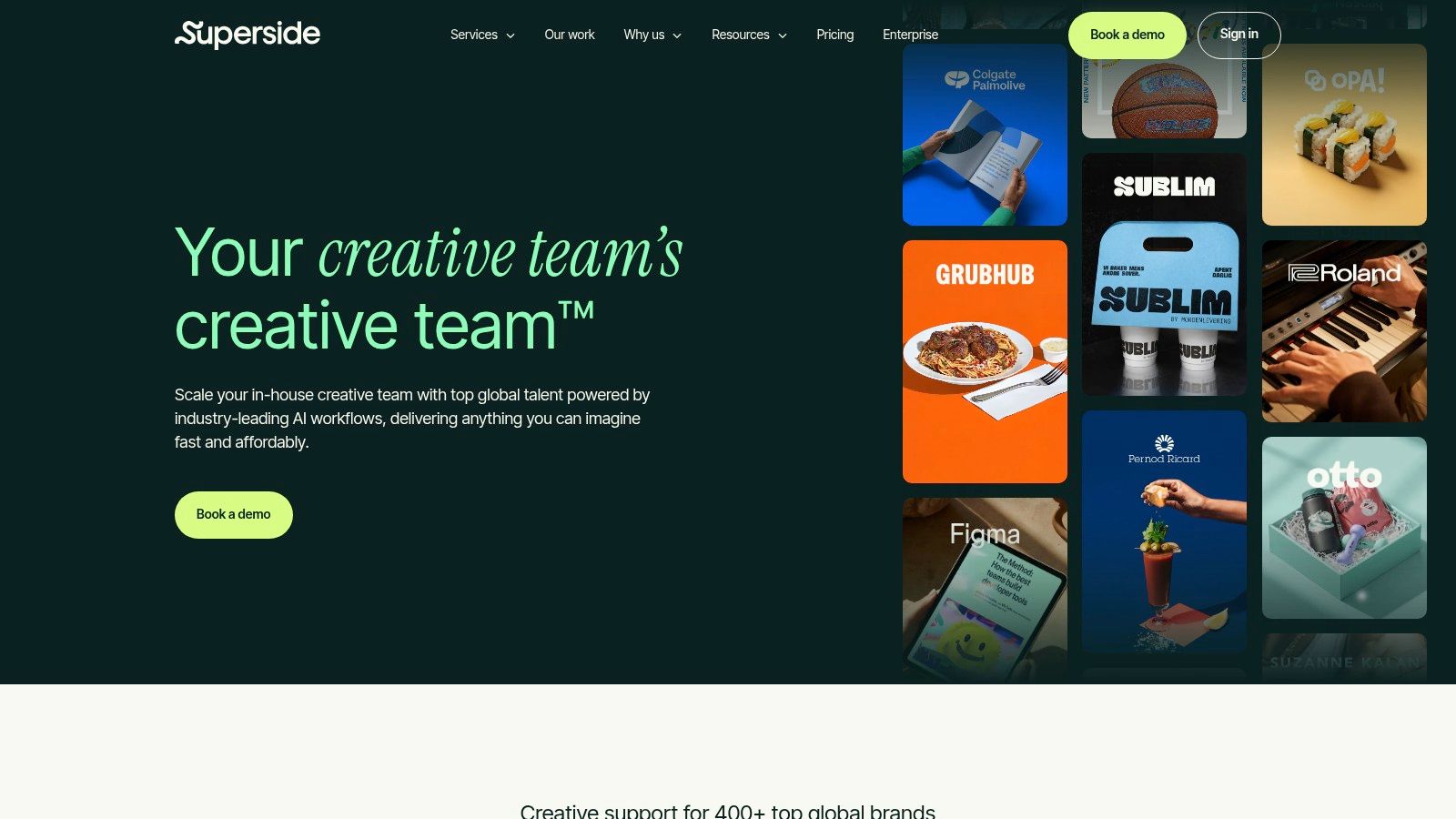
Superside is built for teams that need several creative disciplines operating at the same time. Its managed subscription combines design, video, motion, 3D, illustration, presentations, web and interface work, plus creative strategy. A project manager or creative lead sits between the client and the production team, which gives larger marketing organizations a clearer operating layer than a solo designer can provide.
Where Superside fits
The Flex Budget model is useful when an AI company needs a product launch, paid campaign, motion assets, and sales presentations in the same period. Slack, Asana, and Figma integrations make intake easier for teams that already work across those tools. AI-assisted production can help with repetitive work, while human leads handle scoping and quality control.
The strength is multi-stream capacity. You aren't asking one person to move from a fintech dashboard to a campaign video and then back to a design system. The trade-off is that the model can feel heavy for a startup with one urgent product flow and little marketing volume. Pricing is sales-led, so a founder can't easily compare it with a public monthly plan.
Practical rule: Choose Superside when the problem is coordinating many creative workstreams. Don't choose it just because you need a few interface screens.
For a deeper comparison of operating models, see this guide to Superside alternatives and dedicated design. Superside can cover product design and brand production, but frontend implementation needs to be confirmed in the scope. If your real gap is one partner who can take product decisions through shipped code, this may be more infrastructure than you need.
2. Design Pickle
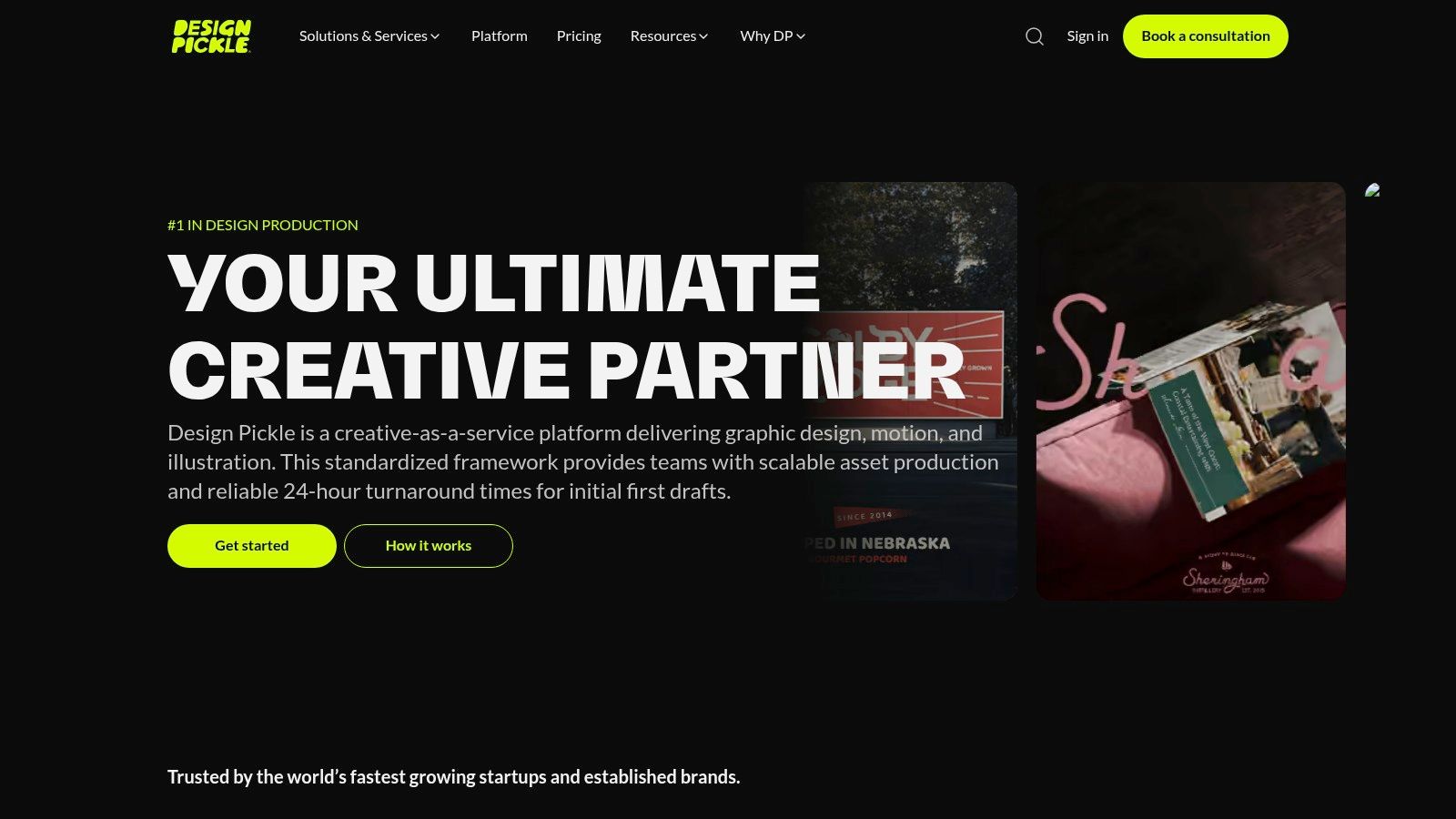
Design Pickle suits marketing and operations teams that need a repeatable creative production line. The service supports graphic design, presentations, motion, and video on applicable plans, with a platform for briefs, feedback, revisions, and project management. The process is more structured than sending tasks to an independent freelancer, which helps when several people review the same brand materials.
Where Design Pickle fits
A fintech marketing team can use it for campaign graphics, presentation updates, email assets, and recurring sales collateral. A Web3 team can keep a queue of community visuals, announcement graphics, and event materials moving without hiring a full-time production designer. The platform's defined service scope also forces teams to describe what they need before work begins.
The main limitation is depth. Design Pickle can be a sensible choice for brand production, but it isn't automatically a product strategy partner. Confirm who owns user flows, design-system maintenance, responsive states, and developer handoff before assigning a core application redesign. Current pricing is routed through consultation rather than a fixed public list, so budget comparison requires a sales conversation.
Use this design agency versus design subscription comparison when deciding whether your team needs production capacity or deeper product involvement. Design Pickle is strongest when requests are repeatable and the brief is already clear. It stops being the obvious fit when the brief itself needs product judgment.
3. Penji
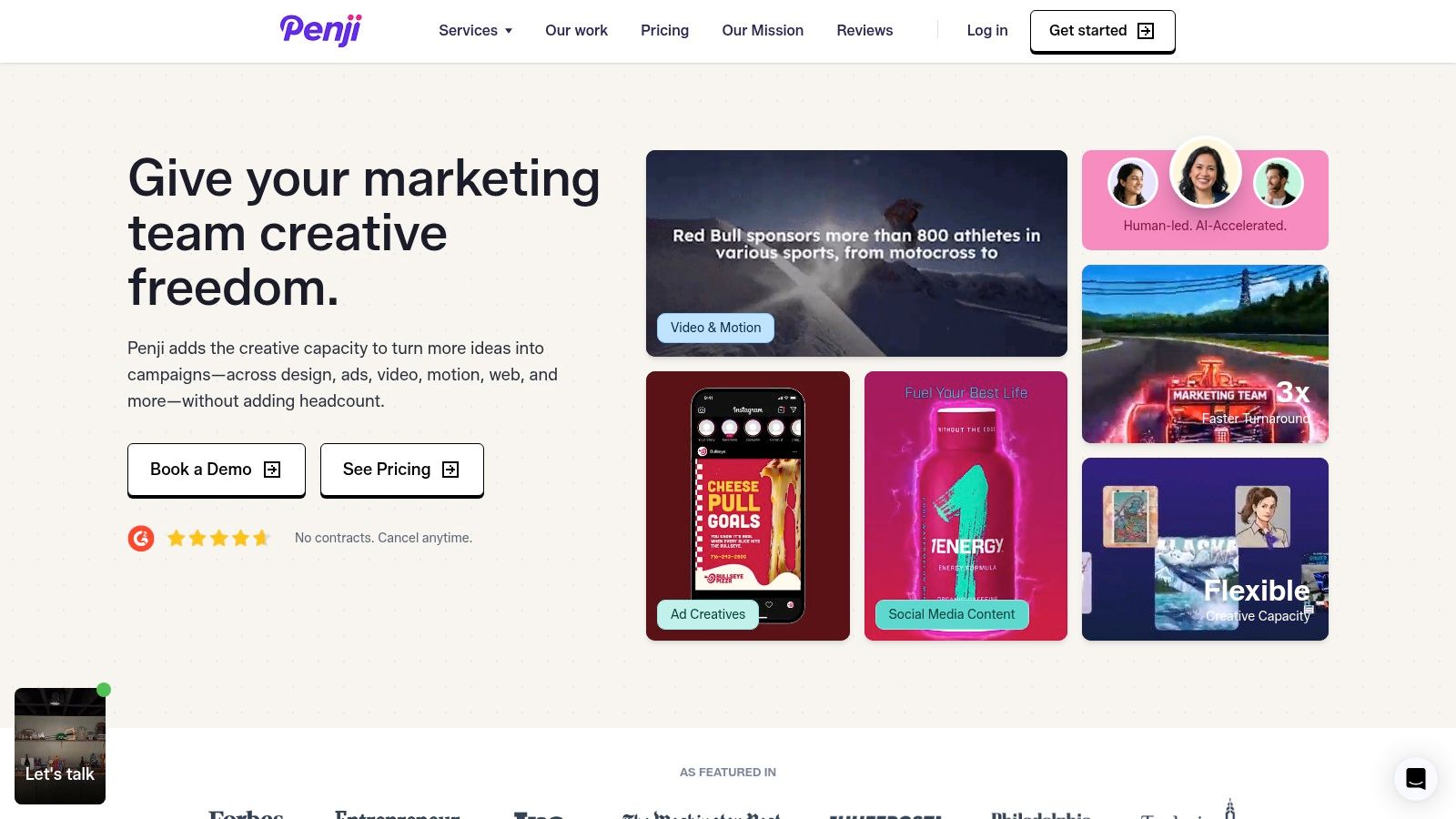
Penji is a practical option for a team that needs daily marketing and product support through a managed queue. It covers a broad set of categories, including web work, advertising, motion graphics, presentations, and brand materials. The workflow combines human designers with AI-supported production, while in-app annotation keeps feedback attached to the work rather than scattered across email threads.
Where Penji fits
Penji works well when the request is clear and the team needs a first draft quickly. Common tasks such as ad variations, social graphics, pitch-deck slides, and simple landing-page sections can move through the queue without a separate hiring process. Higher plans support more concurrent work, so the important question is not whether requests are unlimited. It's how many active projects your plan can move.
UI and product depth can vary by assigned designer. A startup redesigning onboarding, billing, permissions, or a trading workflow should ask for relevant examples and test the collaboration on a real screen. A fast visual draft isn't the same as a resolved user flow, accessible interaction, responsive layout, and developer-ready specification.
A subscription queue is useful for production. It becomes risky when the team mistakes production capacity for product ownership.
Penji can replace part of a brand designer's workload and support interface production, but it won't necessarily replace a frontend developer. Confirm whether implementation is included or whether your engineers still need to translate the files into a working product. For funded AI SaaS and fintech teams, that handoff can determine the true cost of the engagement.
4. Kimp
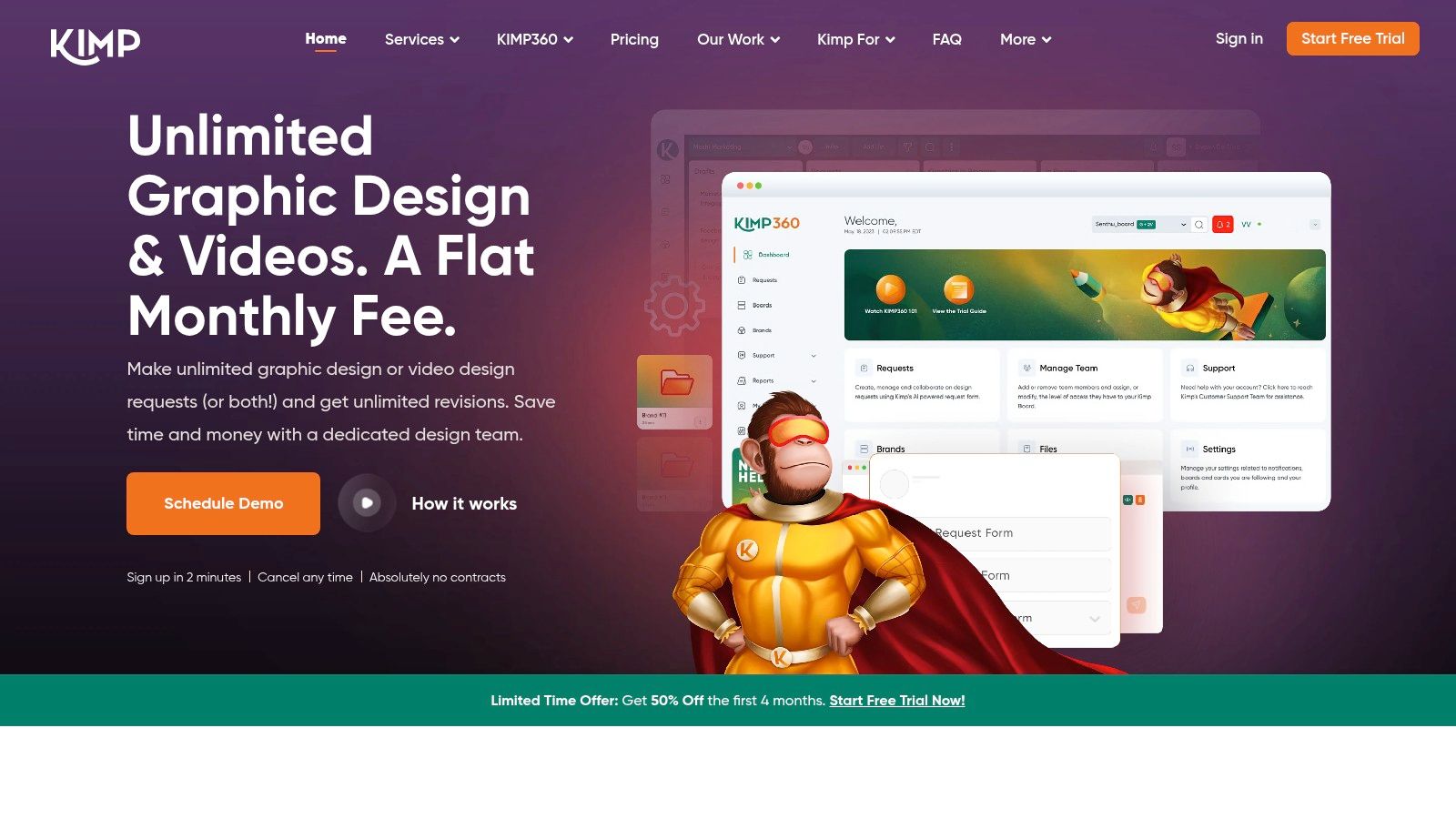
Kimp is a straightforward choice for teams that mainly need graphics and video. It separates Graphics and Video subscriptions and also offers a combined option. That makes the buying decision easier for a content team producing social assets, campaign creative, explainer edits, and recurring brand material.
Where Kimp fits
The operating model is easy to understand. Simple items may receive a 24-hour turnaround, while complex work can take 2 to 4 days, according to the service description. Plans limit concurrency, with examples including 2 tasks in progress, so a campaign with several dependent assets can still move in sequence rather than all at once. A pause feature lets teams stop the subscription while retaining boards and files.
That structure is valuable for an AI SaaS growth team running a steady stream of ads and short videos. It's less useful when the hard problem is not asset volume but product comprehension. Kimp isn't the first provider I'd choose for a complex permissions model, a financial-risk disclosure flow, or a full design system.
Good fit: Social graphics, paid campaigns, video editing, and repeatable brand production.
Watch the limit: The number of projects that can run together matters more than the word “unlimited.”
Poor fit: Deep UX research, product strategy, and frontend implementation.
Kimp can reduce the need for a separate production designer and video specialist. It doesn't automatically replace a product designer or developer. If your roadmap depends on a new dashboard and a new launch campaign at the same time, you may still need another partner for the application work.
5. ManyPixels
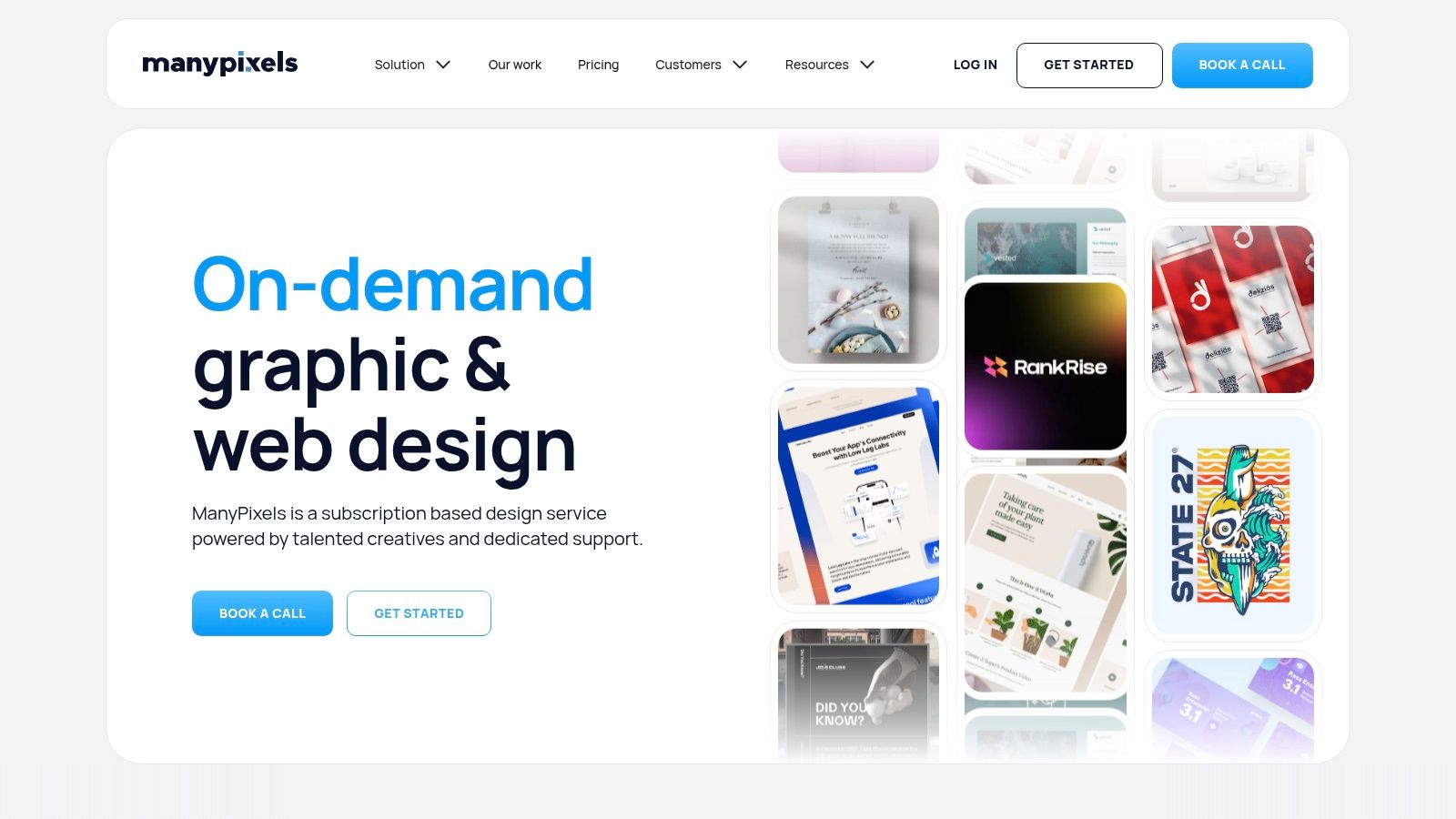
ManyPixels offers a managed design subscription with project management and quality-control layers. It covers graphic design, web design, illustration, and, on relevant tiers, motion and video. The service emphasizes realistic throughput rather than treating “unlimited” as a promise that every request will be completed immediately.
Where ManyPixels fits
ManyPixels is a useful middle ground for a growing SaaS team that has more than one type of recurring design request but doesn't need an enterprise creative department. Most core tasks receive next-business-day first drafts, while higher tiers may offer same-day output, as described by the provider's plan structure. Teams can also choose an assigned designer or use a broader queue model, with communication through platform and chat workflows.
The managed layer is the key difference from a solo subscription. A project manager can help route briefs and a quality-control process can catch obvious brand inconsistencies. That reduces the risk that every request depends on one person's availability.
Still, product design depth varies. A landing page draft and a full SaaS navigation system aren't the same engagement. Confirm whether the designer will document states, empty screens, error handling, mobile behavior, and developer handoff. ManyPixels may support the interface work, but frontend implementation still needs careful scoping.
For a founder, this is a strong choice when the hiring gap is steady design production with some web coverage. It's less compelling when you want one embedded product thinker accountable for research, decisions, and shipped outcomes from the first workshop through release.
6. No Limit Creatives
No Limit Creatives is aimed at ad-heavy growth teams. Its service focuses on graphics and video for paid media, with additional categories such as Amazon assets, email, packaging, and motion. The model is closer to Design-as-a-Service for performance marketing than to an embedded product-design team.
Where NLC fits
NLC makes sense for a fintech or AI SaaS company that already has a product designer but needs more campaign variants. The team can keep paid social, display creative, email graphics, and short-form video moving without pulling the product designer away from onboarding or core workflows. It also fits ecommerce and marketplace teams that need specialized retail assets.
The intake model is self-serve and tiered. That can be efficient for experienced growth teams with clear briefs, approved messaging, existing brand rules, and a defined review process. It is less helpful when the creative partner must define the positioning, simplify a complicated product, or create the visual system from scratch.
Best use: Paid-media production and repeated ad-creative cycles.
Coverage: Graphics, digital and print assets, video, motion, email, packaging, and Amazon-related work.
Boundary: Strategic brand development, product UX, and frontend delivery require separate confirmation or another partner.
A Web3 company should be especially careful not to confuse more ad variations with more trust. Users need to understand wallet permissions, transaction states, and risk disclosures. NLC can produce the campaign around those features, but the product interface still needs a specialist who can make the underlying flow clear.
7. DotYeti
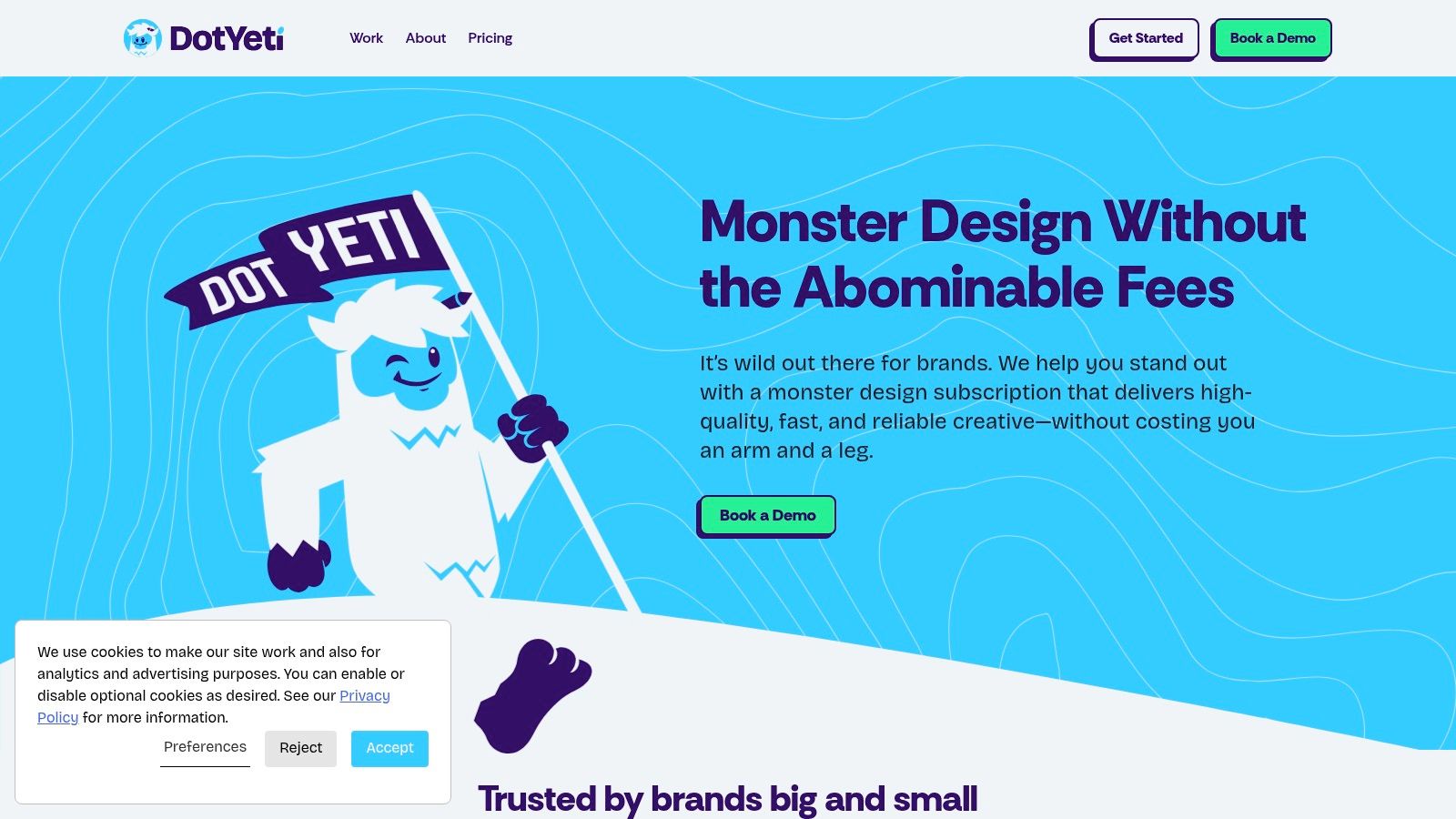
DotYeti sells a creative pod rather than a single designer. The pod covers design, motion, 3D, web, and copy, with art direction and defined concurrency rules. That makes it a reasonable option for a startup that needs different creative skills but doesn't want the cost or process of a large enterprise provider.
Where DotYeti fits
The base plan allows 2 active projects, while higher tiers increase throughput. Most requests receive a first round in 2 to 5 business days, and the service describes unlimited revisions, full rights, and a 14-day money-back guarantee. Those details make the model easier to compare with a queue that hides its actual capacity.
DotYeti is strongest when a brief crosses disciplines. A product launch might need a landing page, a short animation, supporting copy, and a few visual assets. A creative pod can keep those pieces aligned better than four unrelated freelancers, especially when an art director reviews the work.
The trade-off is that complex product UX still needs deliberate scoping. A pod can create a polished interface, but a fintech dashboard may require domain decisions about permissions, audit trails, disclosures, and error states. Global teams should also write clear briefs because time-zone differences can slow clarification cycles.
Ask before signing: Who owns the product decision when the brief is incomplete, and who remains accountable after the design enters development?
DotYeti can cover brand, marketing, and parts of web design. It may not replace a frontend developer or a senior product designer for a technically complex application.
8. Delesign
Delesign takes a different approach by assigning the same designer for daily capacity. Certain plans provide 2 hours per day of dedicated design time, with an unlimited request queue and revisions. First drafts are commonly delivered in 1 business day, but the fixed daily allocation means larger projects span several working days.
Where Delesign fits
Continuity is the main benefit. A designer who sees the same product and brand repeatedly can learn the rules, preferred layouts, and review habits. That helps a SaaS marketing team maintain a steady sprint rhythm across landing pages, sales material, campaign graphics, and light web work.
Higher plans can include a senior designer and art director, while the scope also includes website and landing-page design, video editing, animation, motion graphics, and standard marketing design. The model is more predictable than a broad queue when you need the same person to build context over time.
The boundary is capacity. A major product redesign won't become a one-day project because the queue is unlimited. The daily hours determine how much attention the work receives, and strategic services are lighter than those of a full-service product studio.
Choose it for: Consistent daily production and a named creative relationship.
Check first: Whether the assigned designer has shipped products like yours, not only marketing pages.
Don't assume: Design files include frontend implementation or engineering ownership.
Delesign can reduce the need for a dedicated brand or marketing designer. It won't remove the need for product leadership when AI behavior, financial risk, or wallet security must be explained clearly in the interface.
9. Design Buffs
Design Buffs works best when a funded SaaS, fintech, or Web3 team needs planned design capacity, not an open-ended queue. The model is clearer for teams shipping on a launch calendar. You can map hours to work across product marketing, brand updates, and light frontend support, then decide what gets done first instead of tossing requests into a backlog.
Where Design Buffs fits
The practical fit is a marketing-heavy team with real production volume and someone in-house who can manage trade-offs. A 40-hour bundle can cover roughly two landing-page builds plus monthly deck updates. An 80-hour bundle can absorb a launch campaign without pausing ongoing collateral. That makes it easier to support founders, sales, and growth at the same time.
The optional Webflow add-on helps when the job is publishing campaign pages fast. It does not replace frontend ownership for a product team. Shipping a SaaS app still means handling states, permissions, data behavior, QA, and engineering decisions that sit outside a marketing site build.
Budget for the 3-month minimum commitment before month-to-month flexibility. That commitment can work for a planned launch cycle, but it creates risk if your roadmap is changing every week.
This matters most for teams splitting time between launch assets and brand cleanup. If you're reworking messaging and testing color schemes that convert, an hour-based model helps protect time for both exploration and production.
Design Buffs is a solid match for a company that needs brand, growth, and marketing design on a schedule. It becomes less useful when requests arrive daily from product, growth, and engineering, and nobody owns prioritization.
10. Eleken
Eleken is the most focused option here for a SaaS product-design gap. It provides a dedicated UI/UX designer or team, with part-time, full-time, and multi-designer configurations. The work centers on dashboards, user flows, design systems, and developer-ready Figma files rather than general marketing production.
Where Eleken fits
The embedded model suits a product team that wants a designer involved in agile sprint work. A dedicated person can learn the application, review feedback with product and engineering, and maintain consistency across new features. That is different from submitting isolated requests to a general creative queue.
Eleken offers a 3-day free trial and month-to-month flexibility, according to the plan description. It also provides senior oversight and supports sprint-by-sprint collaboration. Those terms reduce the commitment risk for a team that needs to test working habits before making the designer part of its delivery rhythm.
The trade-off is scope. Eleken is positioned around senior product design, so it costs more than an unlimited graphics provider. Motion, broad brand work, and marketing collateral may require additional specialists. You also need to confirm who builds the final frontend. Developer-ready Figma output can improve the handoff, but it isn't the same as production code.
See this guide to Eleken alternatives for startup design if your hiring gap includes brand and frontend work as well as UI/UX. Eleken is a strong choice when the missing role is specifically product design. It's less complete when one partner must carry the product from interface decisions through website, identity, system, and implementation.
DesignJoy Alternatives: Top 10 Comparison
Provider | Core services | Target audience | Delivery & throughput | Unique selling point | Pricing / value |
|---|---|---|---|---|---|
Superside | Design, motion, 3D, illustration, web/UI, creative strategy | High-volume marketing & product teams; mid-market → enterprise | Dedicated PM/creative lead; AI-augmented workflow; scalable multi-stream delivery | Managed, always-on team with strong process & QA | Sales-led; Flex Budget subscription; higher price point |
Design Pickle | Graphic design, motion, presentations; platform-based intake | Marketing & ops teams needing predictable production | Process-driven intake; plan-dependent turnaround & concurrency | Mature unlimited model with revision platform | Pricing via consult; predictable production value |
Penji | Web, ads, motion, presentations, brand across 120+ categories | Teams needing fast daily marketing & product support | Unlimited queue; ~1 business day first drafts for many tasks; plan concurrency varies | Human designers + AI acceleration; fast first drafts | Tiered pricing; variable by plan |
Kimp | Graphics & Video (separate or combined plans) | Steady ad, social, campaign production teams | 24-hr for simple tasks; 2–4 days complex; concurrency limited by plan | Flat-fee simplicity; pause feature retains files/boards | Transparent flat-fee plans; predictable capacity |
ManyPixels | Ongoing design with PM & QC; optional dedicated designer | Growing teams needing consistent output and clear expectations | Next-business-day first drafts on core plans; PM/QC; throughput guidance | Balance of speed, breadth, and QA; clear “unlimited” expectations | Flat-rate tiers; some sales/contact pricing |
No Limit Creatives (NLC) | Ad-centric graphics & video; Amazon, email, packaging | DTC, performance & ecommerce paid-media teams | Fast ad-creative cycles; self-serve tiers; execution-focused | Specialty ad/ecommerce asset production for testing | Plan-based pricing; confirm specifics pre-sign |
DotYeti | Creative pod: design, motion, 3D, web, copy | Startups needing multi-skill creative without enterprise overhead | 2–5 business day first rounds; defined concurrency (base 2 active projects) | Creative pod model; clear tiers; 14-day money-back | Startup-friendly tiers; transparent pricing |
Delesign | Same-designer continuity; web/landing, motion, marketing design | Teams wanting predictable daily designer capacity | Typical 1 business day drafts; plans with dedicated daily hours (e.g., 2 hrs/day) | Same-designer continuity for steady sprints | Flat-fee subscriptions; mid-market-friendly |
Design Buffs | Hour-capacity subscriptions (40h/80h); optional Webflow dev | B2B/SaaS marketing & product teams preferring hours model | Monthly hour bundles; dedicated team & platform; predictable scheduling | Transparent hours-based pricing mapped to campaigns | Hourly-bundle pricing; min 3-month commitment |
Eleken | Dedicated UI/UX designers, design systems, developer-ready Figma | SaaS/product-led teams needing embedded product designers | Flat monthly pricing; part/full-time or multi-designer configs; 3-day trial | Senior product design focus; dev-ready Figma deliverables | Higher than unlimited graphics; positioned as senior product design |
Match Your Hiring Gap to the Right Partner Before You Switch
The right DesignJoy alternative depends on the role slowing you down. Don't start with the provider's logo, plan name, or promise of unlimited requests. Start with the work that isn't getting shipped.
First, name the single gap
A missing product designer creates a different problem from a weak brand or a messy frontend handoff.
If the product designer is missing, users may face unclear onboarding, confusing navigation, and incomplete states. An AI SaaS product might explain its model well in a sales call but leave users unsure what an automated recommendation means inside the app. A fintech product might look polished while making consent, verification, or account permissions hard to understand.
If the brand doesn't match the product, the issue appears across the website, sales deck, ads, and application interface. Buyers see different visual rules in every channel, and the company has to explain the same product repeatedly because the presentation doesn't create confidence.
If frontend is the bottleneck, the designs may already exist. The problem is the gap between Figma and the browser. Responsive behavior, component states, accessibility, and edge cases get resolved late, usually by engineers who weren't involved in the original decisions.
Second, choose the delivery model
Match the gap to the way work enters the provider.
Unlimited queue: Best for steady marketing volume, recurring graphics, ads, presentations, and small web tasks. The queue can be efficient, but concurrent work remains limited by the plan and production capacity.
Hour bundles: Best when you can plan campaigns and want a visible relationship between time and output. The model requires someone internally to prioritize the hours.
Embedded dedicated designer: Best for ongoing product work where the designer needs context across several sprints. It usually gives deeper product continuity, but it may leave brand, motion, and frontend work outside the subscription.
Product design is a growing outsourced category. One market estimate placed global UX-design-services revenue at approximately $6.25 billion in 2024 and projected about $20.32 billion by 2033, with an estimated 14% compound annual growth rate from 2025 through 2033. The same research also reported a separate 2024 estimate of approximately $4.68 billion, which shows why exact market totals vary by definition. The useful conclusion is directional: outsourced digital-product design is a substantial, expanding category. See the UX design services market estimate for the methodology context.
Third, test one real screen
Don't judge a provider only through a portfolio or an introductory call. Give the team one real screen from your product. Use an onboarding step, billing page, permissions view, or core workflow where the current experience creates friction.
A practical usability baseline is an average task-success performance of approximately 78%, reported as a directional benchmark by DesignRush's product-design statistics. Test at least five representative users per key workflow, and record task completion, time on task, errors, abandonment, and post-task satisfaction. Compare the current experience with the proposed prototype or shipped redesign using the same task and audience.
The test should also expose delivery risk. Ask who writes the interaction logic, who handles responsive states, who prepares the design system, who implements the screen, and who checks the result in the browser. A polished Figma file can still create expensive rework if nobody owns the final experience.
925 Studios is one option for teams that want one partner covering a product designer, a brand designer, and a frontend developer across UI/UX, website build, brand identity, and design systems. Judge that model by the screens it ships, the consistency it creates, and the quality of the working product, not by turnaround time alone.
Before signing any provider, confirm that your company owns the Figma files, source assets, design-system components, copy, and code produced for the engagement. That keeps switching costs low if the fit changes. It also makes the comparison fair. You aren't only buying design attention. You're buying an accountable path from brief to a product customers can understand and use.
925 Studios gives AI SaaS, Web3, and fintech teams one creative partner across product design, brand identity, design systems, marketing websites, and frontend delivery. If you need to replace separate hiring gaps with a single team focused on shipped screens and a consistent brand, visit 925 studios to discuss the work.

Let’s keep in touch.
Discover more about high-performance web design. Follow us on Twitter and Instagram.