Website Redesign Services: A Founder's Guide to Hiring Right

Outrank AI
Your homepage looks polished, but demo requests are flat. Mobile users abandon the signup flow. Sales keeps rewriting the same explanation because the product pages don't make the offer clear. Meanwhile, your team is debating button colors instead of fixing the path from first visit to qualified conversation.
That's the situation where website redesign services either create an advantage or produce an expensive new coat of paint. For AI SaaS, Web3, and fintech companies, a redesign has to clarify a complex product, strengthen trust, improve the buying journey, and ship as reliable frontend code. It should be managed like a performance investment, with baseline metrics before work starts and post-launch KPIs that determine what happens next.
925 Studios approaches that work as one partner replacing three separate hires, a product designer, brand designer, and frontend developer. This guide explains what to demand, what to exclude, how to compare vendors, and how to judge the result after launch.
Table of Contents
Why Founders Get Redesigns Wrong
A fintech founder I know once approved a redesign after seeing a beautiful homepage concept. The vendor had strong visual work, so the decision felt safe. The brief said “modernize the brand,” “improve conversion,” and “make the product easier to understand.”
Six weeks later, the new site looked credible in a presentation and failed in the places that mattered. The mobile pricing interaction was awkward, the signup handoff dropped context, and the product pages still used language that made sense internally but not to buyers. Nobody had defined the pages, flows, technical requirements, or success measures before design began.
That failure pattern is common because founders often treat a redesign as a visual project. The problem may be information architecture, unclear positioning, slow pages, broken analytics, or a product-led funnel that needs product design rather than brochure design. A new color system won't repair a confusing path to activation.
Practical rule: If the brief can be fulfilled by changing screenshots and colors, it isn't a redesign brief. It's a mood board.
The hiring decision should reflect the work. You're not buying isolated screens. You're hiring a team that can:
Shape the product story: Explain what the product does, who it serves, and why it deserves attention.
Design the experience: Structure navigation, pages, forms, pricing paths, and activation flows around user intent.
Ship the frontend: Build responsive, accessible, maintainable templates that behave correctly in production.
For Web3 teams, trust and security communication need the same discipline as interface design. A useful companion resource is this guide to secure Web3 websites for founders, especially when your site needs to explain wallets, custody, permissions, or risk without overwhelming a first-time visitor.
Before hiring, audit whether the partner has all three capabilities on the bench. Review shipped work, not only mockups. Ask who writes the interface, who owns the component system, who builds the templates, and who remains accountable after launch. This analysis of why most SaaS redesigns fail is useful preparation because it focuses attention on strategy and execution instead of presentation polish.
Defining the Scope Before You Talk to Anyone
Write the scope before you contact a vendor. It protects you from vague proposals, surprise invoices, and the slow expansion of “one more page” into an entirely different project.
Start with a surface inventory. List every page and flow that may be included, then separate committed work from later work.
Name the surfaces and their jobs
Your initial list might include:
Core marketing pages: Homepage, solutions pages, product pages, pricing, company, and contact.
Product entry points: Signup, login handoff, onboarding explanation, docs entry points, and integration pages.
Revenue flows: Demo request, trial start, sales qualification, pricing comparison, and checkout if applicable.
Content surfaces: Blog, resource library, changelog, and customer stories.
Each item needs a job to be done. “New homepage” isn't enough. A stronger scope statement says, “Homepage that improves the path from product understanding to demo request, with the conversion event measured after launch.”
Use the baseline if you have it. For example, a target can compare an existing demo-request conversion rate with a defined post-launch result, such as moving from 1.8% to 2.5% within 60 days. That example belongs in the scope only if your analytics team has verified the starting point and agrees that the event is tracked consistently.
Then write what's out. Blog migration, a new CMS, custom illustration systems, app replatforming, and a complete messaging overhaul can each become separate projects. Exclusions aren't defensive paperwork. They let vendors price the work you want.
Capture constraints and ownership
Record the CMS, analytics stack, design system status, brand guidelines, internationalization needs, and compliance requirements such as SOC 2 or PCI. Note whether the vendor is responsible for content migration, copywriting, SEO redirects, frontend implementation, QA, and launch support.
Require sign-off from product, marketing, and engineering. One person should consolidate feedback, but each function needs to approve the parts it owns. This guide to briefing a UX design agency offers useful framing for turning internal needs into a brief a partner can act on.
A good scope makes proposals comparable. It also exposes vendors that talk confidently about brand but can't explain how they'll handle a CMS, analytics events, mobile states, accessibility testing, or production QA.
Three Vendor Models and How to Choose
Founders usually choose among three shapes. The right choice depends on scope, internal capacity, and whether you want one accountable partner or several specialists coordinating through you.
Model | Typical Cost Band | Timeline | Best For | Accountability Risk |
|---|---|---|---|---|
Boutique design studio | Project-based, varies by scope | Focused project cycle | Product and brand craft with a defined build need | Frontend ownership may be unclear |
Full-service digital agency | Project or retainer, varies by scope | Broader project cycle | Content, SEO, design, development, and campaign support | Responsibility can spread across an account team |
Fractional or embedded partner | Monthly engagement, varies by scope | Starts around roadmap priorities | Teams needing senior design capacity inside existing workflows | Scope can drift without a clear roadmap |
A boutique studio can be a strong fit when you need concentrated product and brand work, but ask who handles the build. A full-service agency may cover more disciplines, but demand a named lead who can make decisions and stay involved. An embedded partner works well when your team needs someone in Slack and sprint planning, though the work needs a tightly managed backlog.
Don't compare vendors by portfolio aesthetics alone. Compare their operating model. Ask who owns discovery, who approves architecture, who writes copy, who builds components, who tests forms, and who watches the site after launch.
The design agency versus design subscription comparison can help clarify whether your need is a fixed outcome or ongoing senior capacity.
For AI SaaS and fintech, I prefer a partner that combines product thinking, brand systems, and frontend execution. That structure reduces translation loss between strategy, design, and code. It also gives the founder one place to resolve trade-offs when a visual idea conflicts with performance, accessibility, or conversion.
Pricing, Contracts, and What Drives the Number
Website redesign pricing should follow scope, not the number of people shown on a sales slide. Widely cited 2025 to 2026 pricing ranges run from about $15K to $200K or more, but that range is too broad to help unless you connect it to deliverables and business outcomes. This cost and ROI analysis makes the important distinction, spend matters less than whether the engagement includes measurement and optimization.
Scope | Price Range | What You Get |
|---|---|---|
Marketing-page refresh on an existing CMS | $8K to $15K | Selected page updates, responsive design, existing-template work, and limited frontend changes |
Mid-market SaaS redesign | $25K to $60K | Rebuilt templates, CMS integration, page-level UX, responsive implementation, and structured QA |
Full product-led redesign | $80K to $200K+ | Design system, product and marketing surfaces, animation, complex integrations, and deeper frontend work |
The number moves with page count, template depth, content migration, copywriting, CMS customization, illustration, motion, integrations, and stakeholder review rounds. A site with a small set of reusable templates is a different project from a product-led ecosystem with pricing logic, documentation paths, localization, and custom interactions.
Don't accept a fixed bid that bundles unlimited revisions. Define review rounds and specify what counts as a defect, a new request, or a change in direction. Your statement of work should break delivery into phases with milestone payments and named acceptance criteria.
Contract terms worth demanding
Phased SOW: Tie payment to discovery, approved strategy, design sign-off, staging, and launch readiness.
IP assignment: Confirm that final design files, code, components, and approved assets transfer to you upon payment.
Kill fee: Define what happens if either party ends the engagement before completion.
Defect window: Include a 30 to 60 day period for correcting launch defects that fall within the agreed scope.
Analytics boundaries: State whether event tracking, dashboards, and reporting are included or separate.
Analytics and A/B testing infrastructure often get treated as extras in fixed bids. That's acceptable only when the exclusion is explicit and your team has ownership. Retainers make sense for ongoing experimentation, content improvement, and post-launch optimization, not for hiding an incomplete launch scope.
The Redesign Process From Kickoff to Launch
A serious redesign moves through gates. Each gate produces an artifact your team can review, approve, and use to make the next decision.

Discovery
The team audits the current site, reviews analytics, studies competitors, interviews stakeholders, and inspects the existing CMS and frontend constraints. The deliverable should be a written audit report that separates evidence from opinion.
It should identify traffic and funnel problems, content gaps, technical risks, broken paths, and pages worth preserving. A practical SEO audit guide can help your team prepare the questions before the vendor begins.
Strategy
The partner turns findings into a sitemap, messaging hierarchy, user flows, and conversion plan. The gate deliverable is an approved sitemap and brief.
For an AI SaaS company, this might mean separating “automation,” “security,” and “integrations” into paths for different buying committees. For fintech, it may mean explaining compliance and controls before asking a visitor to request a demo. Strategy gives the interface a job beyond looking current.
Design
Start with wireframes before high-fidelity visual work. Wireframes expose hierarchy, page logic, and conversion friction while changes are still inexpensive. Then move into Figma prototypes, responsive states, content rules, and design system documentation.
The gate deliverable is signed-off Figma files, including mobile states, interaction behavior, component variants, and notes a developer can implement without guessing.
Build
Development covers CMS setup, template development, content migration, integrations, responsive behavior, accessibility, performance, and QA. The staging environment should match production behavior closely enough that your team can test real forms, redirects, analytics, and content.
The gate deliverable is a staging environment matching production. A polished prototype isn't a substitute for a working site.
Launch
Launch includes final content review, redirect mapping, tracking validation, DNS cutover, monitoring, and rollback planning. The final gate is a launch readiness checklist signed by the people responsible for product, marketing, and engineering.
Your job as founder isn't to comment on every pixel. Show up for milestone reviews with decisions made. Resolve positioning questions, approve trade-offs, and prevent five stakeholders from giving contradictory feedback.
Accessibility and Performance as Non-Negotiables
Accessibility and performance aren't optional polish. They determine whether people can use the site, understand the offer, complete a form, and trust the company behind the product.
The floor should be WCAG 2.2 AA across redesigned pages, with keyboard navigation, visible focus states, sufficient contrast, descriptive form labels, clear error feedback, and interactive components tested with screen readers. W3C guidance for WCAG 2.1 specifically covers sufficient color contrast, avoiding color as the only signal, and giving forms descriptive labels and visible feedback.
W3C also recommends consistent navigation naming, styling, and placement, plus more than one route through a site, such as search or a sitemap. The W3C guidance on designing for accessibility is a useful standard for reviewing navigation and interaction patterns with non-designers.
Demand testable performance targets
For a high-intent marketing site, I'd put these requirements in the acceptance criteria:
Lighthouse mobile scores of 90 or higher across categories.
Largest Contentful Paint under 2.5 seconds on 4G.
Cumulative Layout Shift under 0.1.
Interaction to Next Paint under 200 milliseconds.
Keyboard and screen-reader testing for every interactive flow.
axe-core checks in CI, plus manual NVDA and VoiceOver passes.
Real-device throttling rather than desktop-only tests.
These targets are operational requirements, not decorative benchmarks. Independent accessibility data reports that 95.9% of the top one million home pages had WCAG 2 failures in February 2026, compared with 94.8% in 2025. The result is clear. Awareness hasn't made inaccessible redesigns disappear. The accessibility statistics source also points to audits, modern image formats such as AVIF and WebP, keyboard testing, and screen-reader testing as practical parts of a rebuild.
Vendors will blame scope creep, browser quirks, or third-party scripts. Those are implementation problems to manage, not reasons to remove acceptance criteria. Reduce script bloat, optimize media, define component behavior, and test the actual devices your buyers use.
Measuring Redesign ROI After Launch
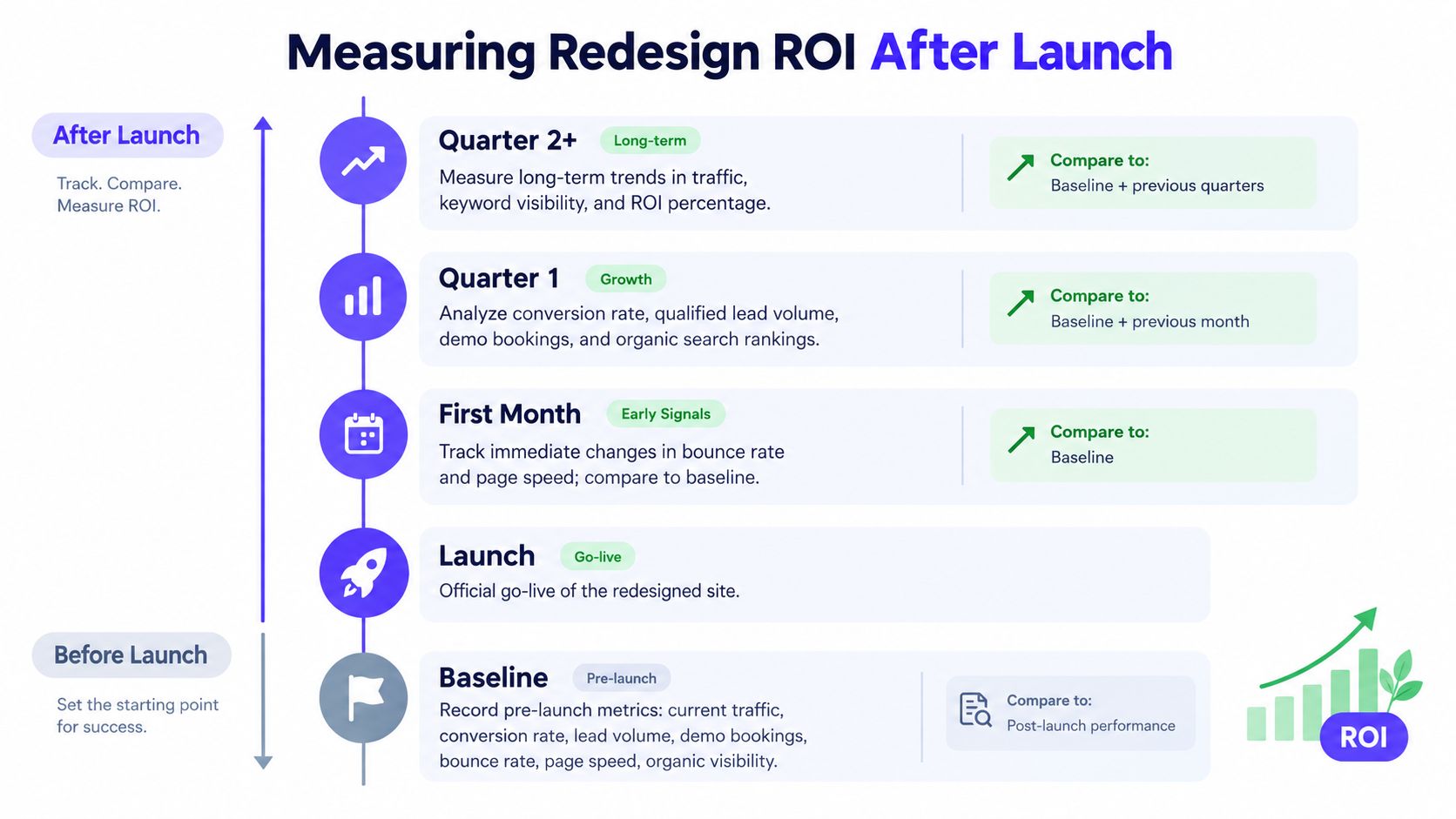
Launch day is the beginning of measurement. Before design starts, record the current baseline across traffic, conversion rate, qualified lead volume, demo bookings, bounce rate, page speed, organic visibility, and revenue attribution for at least one complete sales cycle.
Use Google Analytics 4 for funnel events, Chrome UX Report for real-world experience data, and Lighthouse for controlled audits. The independent website redesign ROI measurement framework recommends tracking page-level impressions, click-through rates, conversion starts and completions, Core Web Vitals, and post-launch trendlines rather than relying on visual improvement.
A redesign can look successful while weakening one important segment. Break results down by device, acquisition source, campaign, geography where relevant, and new versus returning users. Review where users leave the funnel, not just whether total traffic increased.
Use the 30, 60, and 90-day windows
At 30 days, check stability. Look for errors, broken links, failed forms, accessibility regressions, mobile performance issues, and Core Web Vitals changes. Confirm that analytics events fire correctly and that redirects preserve important paths.
At 60 days, review behavior. Compare engagement, scroll depth, pricing-page visits, demo requests, form completion, and qualified lead rate against the baseline. A page that attracts attention but produces no meaningful action needs diagnosis, not celebration.
At 90 days, connect the site to pipeline and revenue. Search rankings and brand effects may need longer to mature, so keep monthly reviews running through the first year. One compiled source reports that about 80% of redesigns fail to reach their full potential, and it identifies poor goal alignment, skipped research, and missing baseline metrics as common pitfalls. The same source reports that rushed redesigns can produce an average 8.1% sales drop, while well-executed redesigns typically produce a 15% to 25% conversion-rate increase within six months. See the compiled redesign performance data for the underlying discussion.
Keep the ROI model honest
Compare the full redesign cost, ongoing content, hosting, and maintenance with incremental gross profit or sales capacity created. Set targets before launch, such as improving demo conversion by 20%, reducing qualified lead cost by 15%, or moving the largest content pages into a “good” Core Web Vitals threshold. These are target examples, not guaranteed outcomes.
Keep a decision log that connects every material change to a hypothesis. If results miss the target, inspect copy, traffic quality, offer clarity, speed, and form friction before commissioning another redesign.
Your founder checklist is short:
Test events: Confirm analytics and conversion events before launch.
Preserve URLs: Keep old URLs where possible and map redirects for changed paths.
Annotate launch: Mark the launch date in analytics and reporting.
Monitor search: Review Search Console for indexing and visibility changes.
Schedule reviews: Put 30-, 60-, and 90-day reviews on the calendar before launch.
925 Studios gives AI SaaS, Web3, and fintech teams one partner across product design, brand identity, frontend development, and design systems, with work tied to a shipped website rather than a presentation alone. If your redesign needs stronger structure, clearer product communication, and measurable post-launch ownership, visit 925 studios to discuss the scope and the outcomes you need to track.


Let’s keep in touch.
Discover more about high-performance web design. Follow us on Twitter and Instagram.