Project Manager Website Development: A Founder's Guide

Yusuf
Founder and lead designer at 925studios

You're probably in one of two situations right now. Your company needs a new site because the current one no longer matches the product, or you already started the build and can feel it slipping. Feedback is scattered across Slack. The homepage keeps changing. The developer is waiting on copy. The designer is solving for a message nobody fully agreed on.
That's the moment when founders realize website problems usually aren't design problems or dev problems first. They're ownership problems. A serious web project needs one person who can turn business goals into shipped work, keep trade-offs visible, and stop ambiguity before it turns into wasted build time.
That's what project manager website development really means in practice. Not someone who runs status meetings. Someone who protects the outcome.
Table of Contents
Why Website Projects Fail Without a Project Manager
A founder approves a direction. A designer makes it sharper. A developer starts building. Then real life hits. Product messaging changes, compliance comments show up late, a new integration gets added, and nobody owns the impact across scope, budget, and launch timing.
That's how website projects go over budget and still feel unfinished.
The failure usually doesn't come from a lack of effort. It comes from the lack of a single operator who can connect decisions across teams. When nobody owns the whole system, every specialist works locally. The copywriter optimizes the message. The designer optimizes the interface. The developer optimizes implementation. The founder assumes those pieces will naturally align. They usually don't.
What breaks when nobody owns the whole build
A website without project management often shows the same symptoms:
Scope keeps moving: New pages, new integrations, and new requests appear mid-build without anyone resetting expectations.
Dependencies stay hidden: Design needs copy, development needs approved flows, legal needs final language. If those handoffs aren't tracked, work stalls.
Feedback arrives too late: Founders review polished screens when they should have been reviewing structure and priorities earlier.
The wrong things get built first: Teams spend time on visual refinements before the core messaging, conversion path, or technical constraints are settled.
Practical rule: If your team is debating details before the scope, priorities, and approvals are clear, the project already has a management problem.
This is why strong project management isn't overhead. It's risk control.
The market signals that clearly. Employment of project management specialists is projected to grow 6 percent from 2024 to 2034, and the median annual wage for these specialists was $100,750 in May 2024, according to the U.S. Bureau of Labor Statistics profile for project management specialists. That demand reflects how much value organizations place on people who coordinate budgets, schedules, and staffing before projects drift.
Why founders feel this pain more than larger companies
Early-stage AI SaaS, Web3, and Fintech teams are especially exposed because the website often has to do several jobs at once. It has to explain a technical product, earn trust fast, support fundraising or sales, and sometimes bridge into the product itself. That means small misalignments become expensive quickly.
A missing project manager doesn't always look dramatic at first. It looks like one unclear homepage brief, one delayed approval, one developer making reasonable assumptions. A few weeks later, the launch date is soft, the brand feels inconsistent, and the site still doesn't explain the product cleanly.
A good project manager prevents that before it becomes visible.
The Project Manager's Real Job on Your Team
Most founders think a project manager keeps the timeline updated. That's part of the job, but it's not the valuable part. The core responsibility is turning a vague business goal into work the team can execute effectively without guessing.
For website projects, that matters more than any standup or task board.

Translation, not admin
Founders often speak in outcomes. “We need the site to feel more enterprise.” “We need to explain the AI clearly.” “We need to convert better with fintech buyers.” Those are valid goals. They are not build instructions.
A strong PM translates those goals into decisions like:
What pages are required
What proof points each page needs
What interactions are essential versus optional
What technical constraints will affect design
What must be approved before development starts
That translation layer is the heart of project manager website development. Without it, teams build from interpretation. Interpretation creates rework.
The gap gets worse in technical categories where founders are selling complex products. AI SaaS teams often want “simple” messaging for products that are not simple. Web3 teams want to communicate trust while still sounding forward-looking. Fintech teams need to balance growth language with credibility and compliance concerns. None of that gets resolved by asking a developer to “just build the new site.”
If you want a useful breakdown of adjacent responsibilities, this comparison of product manager vs project manager roles is helpful because founders often blend those jobs together.
Why developers need to write the plan too
One of the most common failures in web development project management is when ambiguous goals never get translated into concrete technical user stories. A practical best practice, drawn from this Reddit project management discussion on managing web dev projects, is to require developers to document their own task breakdowns in the project management tool before coding begins. That forces clarity and surfaces the gap where “you don't know what the developer knows needs to happen.”
That point gets missed all the time.
Founders assume the PM writes the tickets, the developer builds, and everyone moves on. In real projects, the developer often sees hidden work the founder and PM can't see yet. API edge cases. CMS limitations. Auth logic. Responsive states. Error handling. Analytics events. If that implementation plan stays in the developer's head, the project carries invisible risk.
Don't accept “I know what needs to happen” as a substitute for documented tasks. If it matters enough to build, it matters enough to name.
A good PM insists on that written breakdown before code starts. Not to add bureaucracy. To expose assumptions while they're still cheap to fix.
This is also why strong engineering teams care so much about documentation quality and handoff clarity. A useful companion read is DocuWriter.ai's take on achieving project success in engineering, especially if your site project touches product surfaces, app logic, or technical onboarding.
Here's what that looks like in practice:
Founder says | Weak PM response | Strong PM response |
|---|---|---|
“Make the site feel more premium” | Tells design to explore | Defines trust signals, visual tone, proof requirements, and review criteria |
“We need a better pricing page” | Adds task to backlog | Clarifies audience, objections, plan logic, and analytics requirements |
“Add the integration section” | Assigns to dev | Requires component list, content source, data dependencies, and implementation notes |
The PM's job is not to move cards across a board. It's to remove ambiguity until the team can execute with confidence.
Hiring a Project Manager vs Partnering with a Studio
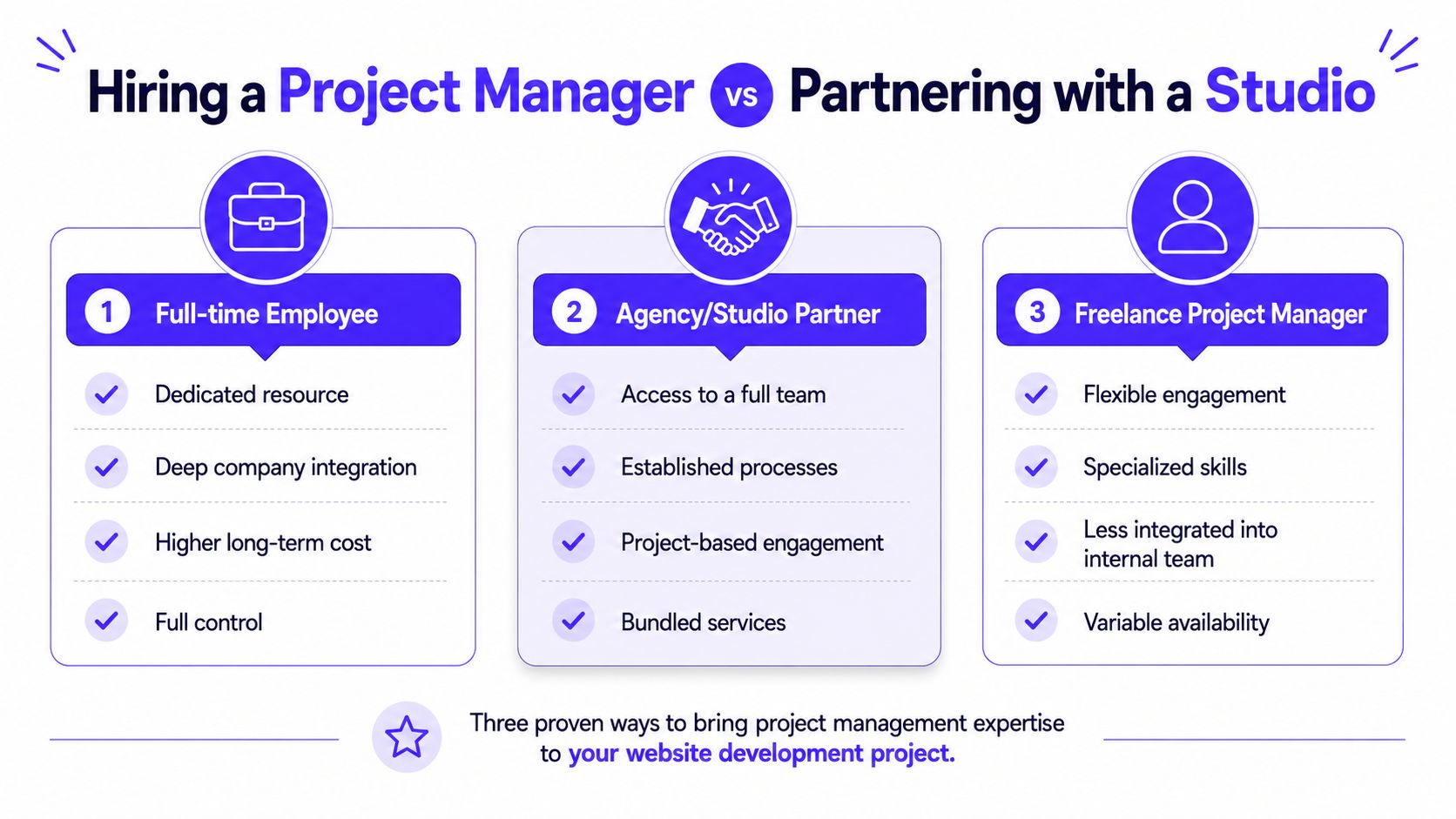
Founders usually solve this problem one of three ways. They hire a full-time PM, bring in a freelance PM, or work with a studio that includes project management inside the engagement. Each model can work. The right choice depends on how often you run web projects, how much internal context the work needs, and whether the challenge is coordination alone or coordination plus design and build.
Three ways founders usually solve it
A full-time employee makes sense when website and product launches are constant, stakeholder complexity is high, and the PM will stay busy after the site ships. This route gives you deep company context and day-to-day access. It also means you still need design and development capacity around that person.
A freelance project manager fits when the problem is temporary and your design and engineering team is already in place. Good freelancers can bring order quickly. The trade-off is integration. They may not own the creative outcome closely enough, and availability can get thin when the project hits pressure.
An agency or studio partner is often the cleanest option when the website project needs management, design, brand thinking, and frontend execution at the same time. Instead of stitching together separate specialists, you work inside one operating model.
That operating model matters more than most founders realize. When evaluating a creative production partner, it's smart to test whether they can scale across markets, channels, campaign peaks, and specialist disciplines, as outlined in this guide to evaluating a creative production partner's operating model. Capacity today is not enough. You need to know how the partner handles complexity when the project expands.
What to check before you commit
Don't evaluate project management with vague questions like “How do you keep projects on track?” Ask for specifics.
Use a checklist like this:
Ask how they define scope: Can they document pages, features, integrations, content needs, and explicit exclusions?
Ask who owns ambiguity: When founder goals are unclear, who turns them into tasks the team can build from?
Ask how they manage approvals: Do they set decision points, signoff rules, and escalation paths?
Ask how they handle technical translation: Can they work with developers without letting implementation details disappear into private conversations?
Ask how they manage creative quality: Can they protect the brand and user experience, not just the deadline?
Ask what happens when the brief changes: The answer should include trade-offs, not optimism.
A PM who can't explain how they protect scope will not protect it when pressure shows up.
For founders briefing an outside partner, this guide on how to brief a UX design agency well is worth reviewing before the first kickoff call. It helps separate useful input from noise, which makes the PM's job easier and the project stronger.
The wrong hire creates polite chaos. The right model gives you one clear chain from decision to delivery.
The Six Phases of a Successful Website Project
Good website projects don't feel mysterious from the inside. They move through a sequence. Each phase has a clear purpose, a set of decisions, and a handoff that should leave the next phase cleaner than it found it.

Discovery and planning
The first phase is discovery. In this phase, the PM collects business goals, technical constraints, user expectations, page needs, integrations, content requirements, and exclusions. Projects that skip a structured discovery phase and rely on assumptions instead of documented scope have significantly higher failure rates, as explained in ITU Online's overview of the web development project manager role.
That's why a serious discovery process should produce tangible outputs, not just a kickoff deck.
Expect documents like:
A scoped page list
Core user journeys
Content and asset requirements
Technical dependencies
Approval checkpoints
Known risks and open questions
The second phase is planning and architecture. In this phase, the team decides what gets built, in what order, and with which constraints. Site maps, user flows, component thinking, CMS decisions, analytics needs, and milestone planning all belong here.
A practical resource if you want another agency-side view is TimeTackle's guide for agency project managers. It's useful for founders because it shows the amount of planning work that should exist before the build starts.
Design and development
The third phase is design. The PM's role here is not to critique color palettes. It's to keep design tied to approved goals. If the site needs to explain a complex product clearly, then page hierarchy, proof placement, and interaction choices need to support that. Design reviews should answer business questions, not drift into personal preference.
A healthy design phase usually moves from low-fidelity structure to higher-fidelity interface work. That sequence matters because structural mistakes are easier to fix early. If the homepage narrative is wrong, polishing the visuals won't save it.
The fourth phase is development. In this phase, the PM becomes the protector of precision. Designs need implementation notes. Edge cases need documenting. Developers need to break work into their own implementation tasks before coding. Founders should review what's being built in staging, not wait for launch week.
A helpful benchmark for founders comparing their own process is this overview of the web page design process. It reinforces the idea that websites aren't produced in one pass. They're clarified in layers.
Before moving into testing, it helps to see the whole lifecycle in motion:
QA, launch, and post-launch
The fifth phase is quality assurance. QA should not show up at the end as a final sweep. The same ITU Online source notes that delaying QA until the end of the schedule is a primary cause of missed deadlines and budget overruns. Good PMs build QA into the plan from the start, including functional testing, responsive review, accessibility review, usability checks, and cross-browser validation.
That changes team behavior. Designers think earlier about states and edge cases. Developers expect review cycles. Founders see issues while they're still manageable.
The sixth phase is launch and post-launch optimization. Launch is not the finish line. It's a controlled handoff into live monitoring. The PM should already have a launch checklist, analytics verification, rollback planning, and a post-launch issue process in place.
A website launch should feel controlled, not heroic. If the team is improvising on launch day, planning failed earlier.
After launch, the best PMs review what shipped against what the business needed. Which pages need refinement. Which user paths are underperforming. Which technical fixes should be prioritized next. That's how the website becomes a working product asset, not just a completed project.
Essential Tools, Timelines, and Deliverables
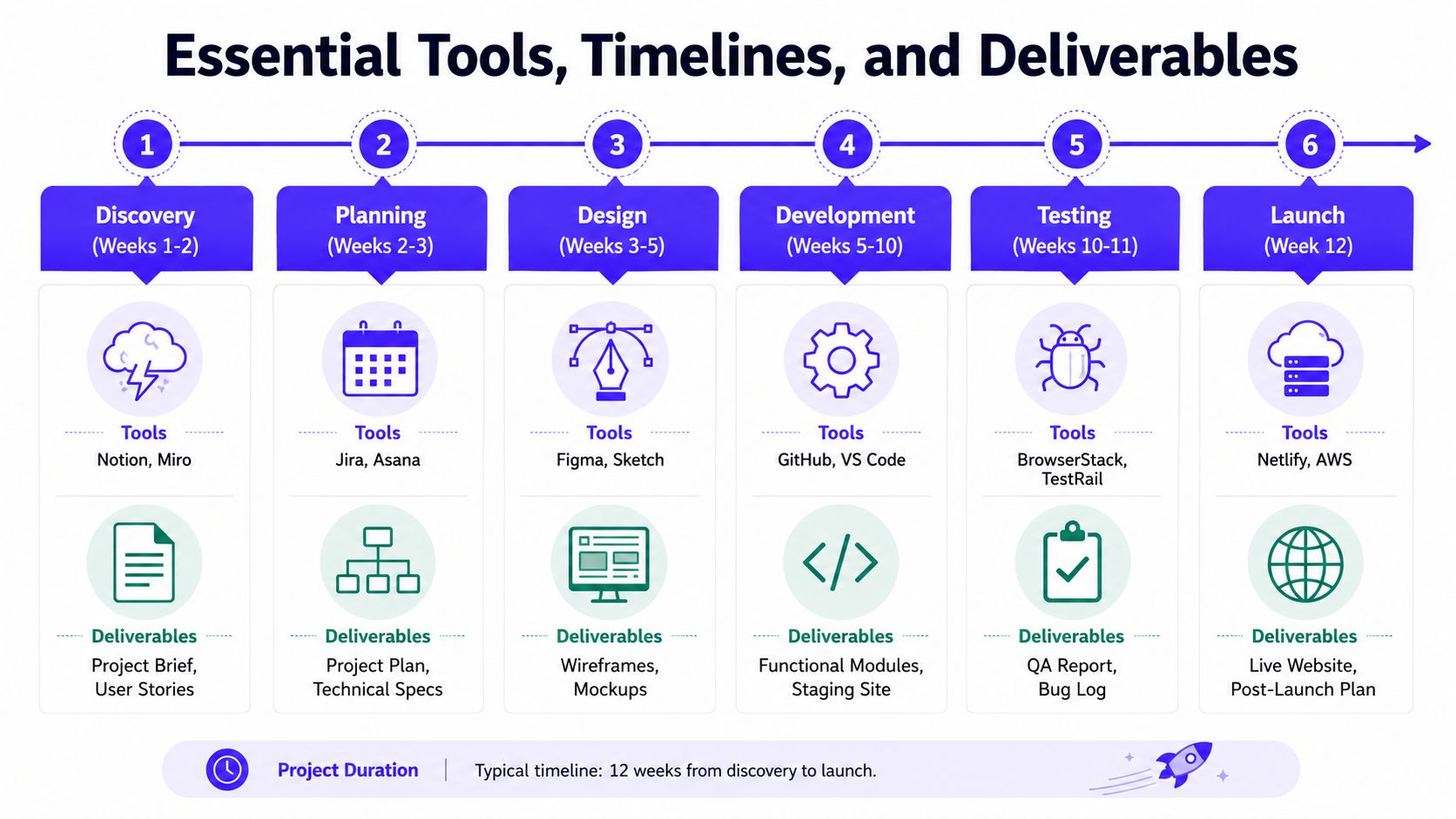
Founders don't need a bloated tool stack. They need a tool stack where each tool has one clear job, and everyone on the project knows where decisions live.
The tool stack that actually helps
For most startup website builds, this setup is enough:
Slack for communication: Fast questions, review prompts, and day-to-day coordination.
Linear, Asana, or Jira for task tracking: Pick one. Don't split active project work across multiple trackers.
Figma for design: Wireframes, UI, prototypes, comments, and shared review.
Notion for documentation: Briefs, scope, user stories, meeting notes, launch checklists.
GitHub for code management: Pull requests, implementation history, and technical visibility.
BrowserStack or a similar QA tool: Cross-browser and device checks before launch.
The mistake isn't choosing the “wrong” platform. The mistake is letting project context scatter. If scope lives in Notion, approvals happen in Slack, bugs sit in email, and design comments stay in a founder's head, your PM spends energy reconstructing reality instead of managing the project.
What a realistic project plan includes
A good timeline isn't just a sequence of dates. It includes room for revision, unknowns, and late-breaking issues. That buffer is not optional.
According to Runn's IT project management statistics roundup, 81% of public-sector and 52% of private-sector IT projects overrun their schedules, and a practical rule of thumb is to allocate a 20% buffer on top of budget and timeline for unexpected fixes and changes. That contingency is not poor planning. It's an honest response to how projects behave.
For founders, that means treating timelines like this:
Project element | What to expect |
|---|---|
Messaging and discovery | More iteration than you think, especially for technical products |
Design reviews | Fast when decision-makers are clear, slow when feedback comes from too many directions |
Development | Smooth only when implementation details are documented before coding |
QA | Ongoing during the project, then concentrated again before launch |
Launch | A checklist event, not a single click |
Deliverables should be equally concrete. A PM should be able to tell you what exists at each milestone.
Expect items like:
After discovery: Brief, scope doc, page list, user stories, dependencies
After planning: Milestones, technical notes, sitemap, review cadence
After design: Wireframes, polished mockups, component states, approved content direction
During development: Ticketed build plan, staging link, implementation notes, bug tracking
Before launch: QA log, final approvals, launch checklist, post-launch support plan
If a team can't name the deliverables for the next milestone, they probably haven't defined the milestone well enough.
Tool clarity, realistic timing, and visible outputs make it much easier for founders to spot risk early.
Measuring Success and Avoiding Common Pitfalls
A successful website project isn't just one that launches on time. It's one that helps the business. The site should explain the product clearly, reinforce the brand, support buyer trust, and give your team something stable enough to build on after launch.
What success should look like
For a founder, success usually shows up in a few practical ways. Sales calls get easier because the site answers the first layer of questions. Product marketing gets cleaner because the messaging is sharper. The team feels proud to send people to the site instead of apologizing for it.
If the site includes AI-generated or scaled creative output, brand consistency matters too. High-performing creative teams often track adherence to brand guidelines closely. One benchmark cited by Superside's guide to measuring AI ROI for creative teams is 90-95%+ adherence to brand guidelines.
Accessibility belongs in that success definition as well. If your team hasn't built accessibility review into QA, use a proper ADA digital compliance audit guide as a reference point before launch.
Three failures that keep showing up
The same problems appear again and again:
Scope creep: Prevent it by logging changes formally and forcing trade-off decisions before new work enters the build.
Communication breakdown: Prevent it by keeping one source of truth for scope, tasks, and approvals.
Technical debt from rushed implementation: Prevent it by making developers document their plan before writing code, then reviewing staging in rounds instead of all at once.
A website project gets easier when one system holds together strategy, brand, design, and build. That's why unified teams usually outperform stitched-together ones on high-stakes launches. Fewer handoffs. Fewer assumptions. Better work.
If you're building a new site for an AI SaaS, Web3, or Fintech company and want one creative partner that replaces three hires, a product designer, a brand designer, and a frontend developer, 925 studios is built for that model. We help funded startups and scaling teams ship polished interfaces, clear brand systems, and conversion-focused websites without building a full in-house team first.


Let’s keep in touch.
Discover more about high-performance web design. Follow us on Twitter and Instagram.